Showing posts with label government. Show all posts

Thursday, April 2, 2009

The future of the UN

The UN, or United Nations, was founded to prevent wars and settle disputes between countries peacefully. A noble goal, but there is just one problem: the UN is weak. Since its inception, the UN has been the pawn of the nations on the UNSC (the UN Security Council)—when all of them agree on something, the UN takes action. But otherwise the organization becomes bogged down with endless discussion and debate. The UN can clearly do more than this, and I believe it should be a stronger, more federal organization between the countries that make it up. Today, I will explain why I support a stronger UN.

The main reason for a stronger UN is to keep belligerent nations in line. Today the UN is made up of many nations, most of whom share the common interest of preventing warring nations from causing harm. However, the UN is often unable to achieve this because their “peacekeeping” army is quite small, and UN intervention often raises eyebrows. For example, in the case of the Iraq War, most of the nations on the UN and UNSC supported entering Iraq, but because of the way the UN functions it is almost impossible for the organization to declare war without unilateral support. If this is amended, the UN can intimidate belligerent nations such as Iran or North Korea because the UN would attack these nations if they disobey it. Though this sounds overly imperialistic, it is very important in the nuclear age—for example, I doubt North Korea would launch a nuclear attack if they knew UN nations would launch a counterstrike.

The second reason is an extension of the UN’s original purpose, peacekeeping. The UN can be used to ensure that the nations that constitute it do not go to war with another by requiring nations participating in the UN to sign a treaty forcing all nations in the UN to go to war with any other UN nation that acts aggressively or violates UN mandates. This will effectively keep UN nations at peace with each other—though this peace might be tense, it would be peace nonetheless.

Furthermore, the UN can be used to issue directives related to environmental, economic, or natural resource-related issues. For example, the UN can coordinate with the IMF and other organizations to regulate international trade and resource distribution. I believe that this power is going to be extremely important in the years to come because of the looming overpopulation crisis and the threat of global warming.

Of course, I am not suggesting that the UN become an all-controlling world government. I am simply suggesting that if the UN were more efficient and more federal, it could accomplish far more. But, as is always the case, if this power is not coupled with responsibility, the results will be disastrous.

But are any of these goals realistic? Is it reasonable to expect the UN to morph into a stronger, more federal union? Probably not. Since its inception, the UN has been bogged down by mindless debate, and even the UNSC members don’t always get along. In the next few years the situation may worsen, as China is beginning to take on a Cold War-type mentality, which is clearly incompatible with a federal UN. 

Friday, March 13, 2009

Death of the GOP?

Is the Republican Party on its deathbed? 

Interestingly, a few years ago this question would have seemed silly. But today I think the question is a legitimate one that deserves serious analysis.

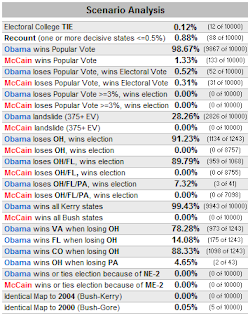
The answer is most likely very dependent on how the financial crisis is resolved. If President Obama’s stimulus plan works, it will mean a huge blow to fiscal conservatism. The days of Alan Greenspan and “Reganomics” will no longer be looked at with nostalgia. The Democrats will undoubtedly rub this in the Republican’s faces, Republican Congressmen who are currently in opposition to the plan will not be thought highly of. Obama will certainly be re-elected, and I would not be surprised if several more Democratic Presidents are elected after him. But if the plan fails, Republicans might have a chance at rebirth. The GOP use Obama’s failed policies as a campaign tool that would probably win them many seats in Congress and possibly the Presidency in four years.

However, the economy is not the only variable in this equation. Social conservatism, an extremely important tenet of the Republican Party, may very well be on its last legs. I am not suggesting that the movement is going to die out, but I believe that the majority of Americans will no longer consider themselves social conservatives or vote for an overly conservative candidate. The best example that comes to mind is former Vice Presidential candidate Sarah Palin, whose popularity rating was around 30%. Palin’s radically conservative views repulsed most Americans, particularly her anti-intellectual sentiments. However, the social conservative base rallied around her views, despite the fact that they are at odds with those of many other Americans. Also, immigration and globalization are rapidly changing the face of American values. Latino immigrants are more likely to be liberal and vote Democratic, increasing the liberal majority by a significant amount. Also, the GOP’s current leader, Michael Steele, called for numerous reforms as a part of his wants to make the Party more attractive to the average American. If he succeeds, he may end up killing social conservatism as we know it. (On a humorous note: Steele said he even wanted to make the GOP attractive to “one-armed midgets.”)

Finally, the GOP currently lacks any semblance of strong leadership. Michael Steele is essentially a figurehead, and I suspect that many conservatives will work against he attempts to give the Party a “hip-hop makeover.” On the other hand, a very dangerous individual’s influence is waxing, so much so that conservatives everywhere are apologizing for any negative comments they may have said about him previously. I am talking, of course, about Rush Limbaugh. Even Michael Steele was forced to apologize to Rush after calling him “an entertainer.” Rush is a radical social conservative, and one of the most hard-line right wing authoritarians I have ever seen. In the future, Rush may be a rallying point for conservatives, but the media’s denouncement of Rush may hurt his popularity in the country overall. In other words: though Republicans may rally around him, centrists and liberals will do everything they can to stop him.

So is the Republican Party dead? Not yet, but if Obama fixes the economy they may hit they lowest point in decades. Though I am a Democrat, I do not welcome the GOP collapsing: a one party system makes government far more efficient for my taste. A two party system offers just enough impediments to government to create a balance of limited government and strong government. 

Saturday, March 7, 2009

American fascism

No, I’m not suggesting that the US government is fascist. But I would like to speculate on what it would take for the US to lapse into fascism. Though I am not concerned it will happen, I think it would be interesting to discuss.

To fully examine this problem, we should first look at what caused the rise of fascism in other nations. The best three examples I can think of are Germany, Italy, and Japan during the early 1930’s. I believe that the ascent of fascism in these states was caused by three classes of factors: economic, political and cultural.

The economic aspect is probably the easiest to analyze: all three countries were in a state of abject poverty before the fascists took power. In Germany, at least, this was directly related to the appeal of fascism: Hitler promised a “National Socialism” (which was nothing like Marxian socialism) to fix the German economy. Italy had a similar situation, and Japan was lacking in natural resources and needed economic expansion. This need for more natural resources would have fitted in perfectly with the fascist principle of imperialistic Social Darwinism, making fascism economically ideal for the Japanese. 

The political aspect requires a brief look at the post WWI period. In Germany, the treaty of Versailles had crippled Germany’s economy by demanding huge reparations, and many important areas of the German Empire—Poland, the Rhineland, Danzig, the Sudetenland—were under Allied control and were then allowed to become autonomous. Fiercely nationalistic Germans in these areas and in Germany demanded that the territories be returned to Germany, and many others wanted revenge against the Allies. Hitler must have seemed extremely desirable to both of these factions, as he promised to encourage more defense spending and expand Germany’s military. In Japan, the Showa movement was nationalistic faction devoted to the destruction communism, socialism, anarchism, etc. The organization played on similar national sentiments, vowing to instill a sense of nationalism and patriotism to Japan; group eventually evolved into Japan’s fascist government. In Italy there was something of a power vacuum—many were afraid of a communism revolution, and the fate of the country was uncertain. Mussolini promised a strong (and anti-communist) government, which must have  been very appealing to worried Italians.

The cultural aspect is the most intangible but perhaps one of the most important. In Germany and Japan the cultural aspect was obviously significant: in Japan, most Japanese people revered their ruler and treated him like a god; in German Hitler aroused anti-Semitic sentiments to unite the German people. Additionally, the Japanese saw their race as the Asian “master race,” a concept similar to the German superiority complex of the time. In Italy the situation was a bit different: the public supported Mussolini’s “blackshirts” because they were the only ones able to defend the country from the hated pro-labor liberals, including communists, socialists, trade unionists, and anarchists. However, the recurrent theme is that in all three countries the ascending government was able to use the culture of the society to facilitate their rise to power by improving their appeal.

So, what can this tell us about the possibility of American fascism? Right now, at least, America is safe from a totalitarian threat: America is not suffering from serious economic woes (compared to those of the 30’s, I mean), its government is secure and has a high approval rating, and there are no cultural constructs that challenge the current democratic system. However, it is possible that if the economic situation worsens fascism might seem to be a more desirable option, at least to some.

For example, if the economy worsens severely, Americans might become more sympathetic to economic policies that involve government intervention. Also, many Americans would want a stronger justice system to combat the crime that usually goes along with a depression. Additionally, if religious fundamentalism increases, this could provide a platform for a right-wing authoritarianism leader.

But remember that the cultural factors are clearly against fascism. Americans are strictly opposed to anything that limits their natural rights. We are obsessed with democracy, and fiercely proud of the fact that we are a democratic nation. Also, we still vividly remember the WWII years, in which we saw the horrors that fascism created.

Because of this, I am not sure that American fascism could ever develop. If it does, however, it would have to be many years in the future, since it would take a lot of time for fascism ideas to catch on in such a democratic nation.  

Thursday, March 5, 2009

Communism: insufficient data

Americans are quick to point to Russia and China as examples of why communism and socialism cannot function on a large scale. However, I believe that Russia and China are not qualified to be considered case studies for communism, for reasons I shall explain.

The main reason Russia is not a sufficient example is very simple: Stalinism. When the Soviet Union began, Russian politicians such as Stalin and Lenin transformed the Soviet Union into something Marx would never have approved of. They crushed liberalism and suspended human rights, turning the country into a dictatorship in the name of prosperity. What Stalinism created was communism, but not in the liberal, democratic form Marxism envisioned. 

Also, note Russia was forced into communism—it did not develop naturally according to Marx’s theories. Marx believed that eventually the proletariat would revolt against capitalism and form a socialist republic. Eventually this would turn into a communist entity simply because Marx believed the latter is more efficient. In Russia, though, this did not occur: after the Revolution the nation was forced into communism.

In China, the situation is a bit different. Though the Chinese government is known for its human rights violations, its governmental philosophy is not nearly as “Stalinistic” as Russia’s. However, they too were forced into communism, negating Marx’s predictions on how communism would arise. Additionally, China is incorporating many capitalist aspects into their economic system, probably because of the necessity to trade with Western societies. Their system is no longer “pure communism,” which also indicates that it cannot be used as a case study for the economic validity of communism.

Because of these factors, we cannot consider Russia or China as case studies for communism, nor can we dismiss communism as a political theory because of the USSR’s collapse. Instead, we must look at smaller examples. I would like to take a moment to discuss a few of these:

The most successful applications of Marxist theory I can think of are the Israeli kibbutzim. These are small socialistic/communalistic communities, usually in rural areas. The residents of a kibbutz often reside in a single, communal living area, and most of them are employed in producing the main product that the kibbutz sells. Kibbutzim are remarkable successful, and they certainly prove that socialism is very efficient in small communities. They also lend some support to the Marx theory of “natural communism,” though I would not consider them alone a proof of this.

The next example is Cuba. Like Russia, Cuba was forced into communism, and like Russia, Cuba is lacking in the liberalism that Marx stressed. However, Cuba’s isolationist policies do make is something of an example of communist economics, and the results are not pretty. Though Cuban communism does have positive aspects, such as healthcare, much of the population is unable to rise out of poverty.

So for now I am holding my evaluation of communism and socialism until a time when we have more concrete examples. However, one trend is clear: communism and socialism often lead to obsequious, servile state-worship, which in turn often leads to unexpected negative consequences. But in terms of evaluating economic prosperity we will just have to wait until someone tries again.


Wednesday, February 25, 2009

Something a little bit different (continued)

Today I am going to launch into a more detailed explanation of the economic system I proposed yesterday. If you have not read yesterday’s post, I strongly recommend it. Before I begin: for the purpose of convenience (my own), I have decided to dub the system I discussed yesterday “Applied Monetary Management,” or AMM. This name is somewhat appropriate, and it will spare me some lengthy sentences.

I would first like to discuss overproduction in more detail, since this is one of the central points I brought up yesterday. Overproduction is a condition in which a nation produces more products than it can consume. In a capitalist system, this is disastrous to the economy if the country suffering from overproduction cannot find an economically viable way to get rid of the excess. In most cases, though, the philosophy of “favorable balance of trade,” in which countries are encouraged to export more than they import, has countered overproduction in most cases. Today, the concept of foreign aid has been added to this as a way to alleviate overproduction. But where there are no more markets for the excess goods, prices plummet and the economy crashes. (This is what happened during the Great Depression—demand dropped because Europe could no longer afford to buy our goods and did not need war materiel, so the US was left with a surplus we were unable to get rid of.) According to C.H. Douglas, overproduction—or at least shortage of money—occurs naturally in capitalism. Douglas explained this idea in his A + B Theorem. In this proof, Douglas explained that a product’s cost is made up of two parts, A, the cost of wages to pay the employees who produce the product, and B, the cost of the materials (including land) needed to produce it. Thus, the price of the product must be A + B + C, where C is the profit. But how can the public possibly purchase all the products created if the collective purchasing power is equal to A when the collective price of all products is equal to A + B + C? The answer: they can’t. This is the rationale for Douglas’s Social Credit as well as for AMM—if more money is pumped into the economy, overproduction can be turned into an advantage rather than a liability.

Next, I would like to talk about taxation and investments in relation to my AMM system. Taxation is entirely useless, as it withdraws money from circulation. Since the national dividend is the opposite of taxation and the government can just print fiat money anyway, taxation is useless. Investments detract from the productivity of an AMM nation, since money used to buy insurance or invested cannot be used to purchase products. Thus, both of these would have to be discouraged and perhaps more strictly regulated (though not banned) in an AMM system. 

I would also like to briefly touch on trade in an AMM system. As I mentioned yesterday, all trade is to be controlled by the government because of the fact that the AMM nation’s currency would probably be worthless elsewhere in the world. Thus, the government will use the barter system to get what it needs from other countries and foreign companies. Though this is somewhat cumbersome, it adds to the power of the government in terms of economic control, which is central to the success of the AMM system as a whole. This does make it difficult to travel to other countries, but this is a minor concern in the big picture.

I would now like to counter some of the standard arguments that are used against C.H. Douglas’s Social Credit, as many of them apply to AMM, the system I am proposing.

Firstly, I would like to counter the argument that AMM suffers because it is overly socialistic. Though it is true that the concept of the national dividend is somewhat socialistic, it does not make anyone’s job into a sinecure. As I briefly touched on yesterday, AMM accounts for the cultural factor that is often the downfall of socialistic systems: lack of incentive to work.  Recall that the national dividend can be distributed either in a more socialistic way (more equal) or in a more capitalistic way (rewarding hard work). Also, remember that it is elected officials who determine how the dividend is doled out. Thus, whichever way the cultural pendulum swings, the distribution of the national dividend can account for it.

Secondly, I would like to further discuss the issue of hyperinflation. As mentioned in the paragraph above, AMM can account for the cultural factor present in the downfall of socialistic systems. Also (and perhaps more importantly) AMM creates perpetual, unlimited demand. This, in turn, creates more production, and hence more work. Also, remember that the government also controls prices to a certain extent. (This is one of the fundamental differences between AMM and Social Credit—Douglas proposes freezing prices, which he calls the “Just Price” system; I propose giving an option fiat money subsidy to lower prices. Companies would prefer to accept this, because not only ensures that they will be paid well for what they produce, but also because the lowered cost (coupled with the national dividend) ensures that they will not have excess goods.
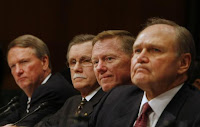
Lastly, I would like to explain my apparent grudge against bankers and capitalists. As I discussed previously when talking about the automakers’ hearing in Congress, the self-declared motive of any capitalist is to seek wealth and personal gain. I am not begrudging selfishness as a personal philosophy, though; I see no problems with selfishness or egoism in general. The problem is that when a company or a few companies are the only major ones in their industry, the executives of those companies have an enormous social responsibility thrust upon them: they are now charged with ensuring the continued prosperity of that industry. But what have they done to earn this position? Though many hold that their ability to succeed in their industry is what qualifies them—however, this is only half true. Though having proficiency in running a company of a particular industry does qualify that person to manage the industry, it does not change the fact that that person is self-serving, not a public servant. Instead, controlling the direction of an industry (as opposed to directly managing it) is a job that should be taken up by the government, which serves the people.

I have also expressed my distaste for powerful privately owned banks and other financial institutions; I would like to explain my reasons for this as well. Banks and other financial institutions are among the most powerful organizations when it comes to determining the value of money; banks can even create money using fractional-reserve banking policies. This is dangerous because banks, like capitalist individuals, have selfish motives. To allow organizations with selfish motives to have so much power over the monetary system is clearly very dangerous. Instead, the government should ensure that it has the most control over the monetary system by forcing banks to utilize commodity money-based polices. Once again, since the government serves the people it is a far better candidate to control the value of money than a bank owned by a self-serving capitalist.

I would also like to discuss some of my influences and some recommended reading on this subject. For information on the economic philosophy of Social Credit, I recommend reading three of C.H. Douglas’s books, Social Credit, Economic Democracy, and Credit-Power and Democracy. Though these aren’t among the most gripping or entertaining books out there, they explain Douglas’s ideas and are very thought provoking. I would also recommend Robert A. Heinlein’s 1939 novel For Us, the Living, which is more of a lecture than a novel, in which Heinlein offers his own take on Douglas and applies to philosophy of Social Credit to culture.

**As a side note: Any real economists reading this are probably laughing at me. I have thus far failed to provide any hypothetical examples, case studies, or any other proof besides logic to back up my arguments. My theory is based mostly off of early 20th century thinkers rather than modern economics, which probably makes it obsolete. I admit, I am quite a neophyte as far as economics goes—this is mostly the reason I approached this problem from a philosophical standpoint rather than an economic one. But this theory is the best one I’ve got, and I suspect there is actually some validity something to it. In the future, I will do some research and try to provide some tangible proof for what I am saying. 

Tomorrow I may or may not continue on this subject—I may decide to take a day off from it to discuss the global economic crisis instead, in particular President Obama’s recent speech. 

Tuesday, February 24, 2009

Something a little bit different

I realize that today’s post is quite long. However, I think it makes up for this by being perhaps the most interesting blog entry I have ever written; I urge you to read it if you have the time. Today, as I promised yesterday, I am going to outline my own views on economics. I believe that an economic system can be analyzed by asking two key questions about it. I shall submit my own system to this analysis so as to best explain how it works and its moral justifications.


The first question we must ask when discussing economics is “what is the purpose of a particular economic system?” As odd as this may seem, it is actually a key question to understanding why certain economic systems function the way they do. For example, the purpose of capitalism is to allow land, labor, and capitol to be privately owned and traded. Communism, however, has a different goal: the development of a classless society. Because of the fundamental difference in why these systems exist, each functions in very different way. So, what is my answer to the question regarding the purpose of economics? Simply this: The purpose of an economic system is to allow the greatest amount of prosperity in terms of goods and services, and to allow these to be distributed to the constituents of society in a utilitarian manner. This sounds complicated, but is actually quite simple: the system’s chief goal is producing the most/highest quality goods and services (don’t worry about how for the moment) and distributing in a way that allows the most happiness for the most people. This leaves some room for flexibility, as it calls for an equal distribution of goods, but only to the point where this does not affect prosperity. This allows for the system to change as the culture of the society does (as the society fluctuates from considering classlessness as a virtue to considering the labor theory of value a virtue). The rationale for this goal—the “why” behind the “why”—is also relatively simple. To quote the economist C.H. Douglas, who is perhaps my most important influence as far as economic philosophy, “Systems were made for men, and not men for systems, and the interest of man, which is self-development, is above all systems.” The reason I encourage prosperity in terms of goods is simple: imagine what happens when an economic system is mismanaged and loses track of this goal. The best example I can think of is this: during the Great Depression, farmers were paid to destroy their crops so that the overall price of crops would rise. This is sacrificing goods for the sake of money; in my mind, this is incredibly foolish, as it means a decline in overall prosperity and wealth (it obviously means this because goods are being destroyed). Thus, seeking wealth and prosperity in terms of goods and services is a better goal for an economic system, as it means that this system works for the utilitarian benefit of all.

The second question we must ask when examining economic systems is “how does the system achieve its goal?” In some cases, there are multiple ways of a achieving the goal; communism, for example, could work toward a classless society by encouraging private ownership rather than collective ownership. Thus, you may agree with my opinion on the best purpose of an economic system but not the way I plan to achieve this purpose. I propose a system similar to C.H. Douglas’s “Social Credit.”

But before I explain the nuances of this system, I would like to quickly explain the nature of money, as it is crucial to understanding what I am about to propose. Money is defined as anything that can be exchanged for goods or services (that is not already a good or service, of course). Also, money is not an absolute; it has no value except in relation to human beings, and it is human beings who decide the exact value of monetary units. Similar to the reason that “dog” only means “dog” because we so choose, a dollar means more than a scrap of paper because we, the general public, have decided that it has a certain value. This value often (but not always) correlates to the quantity theory of value, better known as the idea of supply and demand. Of course, like any other commodity, the value of money to each particular person varies and fluctuates—but because it has at least some value to most people it can function as a part of society. Often, though, organizations such as the government or banks have more control over the value of money than individuals. Money generally functions as a medium of exchange, but, in some instances, it can take on other purposes. The main point, though, is that money is not made “in a factory”—in direct correlation with the production of goods/services—as fiscal conservatives claim, but instead by whoever controls its value (i.e. the government, banks, the people, etc.)

So, here is the system I am proposing: The government should take an extremely active role in economics for the purpose of encouraging overproduction. Though in capitalist systems overproduction is disastrous (it was one of the main causes of the Great Depression), it can be handled easily in “my” system. The government can achieve this by severely restricting trade of goods that can hypothetically be consumed domestically and by providing stimuli (in the form of payments and loans) to encourage the production of goods that can hypothetically be consumed there as well. The government also discourages imports with protectionist tariffs or similar measures. As I mentioned before, this encourages domestic overproduction. Once this occurs, the government is to offer a subsidy to companies to lower prices of their goods. Next, the government issues a “national dividend” to all citizens, giving them the money to purchase the all products produced that can be consumed. This also creates a perpetual demand, which will encourage more production in the next term, but will not alter prices because of the government’s pre-existing subsidy. This subsidy/dividend system ensures that most, if not all of the good produced domestically than can be consumed domestically are purchased and consumed. As I mentioned above, how the dividend is distributed depends on cultural factors (which is fine, because it is determined by politicians, who are elected officials). But where does all this money come from? Very simply—and this is the single most important aspect of what I am proposing—this money is fiat money. It is not backed by gold or any other standard; the government simply prints it at a mint and issues it. It appears that this would cause inflation and collapse, but, as I shall explain two paragraphs below, this is not so.

Additionally, as a matter of policy, the government is the only organization allowed to coin money and regulate its value. Private banks and other financial institutions must deal with money as if it were a physical commodity: under no circumstances may a bank loan more money than it physically possesses. (Today, believe it or not, banks can loan out more money than they actually have; the process is known as fractional-reserve banking.) Also, there is to be a single national bank, which can serve all of the purposes a conventional bank. This bank, however, being a part of the government, does not have to deal with money as a commodity like privately owned financial institutions. This national bank also serves to distribute the national dividend and handle the subsidies used to lower the cost of domestic products.

At first glance it appears that this system suffers from numerous practical flaws, the most prominent being that it encourages hyperinflation. However, remember that companies are paid a subsidy to lower prices and the national dividend creates unlimited demand and purchasing power—this ensure that all the goods produced that can be consumed are purchased. The only instance in which the system encourages inflation is in instances in which the government overcompensates and the national dividend is far greater than the total quantity of products produced. Also, it would appear to be worthless to a country such as Venezuela, which relies heavily on one or two exports. However, the government can deal with this by purchasing quantities of this product with fiat money (or just nationalizing that industry) and bartering with other countries for the products needed (few capitalist countries would want to work with a currency that is not backed by gold and is under the thumb of the government). Also, remember that the currency is only used inside the particular country utilizing the system, and that privately owned banks are very weak compared to those today, meaning that the government has an enormous degree of control over the value of the currency. This should prevent the currency from inflating, though I am sure that some inflation is going to occur. However, as long as there is only a minimal amount of inflation and it does not detract from the efficiency of the system as a whole, it is not much of a concern. Also, it appears that the system would not work for a country that relies heavily on imports. This is true, but, as I suggested above, there are methods by which a country can stimulate its own economy provided it has the natural resources to do so. Another complaint is that this system encourages wastefulness. Though this is a valid argument, the same can be said of capitalism; my system is no more wasteful than a capitalist one.

I welcome any comments on this topic; tomorrow I shall go into more detail and perhaps provide a hypothetical example of how this system would work. Again, sorry about the length of today’s post—I realize it was a bit hard on the eyes. 

Monday, February 23, 2009

Fiat power, fiat money

Unfortunately I was unable to write anything this weekend, as I was quite busy. However, I was only off for two days, which is really not that much in the big scheme of things, and two days is as close to a hiatus as my blog has ever come. But I have devoted this week to discussing topics related to economics, and for the next five days I am going to type out some very interesting posts. Today, the series on economics begins with a discussion of the legality of fiat money.

In these stressful economic times, all eyes are on Obama and his stimulus plan, which just passed through Congress. However, many conservatives are fundamentally opposed to the bill because it requires huge government spending at a time when the government is already very far in debt. Many hold that the government can never engage in deficit spending or even “meddle” with the economy at all. But I believe that economic “meddling” is legally justifiable in the US; whether it is morally justifiable or practical is regardless. Furthermore, I believe that many banks are actually violating US monetary laws with some of their policies. Today, I would like to briefly explain these concepts.

In the US Constitution, there is a line in Article 1 that states, “Congress shall have the power to coin Money, regulate the Value thereof, and of foreign coin.” This is the main piece of evidence on which my argument is based. This authorizes Congress to print as much money as it desires, including fiat money, or currency not backed by gold or any other standard. Furthermore, nowhere in the Constitution is deficit spending forbidden, and I believe it is implied in the phrase “regulate the Value thereof,” as this allows the government to deal with money in any way it wishes. Thus, the government can print as much money as it wishes, and demand that people accept it. 

However, though the government is allowed to do all of these things, banks are not. I take issue with some of the polices of banks, as many of them mess with our economy more than we think. Perhaps the most dangerous is the fact that banks are not required to possess all of the money they loan out; some of it is simply “checkbook money,” not true commodity money. What this means is that banks can give you money that they never really had in the first place; they get away with it by assuming that you are eventually going to pay them this money, plus interest. In doing so, they are coining money, which only the government is allowed to do. Banks also (indirectly) control the exchange rates of foreign currencies. This, too, is technically not allowed as per the quote above; only the government should be allowed to tell people how much of a foreign currency their US dollars are worth (in accordance with the “regulate the value of foreign coin” part).

Of course, these claims sound silly in today’s world, in which our financial system is based on credit, non-commodity money, and imaginary market values. I realize I probably sound like one of those crackpot economists from the 1930s who suggested all kinds of radical schemes, such as printing huge amounts of fiat money or abolishing the stock market. However, remember that credit and the other fundamentals aspects of our economy are what contributed to this crisis in the first place—perhaps it is time to look closely at our economic system and see if it truly works the way we want it to. Also, remember that if we allow banks to have the power to manipulate the economy by being able to regulate the value of currency (directly or indirectly), we are surly headed for disaster—because bankers and capitalists, by nature, serve themselves. The government, however, does not, and allowing it to regulate currency, as it is supposed to, is perhaps our most important weapon against economic disaster. 

Tomorrow, I will discuss my own economic views and their justifications. 

Monday, February 9, 2009

Avoiding MAD

I have briefly discussed the concept of MAD, or mutually assured destruction, here on this blog before. To review: during the Cold War, the US and the USSR followed a policy of “deterrence”—they realized that MAD would occur if either side attacked the other, so they tacitly agree to not take military direction against each other. But, as the Cold War proved, there are many ways to work around the policy of deterrence and MAD, as well as flaws in the theory itself.
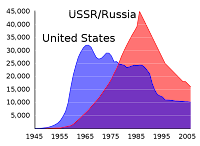
When two nations have nuclear weapons and can destroy each other, in theory relations between the two should be tense but peaceful. Of course, the obvious problem is that even though this creates peace, this peace is jejune and superficial, as it did not come about by a true mutual agreement. Next, MAD does not account for technological advancement—if one country develops superior missile interception technology, that country can attack the other nation with impunity, as they no longer have to fear MAD. Additionally, there is the “Dr. Strangelove” argument—incompetence in government or a rouge faction of the military can create a situation that leads to war and eventually MAD. Next, if a government is willing to accept the terrible humanitarian toll of a nuclear war, they may go ahead and fight one anyway, in defiance of the theory of deterrence. Finally, MAD only applies to those countries with ICBMs—third world countries, which are not tied down to deterrence, can still attack or be attacked without the fear of nuclear bombing.

Even worse, as the Cold War proves, MAD does not necessarily mean an end to war. During the Cold War, the US implemented a plan of “containment,” in which we attempted to keep Soviet ideology from spreading. (This culminated in the Marshall Plan, which pumped $12 billion into post-war Europe to prevent them from lapsing into communism.) Also, as the Korean and the Vietnam war prove, proxy wars can still be fought in areas outside of the countries practicing deterrence. Lastly, the nations practicing deterrence can agree to fight each other using conventional warfare.

Out of all of these methods to circumvent MAD, the most frightening are the concepts that world leaders will continue to find technology to break out of MAD, and the fact that the military could settle for a nuclear war with “acceptable” losses. Also, during the Cold War both the US and the USSR worked to develop superior ballistic missile technologies, and both sides claimed that their own missiles were ahead of any competition, in what was called the “missile gap.” Amazingly, both the US and USSR made provisions for rebuilding their countries in the event of a nuclear attack, and both continued to develop missile defense technology. (“Dr. Strangelove” satirizes this aspect of the Cold War by suggesting that both countries will attempt to out-plan each other in this respect; when it is suggested to the US military that people can survive a nuclear blast by hiding in mine shaft, one general demands that mines be built deeper so that the US does not fall behind the Soviets in the “mine shaft gap.”)

Interestingly, the threat of MAD is just as prevalent as it was during the Cold War, yet the fear of nuclear war is no longer as prevalent as it once was. I suspect that the main reason for this is that there are no longer nations that were polar opposites and enemies as much as the United States and Soviet Union. Though tensions between superpowers flare up occasionally, the Cold War mentality of ultra-nationalism is mostly extinct. Next, remember that today we are more afraid of terrorist nuclear attacks rather than ballistic missiles. Bu the threat of MAD still exists; nuclear stockpiles are as large as they have ever been, and developing countries such as North Korea and Iran are soon going to be nuclear as well.

Despite its flaws, though, MAD and deterrence did prevent bloodshed, particularly during the Cold War. However, for countries to be truly at peace they must be allies, not enemies kept from war because of the fear of MAD. 

Thursday, February 5, 2009

Democracy and responsibility

“Quiet! Your leader is going to speak now. Everyone turn off your mind.” –Chad Urmston

I would like to devote today’s post to a discussion about how to avoid the kind of society that follows the advice of the quote above. (Urmston actually meant the quote above as a response to Americans blindly following former President Bush, but I am going to take his ironic statement into the general sense today.) What Umston is describing is a society in which the people stare, transfixed, at their leaders, listening to every word without stopping to question it. In a fascist system, this would be a virtue (at least to the government) but in a democracy an educated, cautious citizen contributes to democracy more than an uniformed one. The reason is simple: an uninformed citizen can fall victim to the waves of bunkum propaganda that have come to dominate elections, at least in the US. An educated citizen has a much better idea of sort of leader they want, both policy-wise and character-wise.

There are two different ways to approach this problem: the first involves restricting suffrage to certain groups to ensure that people lacking in intelligence or civic virtue cannot vote. The second involves forcing education and civic virtue upon citizens to ensure they vote in a more educated way.

The first is not as alien or unjust as it sounds—even a so-called “unlimited democracy” does limit suffrage from some people. In the US, for example, one must be 18 to vote, entirely excluding younger citizens from voting. Throughout history, philosophers have suggested systems that would exclude certain groups from voting for the betterment of society. Many of these have had racist undertones, but some of the more reasonable ones included denying franchise to anyone with an IQ lower than a certain number. In one of his books, Robert A. Heinlein satirically suggest only allowing people who work for the government the ability to vote, because they clearly have more “civic virtue.” However, this raises some ethical issues, mainly the fact that too much restriction goes against the whole point of democracy in the first place. Also, the overriding practical issue with these systems is that they are subject to bias. “Intelligence” is often difficult to determine, and “responsibility” and “civic virtue” are even harder to measure.

Because of these flaws, the second option sounds more desirable. But how to go about executing it? A school curriculum that includes modern history is a good start, but this does not prevent citizens from falling prey to campaign propaganda. Another possibility is to have the government organize an objective news broadcasting body. Though this would in theory be neutral, in reality it would probably be just as prone to bias as any other news station.

Thus, I think the most reasonable method is actually a third alternative. Part of what Urmston is saying has to do with the way we portray our leaders. In the 1930’s, Hitler and Mussolini used planned theatrics to appear like Herculean supermen (metaphorically), and their august uniforms made them look the part of powerful leaders. In other words: it is often the image of a leader that determines how people feel about that person. In recent years, this is how politicians in the US have been treated (at least by those of the corresponding political party). In addition to educating people, we need to humanize our leaders.

Regardless of how we go about it, we must ensure that we, the citizens of democratic nations, do not allow our system to decay into totalitarianism simply because we were not responsible. Democracy and responsibility must go hand in hand, or else we will foolishly elect leaders who betray the very principles of democracy. It is my hope that the United States in particular stays true to the principles on which it was founded. Though dictatorship can look just as good as democracy on paper, history clearly shows that democracy is the superior system, if the citizens it rules are responsible enough. 

Saturday, January 17, 2009

In 103 days…

In three days, President-elect Barack Obama will be inaugurated. This means that in 103 days we will have reached the 100th day of his Presidency. Why am I bringing this up? Very simple: a lot can happen in one hundred days. The example I’m thinking of is FDR: in one hundred days he got the New Deal going and was already in the process of pulling the country back together.
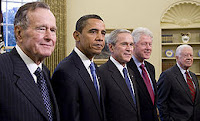
Today, I would like to address two issues: first, I would like to offer a brief prediction of what the world will look like in 103 days, and I would like to amend some of the things I said in a previous post, “Beyond FDR.

First, predictions. The economy will probably be about the same; many economists are predicting that we won’t see any kind of turnaround until late 2009 or 2010 at the earliest. But will we lapse into depression? Probably not, but certainly not in 103 days. I suspect Obama’s huge stimulus plan will have passed by then, but it will still be too early to see the effects. The world will have fallen even deeper into recession, following the US trend. No major wars or conflicts will have developed, barring a major catastrophe. Obama’s foreign policy will look good but probably will not have the chance to try and prove itself just yet. However, I do think there will be one noticeable change in the American people: optimism. Obama will continue to look good in his first hundred days, and the media will continue to portray him as a strong, competent leader. Because of this, he will look like the leader most Americans want, and he will imbue us with a strong sense of hope and pride. Why such an optimistic prediction? Read on:

In my previous post, I stated that the media is too politically charged to allow a politician to be great. Though I still believe that the media does make it harder for a person to achieve true greatness, there are times when the media actually facilitates this, FDR was one of these people who was helped by the media—today, I think Barack Obama is another. The “liberal media” has always supported him, but even now conservative pundits are commending him on a well-run campaign and a historic win. Are some people unhappy? Yes. But on the whole everyone admits that his election is monumental, and a victory for race relations in the US. As far as Obama’s presidency goes, I think the media will continue to support him as long as he does at least an average job—they have set him up for greatness, and in times like these people want to see a hero leading their country. Unless he does a terrible job in his first hundred days, the media will continue to stand behind him. Because of this, future generations will look back and see our negative media praising our 44th President, and they will look upon him as a great leader. In summation: greatness is achievable, even today. Though it takes more media help than before, it is possible.

On a more humorous note: in three days, we can all go back to saying “nuclear” instead of “nucular.” (But it may take us 103 days to get used to it!) 

Sunday, December 14, 2008

Cronyism, government, and Robert A. Heinlein

"At one time kings were anointed by Deity, so the problem was to see to it that Deity chose the right candidate. In this age the myth is 'the will of the people'...but the problem changes only superficially."

The cynical quote above is from my favorite novel, which, as I have talked about at length before, is Robert A. Heinlein’s The Moon is a Harsh Mistress. The quote is essentially saying that democracy is not as romantic or even as valid as it seems—it is just as prone to being corrupted—or even completely rigged—as autocracy. In today’s post, I would like to talk about whether this is a valid statement, and if yes, what the implications of it are.

In the context of the novel, Heinlein is commenting on libertarian revolution. This quote is one of his not-so-subtle hints at why libertarian revolution is not as romantic or idealistic as it seems. (Despite the fact the Heinlein himself was very libertarian and opposed to big government, he did not have an idealistic view of anarchy or a libertarian society; he simply thought it was slightly better than federalism.) History definitely backs his point up here—today, historians have admitted that even the American Revolution was caused by the elite and controlled by the elite throughout the course of the Revolution and Revolutionary War. Indeed, cronyism is more prevalent in our history and in human history than we would like to think.

But if we look at the quote on a larger scale by looking at democracy as a whole in this light, the answer is quite different. Though corruption still exists in modern politics, the Western tradition of representative democracy has created a larger “ruling class,” which has diluted the cronyism inherent in the early American government. This makes it much harder for a select few to control the entire government. Though cronyism probably occurs in the White House, the balance of power in the US government prevents this from spreading to Congress. Also, despite the fact that both the Democratic Party and the GOP are controlled by a few individuals (not the same ones, of course), the fact that remain neck-and-neck in American history prevents this from spreading to the government. Finally, I should add that democracy itself actually prevents cronyism, in direct defiance of the quote. Though I often criticize the American system for not educating US citizens as much as it should, we are still immensely well informed, at least compared to the people of developing Asian nations such as India, China, or Myanmar.

However, there is still a strong argument for cronyism: the control and influence of the media in modern politics. There can be no doubt that the media, particularly the news media, has an enormous effect on the way Americans think; as American news continues to ignore world affairs and politics, the average American’s knowledge of these issues decreases proportionally. The media’s recent fixation with celebrity culture has prompted many Americans to focus on it as well. However, as I have mentioned before in “Culture: the dark side,” the media must pander to what the American people want to hear, and they are often unable to promote their own agenda because they must compete with other news organization (with some exceptions, of course). Also, it is unlikely that the media is under the thumb of the government, since they have been very critical of the government’s actions throughout the last few decades. However, the statistics cannot be ignored: the news media has been influenced by some traces of “liberal bias.” Even so, our media is far from being dominated by the elite for the purpose of spreading propaganda; this argument has very little validity.

Essentially, Heinlein has put his finger on the irony of cronyism in a democracy or a democratic revolution. In some cases, government can be run better by a few people than by the populace—but it defeats the purpose of the revolution in the first place. 

As a side note—the fictional character who says this quote in The Moon is a Harsh Mistress is a rational anarchist, which explains why he is so cynical and critical of government. 

Thursday, November 20, 2008

The problem with Christmas decorations

As anyone in America knows, as soon as Thanksgiving rolls around a Christmas tree will appear in front of every town hall. I am not the first to bring up this controversial issue—atheists, Muslims, Jews, and many other have hectored mayors and town officials about this public display of religion. For the most part these people have simply been viewed as liberal malcontents who need something to complain about. Unfortunately, this is true of some of them, but others are civilly demanding equal representation, and rightfully so.


However, I have a problem with the fact that religious symbols are in front of a public building at all. The Bill of Rights dictates that the State will not discriminate against any religion; we have interpreted this to mean a separation of church and state. However, “state” is a slippery word—remember that it means all things related to government in the US, including local governments. This is because the US is a federal nation, and state and local governments are still technically a part of the whole. Having a religious symbol in front of a building obviously denotes the fact that the “state” is recognizing it—violating the implied separation of church and state.

Why do I have such a problem with this? I detest religious tyranny in every form, and I do not believe that religious organizations should have any political power whatsoever. In our Constitution and Declaration, we vowed to protect civil liberties, and promised that the majority cannot oppress the minority. However, this has happened in terms of religion. The majority of people in the US can be considered Christian, and this enormous Christian influence has corrupted our government, society, and social conditioning. The state openly flaunts religious symbols, recognizes religious holidays, and even bans certain acts or objects for moral reasons (examples: public nudity, polygamy, pornography, “cussing,” etc.) I feel we should correct this error, by abrogating public displays of religion by the state, and by ensuring that our government follows through with its promise to be separate from religion. 

Thursday, November 6, 2008

The ever-changing purpose of culture (part 2)

In my previous post on this topic, I explained the justification for manipulating and changing culture with the purpose of creating the happiness. I also said that this culture would be flexible so that it can adapt to the flow of history. Additionally, I explain that it would be based around empirical evidence and case studies rather than on some baseless theory.

But, as I asked yesterday, what specifically would this culture include? My official answer would have to be “I don’t know.”  (This should come as no surprise—I am a pyrrhonist, after all.) I am neither an anthropologist nor a sociologist—I do not know enough to look at what we know about how people interact and devise a culture based on this.

However, I will make some educated guesses, as I do with everything.

First, I believe this culture will possess various types of group marriage and polygamy. Group marriage is not very common in human history, but has a very high success rate nonetheless. This is mostly because it offers a more secure environment for raising children for economic and social reasons and increases diversity. Group marriage can be arranged in the form of a “line” marriage, in which people continuously join the marriage as older members die or others divorce out of it. This creates a stable environment for raising children, which will, in theory, last forever.

Second, I believe nudity and sexual taboos have no place in this type of society. Though most of the benefits of nudism are false, there are still some benefits to it that have been scientifically verified. Additionally, sexual liberation would create a large amount of happiness in this new culture. Contraception can be made cheaper (or even free), decreasing the risks of increased sexuality in a society. By removing the moral and social stigma from sexuality, it can become a widespread source of happiness that is morally meaningless.

Next, I believe this new type of culture will be very diverse. Mixed-race individuals have greater protection from disease and often have longer life spans. Furthermore, diversity eliminates racism, which is an obvious source of unhappiness in our current culture.

Additionally, I think gender roles and sexual jealousy will almost disappear. Even today there is little use for them; they are simply leftovers from our early history and evolution, as Margaret Mead (right) proved. This would also end sexism, which, like racism, is a major problem in today’s society. The removal of sexual jealousy would aid in the introduction of group marriage, and it would also remove a current source of social tension.

You may be asking in horror: What about all the innocent children? Do they get no protection? Well, yes, of course they do! I did not propose anything that would physically or psychologically harm children (or anyone) in any way. However, I did not protect them morally in any way (by our current Judeo-Christian standards). The reason for this harps back to a previous post I wrote, which had to do with comparing moral systems. To sum it up, protecting children from the “horrors” above is a concept that only applies to our current moral system; in the one I described, they are not “horrors” at all, but the very pillars of society. 

Will we ever see such a culture? Probably not in a large society, but I would not be surprised if some smug philosopher, anthropologist or scientist tries to create such a system and some small utopianist group tries to implement it.

Will it work? I sure hope so. No promises, though. 

Wednesday, November 5, 2008

The ever-changing purpose of culture (part 1)

Before I begin—well done, Barack Obama! Congratulations on becoming President-elect! And congrats to all Democrats, who have won a majority in both the House and the Senate. Now, to business:

We often talk of human nature, using it as an example of something immutable and fixed. We speak of human beings as though they are incapable of changing—but this is far from the case. As George Orwell stated eloquently in his dystopian novel 1984,

“Men are infinitely malleable.”

I won’t take his word for it, though—I have many examples to back up this hypothesis. First, consider the oldest and most basic aspect of “human nature”—our reaction to food. For almost all of our history (more than 99%), the human response to seeing a morsel of food was to devour it instantly. This served us well when we were caveman and when agriculture was in its infancy. Today, though (at least in developed areas), things have changed. In the Western world, it is no longer desirable to do so—in fact, it is very undesirable to have that sort of reaction to food. The result? Our environment changed our nature; I am sure most Westerners can look at a plate of food without trying to eat it instantly.

 Next, look at the second-oldest piece of human nature: the sex urge. Over time, our attitudes and reactions to sexuality have changed—almost every religion and culture has a different view on it. It would be absurd to think that there is a set “human nature” when it comes to sex—think about the differences between a Puritan community, a polygamy cult, and a pagan clan.

Also, note that human nature does not just change over long periods of time—a perfectly civilized person “trained” not to gobble up food instantly will revert back to the caveman reaction if he has not eaten in a few days. Additionally, think about people live for long periods of time in different countries—often their philosophy, religion, and viewpoint changes entirely.

Similarly, culture is mutable and constantly changing. However, all cultures have some sort of purpose. The primary purpose of all cultures is to survive, even if the creators of a culture did not intend this (if a culture did not try to sustain itself, it would not be around for long). In modern history (circa 5000 years) cultures have been based around some kind of religion or moral system. The purpose of these cultures is to carry out the demands of a religion or belief.

I believe that culture and human nature can be mutated to improve quality of life. How, you may ask, can this be accomplished? The answer, I believe, has to do with the way we create cultures and moral codes, and how this can be improved.

Though all cultures undergo a kind of natural selection that weeds out the “weak” ones, human history is so short we have not really had time to see cultures evolve. Furthermore, all cultures, moral codes, or societies that have been designed with a specific purpose in mind have been designed according to someone’s theory of morals. None have been developed by empirical evidence.

You may not see the problem with this, so I’ll use an example to explain:

Consider a cannon. Cannons have been around since medieval times, when gunpowder was invented, and since then they have been aimed with gunsights. In the past few centuries, the theory of how gravity works (which affects cannonballs) has been changed repeatedly. However, all gunsights were not junked every time the theory of gravity was changed. Why? Because gunsights are based on observable empirical evidence, and changing the theory does not change the fact that cannonballs fly a certain way. This is how we must design a moral system—by basing it around evidence and changing the theory to fit. Thus, such a culture would be flexible, so that it could change if necessary. 

How would this be implemented in, say, the United States? Firstly, by finishing the job our Founding Fathers started—creating a total separation of church and state. (It would be naïve to say we have that now—laws prohibiting prostitution, polygamy, pornography, public nudity, and public “swearing” are just a few of the many counterexamples.) The reason for this is simple—morals based on religion do not necessarily create the most happiness possible. As Arthur C. Clarke puts it,

"The greatest tragedy in mankind's entire history may be the hijacking of morality by religion."

Once we have achieved a totally secular society, we can create a new moral system with the aim of creating the most empirical happiness.

Exactly what will this new moral system will include? I will discuss that in part 2.


Tuesday, November 4, 2008

Musings on voting

Inspired by Election Day (today!), I though that it’s time I examined voting. After all, it’s what makes democracy democracy, and empowers the common man. But there are clearly many flaws in voting, and we should closely examine them in order to improve our government. 

An important aspect of voting that should probably be scrutinized is the voting process itself. The system we have in America is almost certainly flawed; it comes from a far less democratic time than today, and it has changed little since then. The most prominent flaws are the Electoral College and the “winner-take-all” scheme used in elections, which makes the “one person one vote” idea bunk. There have been many solutions proposed to amend this, the most obvious being to get rid of the Electoral College altogether.

However, representative democracy is what makes us different from many other democratic nations. Our founding fathers made the nation a representative democracy because they were afraid that a direct democracy would fall prey to “factions,” or political parties. However, today we see that even a representative democracy can fall prey to political parties. Thus, eliminating the Electoral College is probably not a bad idea.

On a similar note, in my favorite novel (The Moon is a Harsh Mistress, by Robert A. Heinlein), one of the characters suggests:

 “Suppose instead of election a man were qualified for office by petition signed by four thousand citizens. He would then represent those four thousand affirmatively, with no disgruntled minority, for what would have been a minority in a territorial constituency would all be free to start other petitions or join in them. All would then be represented by men of their choice. Or a man with eight thousand supporters might have two votes in this body. Difficulties, objections, practical points to be worked out— many of them! But you could work them out…and thereby avoid the chronic sickness of representative government, the disgruntled minority which feels—correctly!—that it has been disenfranchised.”

This is a fascinating proposal (which, unfortunately, is not discussed any more than this in the novel), and it would be interesting to consider the effects if it were applied to our system at one or more levels. If applied to the concept of presidential elections, the result would probably be about the same—people would most likely still support 2 major candidates, one Republican and one Democrat, so that they increase their party’s chances of winning.

In a senatorial election, though, this system would have very interesting implications (Obviously our system would have to be slightly tailored to fit). It is likely that both parties would make a list of candidates and have people support them, so that they can get as many people in the Senate as possible. However, several independents might be elected, because independent party voters from all over the country or state could support one or two candidates, rather than have a few independent voters in each state or district being eclipsed by the majority.

Overall, though, the effects would probably be minimal—the two-party structure built into our country will probably not go away very soon.

There is another point I would like to bring up, one that I feel is forgotten in American history: Which is more important, democracy or the protection of liberties? Remember that what made the US so revolutionary in 1776 was not that it was democratic but that it tried to ensure that government would never encroach on our civil liberties (I won’t say “natural rights”). As history progressed, though, this promise has been broken. We did not extend these rights to Native Americans, African-Americans, or women until recently, and I can think of countless examples of times (usually during wartime) when an act was passed that limited freedom of speech or privacy. Though this was often done without the direct consent of the people, in many cases they would have voted for the decision anyway. (We see this today with the PATRIOT Act.) 

Because of all this, I think our government must always remember its roots, especially its noble pledge to respect all human beings. Though democracy is important, the majority should not be able to vote to oppress the minority. 

Tuesday, October 28, 2008

1984 vs. Brave New World

This is something of a follow-up to my post on Brave New World. You may have been wondering: what happens if we look at George Orwell’s 1984 in the same way? If we evaluate them by the same criteria, is the result the same, or different?

We must remember that Oceania in 1894 is very different from the World State in Brave New World. The World State ensures order by painless social conditioning; in 1984, the government insures order by importuning each and every citizen with questions, inspection, and most important, fear. As Neil Postman put it:

“What Orwell feared were those who would ban books. What Huxley feared was that there would be no reason to ban a book, for there would be no one who wanted to read one.”

Recall that happiness was one of our most important criteria in assessing BNW. This is the most important difference between the two—1984 relies on fear and hate to keep the system running—the World State does not. In BNW, each caste is happy where they are, and the society is maintained with positive feedback. In 1984, though the Inner Party is satisfied, the Outer Party lives in perpetual fear, and the Proles are impoverished, maudlin, and depressed.

Also, the economy in 1984, though balanced, does not provide enough food or goods for its citizens—many people do not have enough to eat, and there is constantly shortage of something. Because of this, 1984 ranks far lower than BNW overall.

However, 1984 does not fail the second piece of criteria we used when judging BNW. Both societies are relatively stable and are far from being on the verge of collapse. This, however, is outweighed by the aforementioned negative qualities—if anything, having longevity only make 1984 worse, since it means that the society will be forever trapped in this sadistic phase.

Many would also argue that 1984 is a dystopia because of its excessive use of brainwashing. However, brainwashing is not inherently evil in and of itself. In 1984, though, it is painful and barbaric, whereas in BNW the social conditioning is almost painless and is relatively subtle.

To conclude—because it encourages perpetual war, confusion, and bigotry, 1894’s Oceania is clearly a dystopia. Though it is just as stable as BNW, it is not ideal because it does not provide happiness and security for its citizens. 

Monday, October 27, 2008

Federalists in space

When we think of space colonization, we think of stereotypical space-opera heroes, evil alien races, individualistic pioneer societies, and terrifying space pirates commandeering spaceships. Why? Because that is the image that classic science fiction drilled into our heads more than 50 years ago. Contemporary science fiction writers continued the tradition and kept writing about these Wild Wests in space.

However, I suspect that if classic SF legends like Isaac Asimov and Robert A. Heinlein were around today, they would portray space colonization very differently. I think that space exploration will not be like the pioneer-like picture painted by these authors—it will far more federal and centralized.

The main reason is the high cost of space travel, and the slow rate that its cost decreases.Obviously, space colonization will not exist until it becomes cost-effective—but it may not become very cost-effective for many years after that. Because of this, the average “Joe six-pack” or ingénue city-dwelling single mother will not be rocketing him/herself and family to start a colony. Instead, space colonization and exploration will have to be funded by large governments. This will mean that it will also be controlled regulated by large governments, unlike the pioneer societies of the past.

Secondly, the technology required to colonize other planets is immense. Again, the average person will not have the means or the money to create or even buy the necessary equipment. This is because all of the planets discovered so far have no breathable atmosphere, which suggests that there are few Earth-like planets in the galaxy. Thus, the necessary technology must be invented and built to create livable environments in these areas.

Next, recall that space travel and colonization will probably not be productive for many years. In the future, the world will probably have more federal governments than it does today (if not one world-controlling federal government), or corporations will have enormous political power (enabling them to initiate space travel). If this does not occur, space colonization will probably not happen, because in a less centralized society no one would be able to afford it. This federalism will determine how the colonies are regulated—they will be government-controlled and centralized rather than pioneer societies.

On a related note, governments would not want their colonies to become too independent. They would insure that the colonies would be unable to declare their independence by ensuring that they, not their colonies, control technology. This, however, is not necessarily a bad thing—not all governments will treat their colonies poorly, so there will be little need for them to exercise their power.

However, all this is probably for the better. It will mean that these colonies will progress more quickly and be more productive than if they were pioneer societies.

As for pirates in space…the chances of space marauders existing are very, very low. Most of today’s pirates do what they do out of desperation—for example, the Somalian pirates who stole Ukrainian tanks as they passed by on a cargo ship. But piracy in space would require huge amounts of funding, as a large amount of sophisticated equipment is needed. Also, space piracy may not even be possible—in order to travel to places that are light-years away, spacecraft would have to travel faster than light or “jump” from place to place—making piracy impossible. Finally, who would these pirates sell their stolen goods to?

To summarize—I hate to burst Robert A. Heinlein’s bubble, but it seems like the governors of colonies in space will be rich, well-mannered, elitist epicures rather than pioneer types or “average Joes”.