Showing posts with label philosophy. Show all posts

Wednesday, May 6, 2009

Name that viewpoint

Today I am going to do something I hope you will find interesting. The lecture that follows is written from a particular philosophical/political viewpoint, but I do not mention the name of this viewpoint anywhere in the lecture. It is your task to guess what position I am espousing. Here’s a hint: I do not actually endorse this view, it is just for the purposes of today’s game. Feel free to leave your guesses on the comments page. Here goes:

Look at society today. The world is riddled with crime, corruption, and immorality. The root of these problems come from a single source: the systems of government and morality that watch over us. 

First, let us look at one of the most important problems in today's world, crime. With each passing day, more and more children drop out of schools to become career criminals. More and more men resort to animalistic criminal ways, simply because they do not know any better. The reason is not a failure of our educational systems, but a moral failing of our government in general. The reason is simple: man has no moral instinct. Human beings have no inherent knowledge of what is good or evil; the purpose of the state is to teach proper morals to society. But today's methods, proposed by misguided do-gooders, are wholly incapable of doing so. Why? Because of the way human beings learn. Today, child criminals are only scolded, never punished, and adult criminals are given light sentences in all-expenses-paid, state-sponsored facilities where they can learn from other criminals. These methods attempt to appeal to people's "better natures"--which is foolish because they have none. Instead, we should abandon our hopeless attempt to shy away from "cruel and unusual punishment" in order to stick with what works

What these criminals--and society as a whole--do not remember is that the basis of all morality is duty. Today, society drones on and on about our "rights" while forgetting to tell us about duty. The results are predictable, because human beings have no natural rights of any nature. Look at the three famously proclaimed in our Declaration of Independence, life, liberty, and the pursuit of happiness. Life: what right to life does a man have who is drowning in the ocean? The sea will not harken to his cries. What right to life do two men have if they are stranded on an island, with only the other man as food? Which man's right in "unalienable?" Liberty: The men who signed this document knew that liberty was not a "right," since in doing so they pledged to buy liberty with their lives.  The pursuit of happiness: this is unalienable, though it is not a right: it is simply the universal human condition. But society reminds us of it nonetheless. This is the soft spot that our nation suffers because of: society--and the state--does not remind us of our duty, but of our imaginary rights. No nation, so constituted, can possibly endure. Instead, the state must cultivate our moral sense, so that we may live in harmony and prosperity. 

And what is this ideal moral sense? It is an elaboration of the instinct to survive; all moral rules are derived from this key instinct of human nature. Anyone who attempts to deny this basic principle is destroyed sooner or later--this is the proof of its validity. But moral rules are more simple than just this blind instinct; the survival of the individual is in fact quote low on the moral scale. Higher up on the moral ladder are concepts such as duty to family, duty to one's nation, and duty to the human race. It is this theory of morals that is absent from today's society, and for this reason problems such as crime and corruption exist. 

Lastly, societies today are at fault when they scorn the military. They accuse leaders of causing unnecessary wars, bashing the army for being a "functionless organ" in today's world. What they forget is that wars are not caused by politicians, religions, or cultural differences--these are simply secondary factors. The truth is this: all wars are caused by population pressure . When two societies meet and here is only room for one, war is the natural and moral course of action. But this does not meet that we should implement birth control to prevent war--remember that societies who stop expanding will be wiped out by those who don't. So when one nation balances its population and declares it will never study war anymore, pretty soon (about next Wednesday) it gets crushed by a society that realizes that such a mentality is wishful thinking. The military performs a necessary and noble duty in defending the society it represents. Though civilians scorn military people, accusing them of being violent and barbaric, soldiers possess an important quality that many of these civilians lack: civic virtue. Each member of the military has shown that he willing to sacrifice his life for society, which is the noblest virtue a person can ever achieve.   

Thursday, April 16, 2009

Just for fun: the Time Cube

Today I would like to take brief moment to discuss something I have stumbled across: the "Time Cube" website. This site is the outpost of a certain Dr. Gene Ray, who invented a theory that supposedly explains everything. This theory (which I am having some trouble understanding) has something to do with the way Earth rotates, but because it goes against most religions and makes little sense most people have never heard of it. Dr. Ray (who signs all of his posts on this website "Gene Ray, Cubic and Wisest Human") claims that there is a giant conspiracy to prevent people from learning about the Time Cube, perpetuated by the education system. He suggests that if people disagree with the theory or even are unaware of it they will burn in hell (even though the theory has nothing to do with the afterlife at all, as far as I can tell. 

I found Ray's use of extra-large text aggravating, and his writing style is almost completely incoherent. After reading through the website, I came across a few points that Gene Ray makes that I would like to repeat. First, Dr. Ray believes that -1 times -1 is equal to -1. Don't ask me why. Second, this theory of the Time Cube somehow has to do with race relations. From what I gather, Dr. Ray is a bit of a racist, which he somehow justifies with the fact that Earth actually has four simultaneous days instead of one. Next, Dr. Ray believes that the Judeo-Christian God is homosexual. Again, don't ask me why. Overall, the website appears to be the best example of crank fundamentalism, pseudoscience, conspiracy, and incoherence I have ever seen. 

For these reasons, check the website out for yourself. If nothing else, it is hilarious to read. And if you figure out what Dr. Ray is talking about, please tell meI’d like to know.

Wednesday, April 15, 2009

Dialogue with an objectivist (part 2)

Today I will continue my discussion on my conversation with my objectivist relative. As the conversation progressed, the topic of public versus private education kept coming up. As a pure laissez-faire capitalist, libertarian, and objectivist, my relative opposes public education, stating that education should be left in the hands of individuals.

My argument against privatized education is this: without public (“socialized,” as he called it) education to act as an equalizer, society could develop into a rigid caste structure defined by the cost of this education. My reasoning is simple: education is obviously an integral part of any successful person’s upbringing—no matter how intelligent a person is, without an education they will only be able to rise so far. If education is privatized, a large percentage of the population would not be able to afford it, meaning that they will be unable to ascend in socio-economic status. However, the sons and daughters of the rich can afford education that will allow them to be “qualified” for many high-level positions, often regardless of skill level. Because it is impossible to break from this cycle, the result is a world defined by class, in which one’s greatest asset is rich parentage. Since this type of society is neither desirable nor equal (which is the objectivist reason for capitalism, since it forces people to be on equal ground and “earn” everything they have), it is obvious that public education serves society much more.

My relative’s refutation of this is that education is not the most important aspect of success—he stated that natural intelligence, which cannot be taught, is the most important. I find this view overly idealistic—as we see today, employers are not as skilled and gauging incompetence and stupidity as many think. Also, it is not true that wisdom is often more important the knowledge—most jobs require a person to be learned in a subject, regardless of how smart they are.

Additionally, the topic of ownership was brought up repeatedly. My “opponent” stated that the product of a person’s are always their property, and any government that thinks otherwise is oppressive and unjust. Indeed, he compared any form of government intervention or income redistribution (a term he used in a disgusted tone) akin to slavery. However, he did mention some odd points about the concept of ownership. First, he stated that only a person, not a group of people, can own a invention. At one point he went as far as to say that groups of people cannot invent things, only individuals can. (I quickly shot this down with numerous examples.) Additionally, he stated that it is impossible to force someone to think. This did not surprise me—it is one of the central themes of “Atlas Shrugged,” which I have read and discussed here before. I am not so sure of this one, either—I mentioned the Soviet Union as a counter example, but my relative did not accept this.

Overall, I was quite surprised to meet a hard-core objectivist in the flesh. I knew such people existed, as there is are several foundations and organizations devoted to the promotion of the objectivism. However, I was very surprised to find one who is so few “degrees of separation” away from me. Also, I should point out that this conversation did not change my views—I still regard objectivism as invalid and outmoded. 

Tuesday, April 14, 2009

Dialogue with an objectivist (part 1)

Tomorrow I will return to my discussion on 1776 ideals applied to 2009. Today, I would like to discuss something different.

This weekend I had an interesting conversation with one of my relatives, who happens to be a hard-core Randian objectivist. He owns an impressive library of objectivist literature, namely “every book Ayn Rand has ever written.” (Interestingly, he also possesses many of Zecharia Sitchin’s works. But that’s a discussion for another day.) This relative (who I will not name) and I conducted an interesting discussion on politics and economics, which I would like to talk about here.

First, I would like to delve into some of what he believes, which he explained to me at the beginning of the discussion. Though his views are not exactly the same as Ayn Rand’s, they are still in line with mainstream objectivism. For the most part, he sees government as a pestilence that causes nothing but trouble. Not surprisingly, he wants to see a very laissez-faire government that does not interfere in any industry whatsoever, including healthcare, food production, education, and social security. He believes that taxing a person and allowing that tax money to benefit another person is the equivalent of slavery—the worst thing in the world, he said, is “to be a slave to someone else’s need.” To him, any form of income redistribution or taxpayer-funded service is immoral and unjust. Next, he believes very firmly in the concept of ownership—he claims that that all inventions were created by people acting individually and of their own free will. From this he derives he equally strong views on ownership: anything a person owns is their property, and no one else (especially not the government) should be allowed to take it from them. Lastly, he is a libertarian in the traditional sense—he believes that “consensual crimes” and crimes in which only the person committing them is harmed should not be crimes at all. Overall, his emphasis was on “letting the chips fall where they may,” a very objectivist dogma.

I, on the other hand, argued for a government that was based around the idea of a social contract, in which all citizens must help society as a whole. Though I did not argue with his libertarian ideology (as I am a libertarian in the social sphere as well) I did protest against a society in which the prime movers are profit-seekers. (I am no fan of objectivism, though it does interest me.) Though there was no real conclusion to this argument, there were some interesting points brought up, a few of which I would like to mention.

First, I argued that a social-contract based government is necessary for survival, especially in today’s world. Consider what would happen to America if it had no standing army—within days it would be invaded and conquered. Though my objectivist relative eventually conceded that a military is necessary, he firmly stated that government has almost no other role besides protecting it citizens. He then reaffirmed his point that government should never force people to give what they have earned.

I then went on to argue that a world without government regulation or interference would be far less desirable than one with it. He persisted that if industry is run by profit-seekers, “at least we know where they stand.” However, I brought up one of the central points raised in Upton Sinclair’s “The Jungle”—rich capitalists can subjugate the world by maintaining a monopoly on the things people need to survive. (Unfortunately my objectivist relative had not read “The Jungle”, so the analogy was mostly lost. I suppose I shouldn’t have expected him to have read it—it is a socialist rag, after all.)

My relative then proceeded to reiterate that government should not force people to sustain other people who cannot earn a living by making them pay for things such as public education. However, I argued that the system he is proposing actually destroys the idea of equal opportunity rather than promoting it, especially in the case of education. (I will cover this in more detail tomorrow, as it became one of the main points of the discussion.)

Overall, this was one of the most interesting conversations I have had in a very long time, and for that reason I felt it was worth noting. It was very intriguing to talk with such a pure objectivist, whose ideas on what government should do are so radically different from everyone else’s. Tomorrow I will focus on the topic of education, which because one of the central themes of the discussion.    

Monday, April 13, 2009

1776 in 2009 (part 1)

American politicians often quote or mention America’s Founding Fathers to gain popular support. Most politicians will promise to stay true to the principles of 1776, as this usually reassures and comforts Americans about that politician’s agenda. Americans feel something of a longing for the ideologies of the time, and both Democrats and Republicans look back on 1776 with nostalgia. Indeed, the phrases “Framers of the Constitution” and the “Spirit of 1776” have developed an extremely positive connotation. However, many things have changed since 1776, and the world is not what it once was. Is the spirit of 1776 still applicable today?

The essential question it comes down to is this: are the Framers of the Constitutions’ visions worth preserving? At the time, the nation the Founding Fathers envisioned a nation steeped in the democratic spirit and in the protection of civil liberties, which was certainly in the public good. But should the US government still function by these same principles today, given the changes in technology and world affairs? Let me be clear—I am not suggesting that democracy and civil liberties are outdated—however, there are specific aspects of the early American government that are probably not applicable today.

The central aspect of 1776 that most Americans look back nostalgically on is the era’s supposed rugged individualism and limited government. People were patriotic and supported their country, but their government did not interfere with their lives. Today, though, a small, limited government would be extremely impractical. However, it is possible to pursue libertarianism and more civil liberties, restricting government’s role in the social sphere, but it a large, central government is almost indispensable. The reasons for this are obvious: a large government is necessary in order to provide for national security, fight crime, maintain the public school system, and so on. In this respect we cannot regress to 1776, but we can limit government’s role in our lives by reinforcing civil liberties.

Next, in early America there was a strong focus on state’s rights. This debate pretty much ended with the American Civil War, when the government became more federal and state’s rights were reduced. Thankfully few people are nostalgic for this part of early America, since the notion that states can blatantly disobey the federal government caused enormous problems. Today, states rights might result in a conflict similar to the Civil War, as the country is divided along partisan lines just as it was in Lincoln’s day.

Also, many conservatives are nostalgic for 1776 because it represented a time when America was more homogenous, and “problems” such as homosexuality were all but invisible. Personally, I do not find this aspect of 1776 very appealing, as I believe diversity is what makes America so special. (I have the same problem with people who are nostalgic for the conformist era that was the 1950’s, or for the Regan administration, which tried to accomplish the same thing. However, I suspect I am alone in this respect—according to a recent survey, many Americans do not believe that minorities (especially atheists, to my surprise) do not fit in with their “vision of America.”

Overall, though, one of the aspects of 1776 America that people long for is the era’s (supposed) rugged individualism. However, this lifestyle and mentality are no longer compatible with today’s society, except in some isolated, rural areas Though many people are justified in longing for a “simpler time” or an era of pioneering spirit, America has long since moved away from pioneer ideals.

Despite these differences, though, America is still not completely different from that of 1776. It is still a democratic nation (as it should be), and it still places emphasis on civil liberties (though there is some controversy over these). Though it is important to remember the spirit of 1776, we must always keep in mind that we cannot apply 200 year old philosophies to modern life. 

Next time, I will discuss this issue in relation to the issue of gun control. 

Sunday, April 12, 2009

Utilitarianism and libertarianism

Believe it or not, the radically different philosophies of libertarianism and utilitarianism are actually connected. Utilitarianism focuses on “the greatest good,” and the idea that the moral worth of an action is related to its overall utility. Libertarianism is seemly unconnected, as it deals with maximizing civil liberties and reducing government interference in the social sphere.

However, the two have far more in common than meets the eye. Enter “preference utilitarianism,” the belief that utilitarianism is best fulfilled by examining through the eyes of “preference satisfaction.” Because each person’s preferences are different, preference satisfaction is not one-size-fits-all—instead of emphasizing a single solution like classical utilitarianism, it is much more tailored to individuals.

This is where libertarianism comes in. In order to allow people to fulfill their own preferences, it would be more desirable for a society to maximize civil liberties. This way, instead of the much-criticized draconian or fascist brands of utilitarianism, people are allowed to pursue their version of happiness in their own way.

But where does it stop? Should people be allowed to harm or kill others if they so desire? Should certain people be allowed to possess nuclear weapons if that is their version of satisfaction? On a large scale, it is obvious that one person harming multiple people is unethical according to utilitarianism and should therefore be prevented. On a smaller scale, though, this becomes a tricky question in utilitarian ethics. Consider the following example: Person A is harming Person B, which is causing Person A the same amount of happiness as it is causing Person B unhappiness. Because the two cancel each other out, intervention would seem to be unethical according to utilitarianism. Act utilitarian would probably state that even though it is in the common good to prevent people from harming others, the particular scenario I mentioned is ethically neutral. Rule utilitarians, however, would most likely consider the scenario morally wrong (assuming that “don’t harm others” is one of their ethical rules). Even so, it is a thorny problem that highlights the consequences of utilitarian ethics.

Additionally, preference utilitarianism—and particularly the libertarian version of it—are far more “less than perfect” than the idealistic vision flaunted by classical utilitarianism. Though this may deter classical utilitarians (especially act utilitarians) from supporting it, utilitarianism has always been criticized for being to utopian to be realistic—perhaps libertarian utilitarianism is a reasonable middle ground. Also, utilitarianism is often not egalitarian because of the repugnant conclusion—however, libertarianism corrects this, as libertarianism focuses on equal civil liberties. Though it diverges from the traditional definition of utilitarianism, I believe that libertarian preference utilitarianism is a viable and practical way to achieve “the greatest good.”

Wednesday, March 4, 2009

Adam Roberts on TMIAHM (2)

Today I am going to continue my discussion of Adam Roberts’ review of Heinlein's The Moon is a Harsh Mistress.

First, I would like to focus on the main theme of Moon, libertarianism. Roberts conclusion about Heinlein’s opinion of libertarianism is similar to mine: Heinlein clearly supports it, but in Moon he points out some of its flaws. At first, this conclusion seems a bit off-base—throughout the book, the narrator glorifies small government and personal liberties. However, I believe—as does Roberts—that Heinlein portrays it this way because the reader is supposed to realize that he is hinting that such a society is too to be true. This is similar to the approach he used in Starship Troopers: the narrator raves about the advantages of fascism and militarism, but Heinlein expects the reader to see through his false arguments. The same can be said of his approach to polygamy and group marriage in Moon: thought Heinlein believes in both, he pokes fun at certain aspects of group marriage by portraying it as too perfect.

In the first half of the book, Heinlein focuses on the libertarian revolution itself. Again, though the narrative voice glorifies the revolution, in reality it is far from romantic. The revolution is not libertarian at all—from start to finish two or three individuals control it. The revolution is carried out with much help from the almost omnipotent computer Mike, who is almost certainly too good to be true. Heinlein leaves out all the messy details of revolution—for the most part the revolution is bloodless and pain-free. In other words: Heinlein is showing us a caricature, a parody of real revolution.  The revolutionaries themselves are far less respectable under the microscope as well—at first they appear to be a merry bunch of romantic idealists, but a closer look reveals that they have more in common with terrorists.

Later on, this satirical theme is still present. The small gang of characters who organized the revolution creates a mock-up of a democracy while they silence all opposition. Anyone who attempts to interfere with their policies in Congress is dubbed a “yammerhead” and is silenced by their majority. They rig an election to re-elect themselves, while at the same time declaring their support for democracy. This is certainly not a libertarian government in any sense—it reeks of authoritarianism and oligarchy. Interestingly, Heinlein portrays the blatant authoritarian rule as benevolent—he shows how a group of super intelligent overachievers could rule society very efficiently. This odd contrast makes the overall message of the novel somewhat unclear. I agree with Robert’s analysis: Heinlein is taking “relocating the political dynamic [of libertarian revolution] to the twenty-first century.” It is a utopian satire, but Heinlein is not fundamentally opposed to the system he is criticizing. 

Tuesday, March 3, 2009

Adam Roberts on TMIAHM (1)

Though I’ve talked about it again, again, and again, but I can’t resist. By “it” I mean Heinlein’s The Moon is a Harsh Mistress, my favorite novel. After skimming through it again and reading a review and analysis by the literary critic Adam Roberts, I would like to discuss the political messages of Moon once again. The review can be found here for all those who would like to read it. Today’s post contains some plot spoilers, so if you plan on reading Moon recommend you wait and read this afterwards.

Roberts also discusses racial equality as a major message of Moon. Like in many of his other books, the main character is revealed to be a “person of color” about halfway through, after the reader already likes him as a character. Heinlein satires American racism, highlighting it with Kentucky’s violent reaction to the main character, a person with a “range of color” in his family.  Lastly, Roberts points out that Heinlein ends the novel with a “person of color” pressing the button to destroy American cities. This is quite radical for 1966, and people reading it back then probably felt differently about the ending than we do now. This is probably emphasized by the fact that Heinlein describes ending with gusto and panache—it probably comes off as somewhat offensive for less progressive readers.

Roberts then goes on to compare the revolutionary war in Moon to the Vietnam War. Roberts writes, “the whole scenario of a war between Earth (a large, populous, technologically-advanced world) and the Moon (a small, technologically-backward nation of farmer struggling for independence) presents a penetrating commentary upon the international events of 1966.” Roberts is obviously talking about the Viet Cong. Viewed this way, some of the events and quotes have a new, double meaning. Many of the Luna revolutionaries believe that Earth can destroy them, but if the revolutionaries make it look like it will be difficult to do so perhaps Earth will back off. Heinlein also uses the Moon’s lower gravity as a metaphor for the US being unprepared for Vietnam—in the novel, the soldiers from Earth struggle with the new gravity and are ambushed by the Moon-dwellers before they have time to adapt. This analogy is extended even further when Heinlein explains the difficulty the Earth armies have of finding the “Loonies” in their underground caverns—very similar to the difficult the Americans had locating the Viet Cong. Also, there is much discussion of the way news is broadcast on Earth—the media on Earth condemns the Lunar colony when they kill civilians in the war (which they did out of necessity) but it ignores the fact that they, the peoples of Earth, are trying to do the same thing. Though I doubt Heinlein had too much sympathy for the Viet Cong, Moon does put the war in a different light by showing us the war from the opposite perspective.

Roberts also points out that many of the other events in Moon speak out against the average American’s “Americanocentric” views of the time. To the Lunar colony, America is the main force that stands in the way of independence; rather than being portrayed as spreading freedom, the US is shown as an imperialist/colonialist power. Says Roberts, “Independence and freedom for Luna is not code for 'independence and freedom for America', but rather 'independence and freedom from America'.” Interestingly, this is contrasted by many of the book’s parallels to the American Revolution—the characters quote Thomas Paine, Jefferson, and Patrick Henry, draft a Declaration of Independence and Constitution, and have a very 1776-like issue with taxation. However, this is probably just because Heinlein is using this to prove is point that a true libertarian society exists along the frontier. As he hints at the end of Moon, even the Moon is becoming more and more populated and a more centralized government is evolving. Like Marx, Heinlein is hinting that history follows something of a pattern—but for Heinlein, who believes that libertarianism is ideal, this is a vicious cycle: libertarian societies exist only for short periods of time, and then the frontier moves again.

Tomorrow I will conclude this series with an analysis of Robert’s take on Moon’s main theme, libertarianism. 

Sunday, March 1, 2009

Skepticism and the scientific method

As I have mentioned before, I am something of a Pyrrhonian skeptic. Today, I would like to discuss the differences between pyrrhonism and the scientific method, as well the effects of this difference.

In many ways Pyrrhonian skepticism and the scientific method are quite similar. Both teach that human beings are small, Lilliputian creatures in a big and mysterious universe. Both embrace the unknown, asking people to search for answers amid uncertainty.

But beyond that, the two philosophies are radically different. The first main difference has to do with absolute truth. Pyrrhonism rejects the idea of absolute truth, stating that nothing can be known with absolute certainty. The scientific method, on the other hand, holds that absolute truth can be uncovered with experimentation. Science claims that the universe is a logical one, and certain truths can be uncovered by logic and reasoning (skepticism rejects this analysis, since the universe is not necessarily logical).

The other central difference between skepticism and the scientific method has to do with one of the later additions to the list of key principles of the scientific method, Occam’s Razor. This is the idea that if one is presented with multiple hypothesis, the simplest one is the one that should be considered the most credible. Occam’s Razor has its roots some of the writings of Thomas Aquinas. In one of his works, he states “If a thing can be done adequately by means of one, it is superfluous to do it by means of several; for we observe that nature does not employ two instruments where one suffices.” Pure skepticism rejects this analysis, since the complexity of a hypothesis is not necessarily related to its validity. Also, Occam’s Razor includes the elimination of hypotheses that are contrary to common sense. Skepticism rejects this analysis as well, since “common sense” is subjective and the popularity of a hypothesis may or may not be related to whether it is true. On a related note, the scientific method holds that an experiment should be able to replicated and any other scientist should be able to achieve the same result. (Skepticism rejects this claim as well.) 

So, are the scientific method’s divergences from skepticism strengths or weaknesses? Are they what has carried science this far, or are they foibles that have prevented science from reaching even further? I suspect that the answer is a little of both. Pyrrhonian skepticism’s rejection of absolute truth would make science grind to a halt if it were a part of the scientific method. This rejection absolute truth would also contradict the scientific principle that experiments can always be replicated, which would make experimentation pointless. Science needs some level of common sense, since it assumes philosophical Realism and Infallibilism (otherwise there would be no point to truth-seeking).

But Occam’s Razor is another matter—I believe that this principle has actually slowed science down. The main reason for this is that the definitions of “common sense” and even “simplest hypothesis” are dependent on cultural factors and religious beliefs. For example, in Galileo’s time the “simplest hypothesis” was that the Sun rotated around the Earth. Today, the scientific community often uses Occam’s Razor to shun hypotheses that seem unlikely or unpleasant to them, even if such hypotheses are plausible. Though science needs some level of common sense, Occam's Razor is going too far.  

Sunday, February 15, 2009

Randomness and determinism

Classical physics would seem to suggest that the world is deterministic. According to classical physics, if someone had an infinitely large memory and could perform calculations in their mind instantaneously, they would be able to predict the location of every particle at any moment in time. How? Because there is no inherent randomness in classical physics: everything, even something as seemingly random as rolling dice, can be explained and predicted with 100% accuracy using mathematical equations. Assuming that the brain and not the mind controls human decisions, this means that everything, even what human beings do, can be predicted with physics because the particles inside of a person’s brain are still subject to physical laws.

But, as it turns out, classical physics is not the only set of laws governing the universe—in recent years more and more proof has turned up for quantum mechanics. Unlike classical physics, quantum mechanics does include random factors, namely the Heisenberg Uncertainty Principle.

So, how does quantum mechanics mesh with the determinism/free will debate?

Firstly, it is obvious that the original model of determinism must be discarded. If random factors are influencing the interactions of particles, then the movements and interactions of these particles can no longer be explained with classical physics. Thus, they can no longer be predicted with any accuracy, making it obvious that determinism must be discarded. Most scientists agree with this analysis, stating that quantum mechanics suggests that the universe is probabilistic rather than deterministic. 

However, in terms of the relationship to human beings, the result remains interestingly similar to determinism. In a deterministic universe, human beings have no control over their actions, and everything they do is predetermined. Again, assuming that the brain and not the mind control a human being, even in a quantum mechanics based universe human beings still don’t have control over their bodies. Remember that in the previous case human choices were simply a product of the predetermined motions of atoms in the brain interacting with each other; now, they are the product of non-predestined atoms in the brain interacting. So even determinism no longer exists, humans still have no free will in the traditional sense.

Of course, remember that this is assuming against the existence of the mind. If human decisions cannot be explained by the interactions of the atoms in the brain and non-physical minds do exist, we would have free will anyway. 

Wednesday, February 11, 2009

On “Starship Troopers” (part 2)

Today I am going to discuss some of the philosophical aspects of Robert A. Heinlein’s Starship Troopers. Yesterday I addressed some of the many criticisms of the novel, and today I will extend this to philosophical criticisms.

The first and most important aspect of Starship Troopers is militarism, fascism, and ultra-patriotism. In the novel, human society has consolidated into a single world government, “the Federation.” This government is democratic, but only “public servants”—veterans—can run for office and vote. Indeed, veterans are referred to as “citizens”, and everyone else is simply “civilians.” Furthermore, the society is portrayed as being very close to ideal, and because of this Heinlein was harshly criticized for promoting militarism.

I believe the answer is a bit more complicated than this. Starship Troopers is somewhat militaristic in that is does glorify patriotism and the military, but it is important to remember that Heinlein speaks out strongly against conscription, which he refers to disgustingly as “slave armies.” The military force in Starship Troopers is a volunteer force, and Heinlein emphasizes that the military cannot turn anyone down; they must allow everyone a chance to perform public service. However, recruiting stations are present in every school in Starship Troopers, and students are required to take a class called History and Moral Philosophy, which is simply a teacher lecturing on why to join the army. The whole culture of the society is based very much around the military, and “citizens” are glorified. In terms of prosperity, the society Heinlein describes is so ideal it is almost utopian—and remember that the original definition of utopia is “no place,” a society too perfect to exist. The justification for the society is rooted in the idea that man is simply a wild animal, without any higher moral authority. This theme is prevalent thought the novel, and though it does justify mankind’s war with the novel’s aliens it does not fully account for the nature of the society. One of the characters defends the society by saying that veterans are more responsible than non-veterans, and they are more qualified to vote because they are lacking in civic virtue. To put it politely, this completely absurd. A government of veterans would be just as corrupt and inefficient as a regular one, and civic virtue is not as important as intelligence when voting. I suspect that this justification, along with the fact that the society is portrayed as ideal, is not meant to be taken as face value: it is actually satire. In many other books, Heinlein satires a concept by pretending to promote it; here, though he does show militarism in a positive light in some ways, Heinlein is mocking the society he is describing. The only part of it that has any legitimacy is the idea that man is a wild animal, which his reflected in some of his other novels.

Additionally, there are several famous soliloquies in the novel, in which Heinlein comments on various philosophical topics. I have already discussed one of these in a previous post, but I would like to tackle another one.

The first is a speech given by the teacher of a History and Moral Philosophy class. In it, the teacher justifies corporal punishment, stating that because man has no moral instinct, our moral sense must be cultivated with cause-and-effect learning. He compares it to raising a puppy, saying that if a puppy were never scolded for doing something wrong he would never learn. He then goes on to relate this to juvenile delinquents, stating that minor criminals must be punished so that they learn proper morals. The idea of moral sense rather than moral instinct is very prevalent in all of Heinlein’s works, so I suspect that this speech is not a mockery or a satire. Here I agree with Heinlein in terms of the concept of moral sense, but I disagree in the corporal punishment is not always necessary to cultivate moral sense.

Also, Heinlein viciously attacks communism in Starship Troopers. Though Heinlein was a leftist in his early days, the left of the 40’s understood the fundamental difference between socialism and communism; Heinlein was a socialist but not a communist. In Starship Troopers, Heinlein calls Marx a “pompous fraud,” and denounces Plato’s The Republic as “weird in the extreme.” He bashes Marx’s labor theory of value, explaining how the theory pales in comparison to the traditional supply and demand model. Also, the alien race in the novel, the Bugs, is a hive-mind organism. Heinlein uses them to speak out against communism as well; he admits that communism is useful for a species evolved for it, but he still points out many flaws in the Bugs' society. Here Heinlein is not equivocating or being subtle—his message is abundantly clear. For whatever reason, Heinlein has a serious personal vendetta against communism, and it is very apparent in his works.

Tomorrow I will cover more of the philosophical and political aspects of Starship Troopers

Wednesday, January 28, 2009

Who is John Galt?

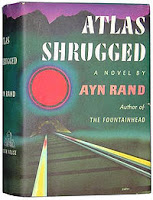
I am going to postpone the series on the fourth dimension for one more day because I would like to talk about the book I just finished, Atlas Shrugged. I mentioned this briefly when I talked about some of Ayn Rand’s philosophies; today I would like to review the book (don’t worry, I won’t give away any plot details). 
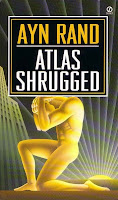
The first thing people notice about Atlas Shrugged is that it is very, very long. And they’re right: the copy I read was 1,100+ pages, but the font was so small it probably comes out to about double that (I think my eyes are much worse after having read it). Unfortunately the length is complimented by the fact that there are huge sections that are almost unbearably boring, particularly in the first half of the novel. Atlas Shrugged is not light reading by any means, but that does not mean it is lacking in suspense—there are a multitude of scenes that are very captivating, it's just that most of them reside near the end of the novel, making the beginning boring.

Throughout the novel Rand lectures the reader, which some think detracts from the entertainment value of the book. To some extent this is true—her constant lecturing can be a bit annoying, but Rand’s ideas are the purpose of the novel in the first place, and I think the not-so-subliminal messages make it interesting. However, this message can get very repetitive, and the fact that the whole book is built around Rand’s philosophy does detract from both its entertainment value and its ability to be believed. At one point, just before the novel’s closing, one of characters launches into a 50-page lecture; this is the read “meat and potatoes” of the book, though it is incredibly boring as well. Almost all the characters are caricatures; they are either Rand’s heroes or her villains, either clearly “good” or clearly “evil.” As the novel progresses this becomes even more and more apparent; near the end of the novel the villains have become so pronounced that the plot just about lost whatever was left of its realism. Even in the names of Rand's villains is this obvious: the controller of the economy is Wesley Mouch, whose name is a clear reference to "mooch." Likewise, the President is Mr. Thompson, a reference to the machine gun commonly used by 1920's mobsters. Indeed, there are far too many characters, especially considering they can all be grouped into two factions. Also, the fact that some of the characters are introduced and then forgotten can become extremely annoying, as does the fact that the novel’s real main character is not introduced until the book is two-thirds over.

Of course, it is a must-read for anyone who fashions themselves an Objectivist or is interested in the works of Ayn Rand. The philosophy behind it is very interesting—even though I abhor Objectivism I found the concepts discussed very thought-provoking. Along with The Fountainhead and perhaps Anthem, Atlas Shrugged effectively describes the Objectivist philosophy and its applications. The Fountainhead uses Howard Roark to describe what Rand’s idea of a “prime mover” is; Atlas Shrugged shows how much the world needs Rand’s prime movers and what happens without them.  

My final word is this: read it if you feel you are up to the challenge. Atlas Shrugged is the kind of book that keeps you from reading anything else at the same time, due to the multitude of characters and plot details to remember. Also, I strongly recommend that anyone who reads it keep an open mind while doing so. After about 500 pages or so, what Rand is preaching suddenly begins to make more and more sense, mostly likely because by that point you have heard it over and over and have been reading about a fictional world in which it does work (I suspect that this is why the book is so long in the first place). Always think about what Rand has to say, do not treat it as gospel.  

I realize I never answer the question I asked in the title of today’s post, “Who is John Galt?” I’m not going to answer it entirely, as it would give away some plot details. I will simply say this: the phrase is an integral part of the novel, and each time you hear it it will mean something slightly different. 

Friday, January 16, 2009

Hume’s guillotine

In one of his books, the philosopher David Hume explains that all religions state what “is” (whether God exists or not, the nature of man, etc) and then what “ought” to be (morality). But Hume asks, can we really derive an “ought” from an “is,” and if so how can it be explained logically? This famous query has since become known as the is-ought problem or Hume’s guillotine, and it is one of the central questions of ethical theory and meta-ethics. Because of its importance, I would like to talk about it today.

Hume himself thought that it is impossible to logically derive an “ought” from an “is.” Because of this, says Hume, there can be no moral knowledge of any kind. From this we can derive two moral theories: moral skepticism and non-cognitivism. The former, as its name implies, is the idea that moral beliefs are unknowable. The latter holds that moral statements are neither true nor false. Both make it impossible to derive any system of morality, and for this reason Hume believes that no objective morality can exist. 

But not everyone agrees, and many critics have given what they consider to be answer to the question or pointed out problems in the theory. I would like to discuss some of these as well:

John Searle, who I have talked about at length in my posts about the Turing Test and the Chinese Room, explains in a paper that the inherent nature of a thing can describe its purpose if this purpose is included in the definition. Many philosophers side with Searle, stating that there is no reason the “ought” cannot be described as part of the “is.”

Ayn Rand, who I have also spoken about previously, dismissed the problem entirely. She stated that an “objective” theory of morals is necessary therefore must exist. Man’s purpose, according to Miss Rand, is the rational pursuit of one’s self interest; this is the greatest form of Objectivist morality. To me, her logic seems a bit sketchy, but this is not really the purpose of today’s post, so I’ll move on.

The third and perhaps most important criticism comes from naturalism. Like Searle, naturalists see no problem with deriving an “ought” from an “is,” and they believe that “oughts” are necessary when describing beings in terms of their goals. For example: “A ought to do B to achieve C” makes B the morality. Also, naturalists hold that moral rules descend from evolutionary truths, such as monogamy from pair-bonding. Thus, morals are an extension of the instinct to survive.

What do I think? I am inclined to agree with Searle and the naturalists. In terms of some religions Hume is correct, but he is certainly not right in every case. Morals are indeed an extension of our survival instinct, or at least our ability to adapt to them is. However, the naturalists would have us believe that morals are always “efficient” because of this, but since human nature is so mutable I think this is not always true.  

What does this mean for us? Very little. It simply shows that we are very far from developing a concrete theory of morals. Of course, this should be no surprise, since we have not worked out a concrete theory of metaphysics or epistemology either. However, the is-ought problem is something to keep in mind when examining a religion or belief system, and even though I disagree with Hume’s conclusion I must admit he has created an interesting philosophical tool. 

Saturday, January 10, 2009

Objectivism in society

Before I begin: Today’s post is about Ayn Rand. For those offended by Rand or her beliefs, consider yourself warned.

Objectivism—a term which I will use today in reference to the philosophies of Ayn Rand—has never been overly popular, but its influence is surprising, especially considering how radical it is. Today I would like to discuss the reasons fort the unexpected significance of Rand’s beliefs.

Objectivism first began in the mind of Ayn Rand. It was unheard of until she published the now-famous novels Anthem, The Fountainhead, and later Atlas Shrugged. Since then, the philosophy has aroused suspicion, controversy, and criticism. But I’ll come to that later; first I would like to explain how this unusual idea caught on in the first place. The answer is quite simple: networking. Rand spread her philosophy through her books and through Objectivist groups and societies.

The first and perhaps most influential Objectivist group is “the Collective”, which consisted of Rand and her close friends. The group met to discuss Objectivist philosophy and politics. The name is ironic because Objectivism rejects any kind of collectivism; it was something of an inside joke among Rand’s followers. However, quite a few influential people rose out of this group, including Leonard Peikoff and Alan Greenspan. Today, Greenspan controls the Federal Reserve Board and is once of the most important economists in the world. Later on, other Objectivist movements were founded, spreading Rand’s works and her beliefs.

As these groups waxed in influence, critics began to accuse them of cultism. The Collective, in particular, came under fire, since Rand was known for excommunicating people from it. She also made sure she was in control of many of the organizations formed later, and many of her followers showed an uncanny amount of admiration for her.  This caused her critics to insultingly dub her the “guru” of Objectivism and call her followers “Randroids,” a portmanteau word combining “Rand” and “android.” This aspect of Objectivist groups also caused Rand’s critics to accuse her philosophy of being hypocritical, since people were supposedly following it blindly in the name of reason. Rand retorted that no Objectivist followed her blindly, but this is of course hard to prove. 

Objectivism has never been popular with academics and intellectuals. This is mainly because of its anti-intellectual spirit, but it is also because of Rand’s harsh and often unjustified criticism of many prominent philosophers. Though Rand cites John Locke, Aristotle, and Nietzsche as her inspiration, she dismissed David Hume’s is-ought problem with little explanation, and famously called Immanuel Kant “a monster.” Most of her critics hold that Rand was not as familiar with the history of philosophy as she claimed to be, and even some of her friends admitted that she had not read as much philosophy as she claimed to. Also, many of her political views came under fire—her conservative-sounding views on feminism seemed at odds with her pro-choice stance on abortion, and her hatred of taxation appeared to contradict her rejection of anarchy. Also, the left was infuriated at her repeated attacks on fiscal liberalism, while the right was aggravated by her repeated denunciations of Christianity. 

In the public sphere, though, she remains quite popular. Her three works of fiction are all regarded as modern classics, and her ideas are often quoted. Objectivist societies and still up and running, and many colleges in the US have Objectivist clubs or organizations.

Rand’s legacy has been carried on by Leonard Peikoff, her colleague and “intellectual heir”. A former member of the Collective, Peikoff wrote several Objectivist books including the famous “Objectivism: The philosophy of Ayn Rand,” which is a prominent Objectivist manifesto. In 1989, Peikoff denounced David Kelly, an Objectivist who began to deviate from Rand’s original beliefs and “correct her mistakes.” Peikoff insisted that Objectivism is a closed system that only follows Rand’s original ideas. Today, most Objectivist groups back Peikoff, but Kelly went on to found a few groups on his own, including the Atlas Society. Many critics of Objectivism in general pointed out that Peikoff was excommunicating Kelly, revealing how cult-like Objectivism actually is. Regardless, the fact remains that Rand’s legacy is still contested.

So, why are Rand’s ideas still so popular? I am not entirely sure, but I would say it is because they are so controversial and radical and because of her three acclaimed novels. This popularity is enough to keep the Objectivist organizations going, which distribute her works and spread her ideas even further. I doubt we will be forgetting about this controversial philosophy anytime soon, no matter how unpopular it may be.

And now, for your amusement, here is a direct quote from Rand herself about the influence of Kant, as printed in an Objectivist newsletter:

“Suppose you met a twisted, tormented young man and…discovered that he was brought up by a man-hating monster who worked systematically to paralyze his mind, destroy his self-confidence, obliterate his capacity for enjoyment and undercut his every attempt to escape…Western civilization is in that young man's position. The monster is Immanuel Kant.”

Monday, January 5, 2009

The sign of the dollar

Warning: Over the past few weeks I have been reading Ayn Rand essays and Atlas Shrugged. As a result, today’s post may appear overly Objectivist.

In recent history, it has become a common trend to slander rich capitalists and call money “the root of all evil.” Today, I would like to address these claims.

First, I would like to reiterate the theme I discussed in a previous post. During the auto bailout hearing, many Americans were shocked to discover how blatantly greedy the auto company executives actually are. However, as I stated previously, we should not be fooled; obviously, these executives got to where they are by being shrewd, profit-seeking businessmen, not public servants. However, many would argue that this is a virtue, not a sin. In a capitalist society, business owners are the true “prime movers” of the world (though our “mixed” economy dilutes this somewhat). Again, some would consider this a good thing, but others would disagree.

The main argument for this concept of industrialists as prime movers stems from egoism, particularly the egoist refutation of altruistic theories of morals. According to egoism, a person’s purpose is to act in his/her own self-interest. Rational egoism alters this definition somewhat, stating that a rational action is one that is in one’s self-interest; Objectivists and others have altered this definition to include certain other qualities such as self-esteem. In any case, according to egoism there is no reason follow any doctrine that involves justifying one’s existence to others. Thus, (if egoism is correct) charity is not a moral or virtuous action. For egoists, this “proves” that there is nothing morally wrong with profit seeking. Rational egoists would add that it is necessary to be rational in order to create anything of value to human beings. Thus, an irrational person cannot create anything of value (including food) and is therefore at the mercy of those who think rationally. In terms of economics, irrational people are parasitic dependents who live off of others by seizing goods or receiving them as charity. However, for better or worse, this viewpoint is not a very popular one in today’s world.

Second, I would like to address the topic of “money” itself. In essence, money can be defined as “anything that is not a good or service that can be exchanged for goods or services.” This means that money is simply a medium of exchange, or a form of credit. In other words, it is not an absolute—it only has value in relation to human beings in particular scenarios. Its value is determined by a society as a whole.

A society with money has obvious advantages over a society that uses the barter system; thus, a society with money is usually superior to a bartering society. Also, if money is present in a particular society, certain aspects of that society’s moral code and status can be inferred. For example, if a society has paper money, this means that the society is orderly and civilized enough to handle it, which means the society is stable (remember that money completely loses its value in times of crisis, since it simply becomes worthless paper). (According to Objectivism, the value of money in a society is also a gauge of how capitalistic the society is: in theory, a society that values money more has less of what Ayn Rand calls “looters” and “moochers,” meaning it is also more laissez-faire. However, this is not always true, and there are numerous counterexamples that disprove this. That, though, is a discussion for another day.)   

The point is, in light of all this the claim “money is the root of all evil” looks absurd. This should be no surprise, though, since the phrase was most likely coined to lash out at the rich. In this context, the phrase can be considered half-true since the imbalance of wealth probably perpetuates class differences (according to Marx), but money itself is not the root of the problem. 

**On the topic of Objectivism: it turns out that Alan Greenspan was an Objectivist and a personal friend of Ayn Rand's. Scary! 

Friday, December 26, 2008

Exploring the Chinese Room

Monday, in my post about the Turing test, I briefly explored John Searle’s thought-experiment “The Chinese Room.” Today, I would like to delve further into this interesting topic.

First, I would like to better explain the argument itself—I feel did something of a shoddy job of doing so in Monday’s post.  Rather than explain it myself, I will quote Searle’s description of the thought-experiment from his paper, “Minds, Brains, and Programs.” Unfortunately his description is a bit lengthy:

Suppose that I'm locked in a room and given a large batch of Chinese writing. Suppose furthermore (as is indeed the case) that I know no Chinese, either written or spoken, and that I'm not even confident that I could recognize Chinese writing as Chinese writing distinct from, say, Japanese writing or meaningless squiggles. To me, Chinese writing is just so many meaningless squiggles.

Now suppose further that after this first batch of Chinese writing I am given a second batch of Chinese script together with a set of rules for correlating the second batch with the first batch. The rules are in English, and I understand these rules as well as any other native speaker of English. They enable me to correlate one set of formal symbols with another set of formal symbols, and all that 'formal' means here is that I can identify the symbols entirely by their shapes. Now suppose also that I am given a third batch of Chinese symbols together with some instructions, again in English, that enable me to correlate elements of this third batch with the first two batches, and these rules instruct me how to give back certain Chinese symbols with certain sorts of shapes in response to certain sorts of shapes given me in the third batch. Unknown to me, the people who are giving me all of these symbols call the first batch "a script," they call the second batch a "story. ' and they call the third batch "questions." Furthermore, they call the symbols I give them back in response to the third batch "answers to the questions." and the set of rules in English that they gave me, they call "the program."

Now just to complicate the story a little, imagine that these people also give me stories in English, which I understand, and they then ask me questions in English about these stories, and I give them back answers in English. Suppose also that after a while I get so good at following the instructions for manipulating the Chinese symbols and the programmers get so good at writing the programs that from the external point of view that is, from the point of view of somebody outside the room in which I am locked -- my answers to the questions are absolutely indistinguishable from those of native Chinese speakers. Nobody just looking at my answers can tell that I don't speak a word of Chinese.

Let us also suppose that my answers to the English questions are, as they no doubt would be, indistinguishable from those of other native English speakers, for the simple reason that I am a native English speaker. From the external point of view -- from the point of view of someone reading my "answers" -- the answers to the Chinese questions and the English questions are equally good. But in the Chinese case, unlike the English case, I produce the answers by manipulating uninterpreted formal symbols. As far as the Chinese is concerned, I simply behave like a computer; I perform computational operations on formally specified elements. For the purposes of the Chinese, I am simply an instantiation of the computer program.”

Searle’s point is obvious: In the proof, he is manipulating Chinese symbols without true semantic understanding of what they mean. This, he argues, is what computers do: they simply carry out “the program” without having true understanding of what they are doing. It is important to note that Searle is not a dualist—he does not believe the human mind has any kind of non-physical component. He concedes that the human brain is simply a biological “machine,” and that an artificial mind could hypothetically be constructed. Searle is trying to prove that a computer program can never create a true “mind” because computer programs are in scripts that have syntax but no semantics. Essentially, Searle is challenging the computational theory of the mind: the idea that human beings cannot be explained in terms of input/output (note how similar this is to philosophical determinism).  

Also, I should mention that though I had never heard of the Chinese Room argument until the other day, it is one of the most important issues in cognitive science and philosophy today. In fact, the influential computer scientist Patrick Hays even joked that cognitive science should be renamed “the ongoing research program of showing Searle's Chinese Room Argument to be false.” There are an enormous number of responses to the argument, and unfortunately I do not have time to cover them all today. However, I would like to look at the implications of Searle’s argument and at some of the more convincing responses. 

Many philosophers and scientists have looked at what the Chinese Room thought-experiment implies, including John Searle himself. Searle created the following proof from his thought-experiment:

Axiom 1: Computer programs are formal and syntactic.

Axiom 2: Minds have mental, semantic contents.

Axiom 3: Syntax is not enough to create a semantic mind.

Conclusion: Programs are “neither constitutive of nor sufficient for minds.”

Searle’s conclusion is intuitive enough, given the data he is starting with. Axioms one and two are pretty obvious—1 states that computers have no true understanding of things, and 2 states that human minds do. Axiom 3 is what the Chinese Room proves—the fact that a computer can pass a Turing test without true understanding (at least, according to Searle). However, as I mentioned, the Chinese Room has attracted thousands of intellectual critics, and there are a multitude of responses to the proof from various areas of science. These responses attack Searle’s axioms, his conclusion, and the validity of the thought-experiment itself. I would like to take a few moments to explore some of these claims. 

The first is the “systems” response. This states that even though the man in the room does not understand Chinese, the man, the room, and the program as a system do. However, Searle’s reply is that it is possible for the man to memorize the program, making him the entire system even though he still has no understanding of Chinese characters. The “systems” reply is that the mind is virtual mind, which has a variable physical component. (For example, the software of a computer is a virtual machine) Thus, there is an “implementation independent” virtual mind at work. Searle, however, would maintain that such a virtual mind is still a syntactic simulation incapable of cognitive understanding.

Other responses are related to so-called appeals to reason. For example, a “program” to do what Searle is suggesting would be enormously complex, and it may require a whole new kind of programming. However, I will not even address these because they are insignificant—the Chinese room is a hypothetical case, after all. 

So, what is the final verdict on Searle’s Chinese Room? I don’t have one. Searle’s proof seems legitimate, but several of its aspects remain unproven, as many of the responses show. I promise to revisit the Chinese Room soon, since it is such an important and influential argument. For now, all I can say is that since the Chinese Room resides in the grey area between science and philosophy, someday either experimentation or logic may yield the answer. 

Monday, December 22, 2008

Musings on the Turing test (part 1)

In 1950, philosopher and computer scientist Alan Turing began to explore the philosophic implications of computers, specifically the problem of machine “intelligence.” Turing asked whether machines can ever obtain true intelligence or consciousness, and if they can, how do they differ from human beings (besides physically)? Turing published the following in a paper:

“It is not difficult to devise a paper machine [computer] which will play a not very bad game of chess. Now get three men as subjects for the experiment. A, B and C. A and C are to be rather poor chess players, B is the operator who works the paper machine. Two rooms are used with some arrangement for communicating moves, and a game is played between C and either A or the paper machine. C may find it quite difficult to tell which he is playing.”

What Turing is saying is that in this case a computer is indistinguishable from a human. To solve this problem, Turing developed the Turing test (named after himself), which is a hypothetical written test that can distinguish between a human being and a computer. Many versions of the test have been created, covering a variety of subjects. In fact, contests have been held, in which programmers attempt to create computer programs that can pass the Turing test (or at least appear to pass it according to a certain percent of judges).

Despite its popularity, the Turing test is often criticized. One of the most compelling arguments against it is the thought-experiment “the Chinese Room,” devised by John Searle in 1980. Searle argues that a computer could answer all of the questions correctly but still not have true intelligence, which is what the test is really meant to discover. In other words, the computer could answer the question simply by using a complex series of decision algorithms (to anyone who knows Java, think nested “if” statements). Thus, the computer is simply manipulating ideas in the way a non-Chinese speaking person can manipulate Chinese letters—they can answer a question in written Chinese without actually understanding what they are saying. This brings up a slew of complicated questions, including determinism, philosophy of mind, and the problem of consciousness.

First, determinism and the computational theory of the mind. This essentially means that human minds are computers in that we just take in data and process it in the same way computers do, and we have no “understanding” of concepts more than computers do. If this true, computers will eventually be able to pass the Turing test; all they have to do is mimic the algorithms the human mind uses. However, many philosophers believe in dualism, the idea that the mind has a non-physical component, or something like a soul. In this case, computers will never be able to pass the Turing test, as a non-physical mind would truly have free will, which a computer cannot mimic.

The problem of consciousness also comes into play, since this is another aspect of the human mind a computer may or may not be able to copy. This depends on the nature of consciousness—if it simply stems from the human brain having a huge number of neurons, there is hope for computer consciousness yet. But if it comes from a non-physical source such as the soul, computers will never be able to achieve consciousness as we know it. Also, the relationship between consciousness and self-awareness come into play here: Unless consciousness is defined as simply self-awareness, computers may be able to achieve self-awareness without achieving true consciousness.

If we ignore these philosophical problems for a moment, though, as follow the “Chinese room” theory that computers may be able to pass the Turing test even if they are truly “intelligent,” we can examine the problem more practically. Many computer scientists have predicted that computers will soon be able to pass the Turing test because of future advances in computing power. Moore’s Law holds that the number of transistors in a integrated circuit will double every two years, which means an exponential increase in computing power. So far, computer science has followed this pattern, However, many intellectuals argue that eventually this will break down because there is a point at which it is almost impossible to make smaller transistors. Moore himself stated that he doubts that the law will continue forever. Though some believe that quantum computers will be developed enough to replace circuits by the time this happens, this will also mean that Moore’s law no longer holds true because it only applies to integrated circuits.

However, it is clear that computers are going to undergo huge increase in processing power, whether they follow Moore’s Law or not. If quantum computers eventually become a reality, the amount of computing power available is going to be enormous. With all this “intelligence” at a computer’s fingertips, the Turing test as we know it will soon become obsolete, as computers will be able to immediately determine the “human” answer to any Turing test question with a low probability of error.

This aspect of the implications of the Turing test is a popular subject of debate among intellectuals. Two prominent philosopher/futurists, Mitch Kapor and Raymond Kurzweil, have placed a $10,000 bet on whether computers will be able to pass a Turing test by 2029. Check out this link for their arguments and the conditions of the bet. 

Another time, perhaps, I will review Kapor and Kurzweil’s arguments. I have barely scratched the surface on this topic, so I will almost certainly discuss it again. 

Monday, December 1, 2008

On "Anthem"

The other day I read Ayn Rand’s “Anthem.” Like all of her other novels, it was little more than a piece of Objectivist propaganda. Nonetheless, I would like to talk about some of the concepts discussed in the book.

The basic premise is that society has become so collectivist that people have forgotten the word “I.” The main character, however, wishes to be individualistic, so he runs away from society and lives by himself in the woods. The last chapter, which is the actual anthem described in the title, is about his discovery of the words “I” and “ego.” The book scathingly criticizes the fictional collectivist society and praises individualism. In the introduction, Rand likens any kind of conformism or collectivism to slavery.

I found the whole thing somewhat reminiscent of 1984 or Brave New World, since the lesson each novel is trying to teach is very similar. Here, though, the lesson is more extreme—BNW speaks out against consumerism and conformism and 1984 against fascism and false revolution, but Anthem seems to be against any kind of government whatsoever.

Rand’s description of a collectivist society, though chilling, seems very unrealistic to me. The society is technologically backwards, which seems a bit ironic, since more advanced technology could be used to achieve a great amount of control. However, examples such as China show that Rand may be on to something.

The whole concept of forgetting the word “I” was very intriguing to me. I could not help thinking of it as a thought-experiment to prove the Saphir-Whorf hypothesis (linguistic determinism). 1984 explores a similar idea, but in less detail—the government plants to use the “newspeak” argot to control how people think.

I would also like to take a moment to talk about Objectivism in general. Here is a short dossier of Objectivist ideas:

Metaphysics: Objective Reality, or the idea that reality exists independently of the human mind. Objectivism states that the purpose of the senses and consciousness is to perceive reality, not create it.

Epistemology: Reason, reason, and more reason. Rand rejects mysticism and skepticism, and it holds perception, combined with reason and rationality, is sufficient to achieve knowledge. 

Ethics: Objectivism rejects any kind of determinism, but it also rejects the concept of a soul. Instead, it states that human beings have a conscious mind that possessed free will. In terms of ethics and morality, Objectivism holds that the only concrete form of morality is that which is required to ensure man’s survival, not only physically but also as a rational being. Beyond that, the only morality, according to Rand, is self-interest. In other words, man is an end, not a means. I also suspect that Rand has a personal bias against moral systems that stress altruism, since she highlights this point in the book’s introduction.

Politics/Government: Objectivism states that a concept such as “the State” has no moral value whatsoever. Rand also argues that no man can force his values on another, and physical force is discouraged, except in self-defense. Man’s political purpose, according to Objectivism, is to interact with others independently, like traders. Laissez-faire capitalism is also strongly encouraged, since it allows people to interact in this way. Thus, Objectivism is strongly against any kind of collectivism or socialism.

Naturally, I reject most of these claims. The whole philosophy is based on a few assumptions, and since I am a skeptic I do not agree that these assumptions are true. However I can see how Rand came up with this philosophy, since she grew up in Soviet Russia—the invidious Russian political system angered many during her time.

This is probably not the last time I will be talking about Objectivism here, as I look forward to reading more of Ayn Rand’s books. 

Saturday, November 29, 2008

Clarke and the mind

In many of his works of science fiction, Arthur C. Clarke often muses about the concept of the mind. In books such as 2001, Childhood’s End, he toys with the idea that there is “something special” about the mind. He suggests that human beings will eventually learn to become independent of their bodies, and that their minds will be amorphous, “free from the tyranny of matter.” But is there any substance to all this, or Clarke just being poetic? In other words, is this really possible?

I think the answer depends on the exact nature of the mind. Clarke never explicitly stated if he believed in the concept of a soul, but he always attached a kind of importance to consciousness and self-awareness. However, I think he had a very scientific reason to do so—he hinted in his novels that he had a somewhat deterministic view of the mind—he often portrays it as a computer, a processing machine—but with the ability to connect with the supernatural. Clarke probably figured that the brain, the physical component of the mind, could be mutated or rebuilt (as computers have proved to a certain extent).This seems in accordance with the entities described in his books; in works such as the 2001 series, he describes an alien race that gradually becomes machine-like.

However, Clarke also goes one step further. He states that minds can eventually become contained in “lattices of light.” In other words, he is saying that the mind can be reproduced with non-physical materials such as light. This, of course, it pure speculation, and we probably do not possess enough knowledge of the universe to confirm if this is possible.

But what about the mind’s connection with the supernatural, which Clarke focuses on in novels like Childhood’s End? (In this novel, there is much discussion of the paranormal, and almost all of the characters have ethereal or otherworldly visions.) At first, this seems to conflict with the idea that the mind can be reproduced ad physically altered—after all, a deterministic view of the mind cannot explain the supernatural. However, I think that Clarke simply thought of the mind as more than the sum of its parts. Though I am critical of this view, the supernatural has yet to be explained—and Clarke may be closer to the truth than I would like to believe. 

Wednesday, November 26, 2008

The BBC’s four questions (part 4)

The series on the BBC’s philosophical questions concludes with what is probably the most important one of the four:
Did you really choose to read this article?

The passage goes on to describe an imaginary entity, “Fred,” who has an infinite amount of intelligence and memory. Fred uses these skills to figure out the state of every molecule and particle in the universe, and uses that to predict the future. Thus, Fred knows the location of every particle in any future time, meaning the future (and past) is predetermined. 

The passage is basically laying out the fundamental principles of determinism, and is showing how it invalidates our idea of making choices if it is true. This is a huge topic—there is no way that I can completely cover this in one post. However, I would like to throw my two cents in and write down some of my thoughts on the topic.

First, I’d like to talk about the topic in general. Determinism has been argued about for centuries, and almost every philosopher I can think of has an opinion on the topic.

One of the most prominent “common-sense” arguments against determinism has to do with the fact that human beings supposedly have free will. The proof for this, according to the argument, is that consciousness, emotions, and self-awareness indicate the presence of free will. However, I would like to refute this claim with a common-sense argument of my own:

Consider a computer, or a computer program. A computer program is obviously deterministic in nature; it simply performs the tasks assigned to it. However, a computer program can be made very complicated by allowing it to make “decisions” and act differently depending on what data it is given. A simple organism, such as a single-celled amoeba, functions the same way; it follows a set of instructions programmed into its DNA—though these instructions give it some leeway, it has no brain of any kind, as it is simply following orders. (The nucleus of a cell is not its “brain,” despite what we are taught in biology; that is simply an analogy to help us remember its function, keeping the cell’s DNA safe.) Thus, a single-celled organism is just as deterministic as a computer. Next, consider a multi-cellular organism, such as a slime mold or plant. Neither of these organisms have a brain, like the single-celled organism I just mentioned. Though, they are more complex than the single-celled organism, they are essentially the same: they follow the instructions in their DNA. Though a plant or a slime mold has more “choices” to make than an amoeba, their nature is still basically deterministic. Next, let’s move on to a simple animal, such as a mouse or worm. Both of these possess a brain, which changes things somewhat. However, these organisms can still be reduced into deterministic terms: the brain is still a product of the animal’s DNA, and all of the “decisions” it makes must be explained in terms of its chemical and biological structure. In other words—“Fred” would be able to figure out the locations of all the molecules in the brain, and he would be able to predict what “decisions” it makes. Thus, the brain in and of itself is not anything special; organisms with brains can still be explained in terms of determinism. Next, I would like to discuss a self-aware animal, such as a chimpanzee. As we have just seen, the fact that chimps have brains does not mean that they have free will. However, many would argue that since chimps experience emotions and are self-aware, the situation changes. However, I believe that this is false. Emotions and self-awareness can be explained medically as chemical reactions in the brain—they do not indicate free will in any way. Finally, we must take the last step and ask the key question in this proof: how is a human being different from all of the other organisms I just discussed? Humans possess no aspects or parts I did not just explain away; the only difference between a human being and another animal is complexity. Thus, a human being is in essence the same as a computer program: deterministic.

(In the grand scheme of this argument, this simple proof means little. But, if the universe does lack inherent spirituality, it may be true.)

I would also like to add a quote from my favorite novel, The Moon is a Harsh Mistress, which I have spoken at length about before. In the novel, one of the main characters is a computer, who is self-aware. When another character is asked how this computer could be alive because it lacks a soul, the snappy response is:

“‘Soul?’ Does a dog have a soul? How about a cockroach?”

The point is quite clear: many philosophers assume that human beings have souls (but not other animals), and use this as an argument against determinism. However, they are guilty of “taxonomic discrimination,” which casts doubt on the concept of a soul in general. 

However, there is strong a scientific argument against determinism: quantum mechanics. This relatively new idea suggests that electrons and other subatomic particles are very different from the matter they make up, since they possess several odd properties that have to do with the fact that they are neither waves nor particles. Also, the Uncertainly Principle states that it is not possible to know all of the information about certain subatomic particles at the same time. This might make in impossible for “Fred” to gather all of the information he needs to predict the location of every molecule in the future.

Because of all this, parts of the universe may truly be random in nature, and these small quantum random patterns can add up to change the movement of molecules, thus disproving determinism. Though quantum mechanics has not been fully worked out, it is generally scientifically accepted, and it is a striking argument against determinism (it does not fully disprove it, though, at least in my skeptical mind.)

The BBC article comments on this, though the language the writer uses is a bit unclear. Here is the passage in question:

“…modern physics tells us that there is a certain amount of fundamental randomness in the universe, and that this would have upset Fred's predictions. But is this reassuring? Notice that, in ordinary life, it is precisely when people act unpredictably that we sometimes question whether they have acted freely and responsibly. So free will begins to look incompatible both with causal determination and with randomness.”

I’m not really sure if I can consider this a legitimate response to the quantum mechanics argument—it seems like the writer is confusing a whole bunch of things in this passage, mixing responsibility and free will and using an unconvincing common-sense example.

That’s all I have time for today. Don’t worry, though—this will certainly not be the last time I discuss determinism here; it’s far too important a topic for me to just talk about it once and put a moratorium on discussing it. For now, at least, the issue remains unsettled.