Showing posts with label United States. Show all posts

Saturday, January 17, 2009

In 103 days…

In three days, President-elect Barack Obama will be inaugurated. This means that in 103 days we will have reached the 100th day of his Presidency. Why am I bringing this up? Very simple: a lot can happen in one hundred days. The example I’m thinking of is FDR: in one hundred days he got the New Deal going and was already in the process of pulling the country back together.

Today, I would like to address two issues: first, I would like to offer a brief prediction of what the world will look like in 103 days, and I would like to amend some of the things I said in a previous post, “Beyond FDR.

First, predictions. The economy will probably be about the same; many economists are predicting that we won’t see any kind of turnaround until late 2009 or 2010 at the earliest. But will we lapse into depression? Probably not, but certainly not in 103 days. I suspect Obama’s huge stimulus plan will have passed by then, but it will still be too early to see the effects. The world will have fallen even deeper into recession, following the US trend. No major wars or conflicts will have developed, barring a major catastrophe. Obama’s foreign policy will look good but probably will not have the chance to try and prove itself just yet. However, I do think there will be one noticeable change in the American people: optimism. Obama will continue to look good in his first hundred days, and the media will continue to portray him as a strong, competent leader. Because of this, he will look like the leader most Americans want, and he will imbue us with a strong sense of hope and pride. Why such an optimistic prediction? Read on:
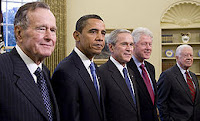
In my previous post, I stated that the media is too politically charged to allow a politician to be great. Though I still believe that the media does make it harder for a person to achieve true greatness, there are times when the media actually facilitates this, FDR was one of these people who was helped by the media—today, I think Barack Obama is another. The “liberal media” has always supported him, but even now conservative pundits are commending him on a well-run campaign and a historic win. Are some people unhappy? Yes. But on the whole everyone admits that his election is monumental, and a victory for race relations in the US. As far as Obama’s presidency goes, I think the media will continue to support him as long as he does at least an average job—they have set him up for greatness, and in times like these people want to see a hero leading their country. Unless he does a terrible job in his first hundred days, the media will continue to stand behind him. Because of this, future generations will look back and see our negative media praising our 44th President, and they will look upon him as a great leader. In summation: greatness is achievable, even today. Though it takes more media help than before, it is possible.

On a more humorous note: in three days, we can all go back to saying “nuclear” instead of “nucular.” (But it may take us 103 days to get used to it!) 

Thursday, January 15, 2009

Coal’s insidious influence

When we think about coal, we think about the bygone era when the sooty stuff was burned to heat our homes. We think of the first Industrial Revolution, of industrialists in top hats surveying strip mines. In other words: coal, in our minds, is not “modern”—it is a symbol of our past. But in reality, this is a myth. Big Coal is alive and well in the US, and it is even more powerful than Big Oil. Today, I would like to deconstruct our incorrect notions about coal, and explain why it plays far too big a part in the US’s energy future.

First, the raw facts: Coal generates 52.1% of electricity in the US. The US currently possesses 1,374 coal mines. In 2007 1,145,600,000 tons of coal were mined. Over 80,000 Americans are employed in the coal mining industry, and many times that number of people live near coal mines. More importantly: coal is not going anywhere anytime soon. US coal reserves stand at about 275 billion tons, which is more than any other nation in the world possesses. The EIA predicts that coal production will increase by 1.1 percent until at least 2030. Likewise, the amount of electricity produced by coal will increase.

Why is this a problem? Coal mining is dangerous, coal itself is a pollutant, and coal burning releases a variety of toxic gases into the air. Coal mining is one of the most dangerous industries in the US, resulting in a number of fatalities each year. Even worse, coal mines are a major source of pollution. Acid mine drainage and fine particulates are harmful to human health and the environment, and blasting mines ruins whole tracts of land. When coal is transported, it releases fine particulates that are hazardous to human heath. And when coal is burned, it gives off CO2, SO2 and other hazardous contaminants. Fortunately technologies such as CCS and IGCC are making coal-burning power plants cleaner by filtering out CO2 and other pollutants. But overall the phrase “clean coal” is a myth because the whole process from start to finish is extremely dirty and dangerous.

So, how do we break away from this dirty energy source? The answer is alternative energy. So far, the US is lacking in terms of clean energy—today renewables only power 1% of our electricity. The other problem with alternative energy sources is that they require electricity to produce, and as I explained above most of this electricity comes from coal. But since many alternative energy sources achieve energy “payback” very quickly (10 to 22 months for photovoltaics!) they can more than make up for the coal used to create them. So if global warming, peak oil, and threats to national security weren’t already enough reasons for the US to pursue energy independence through alternative energy sources, coal certainly is. The sooner we act on this one, the better. I sincerely hope Obama realizes the seriousness of this problem and corrects it by supplanting coal with better, cleaner energy sources. 

Tuesday, January 13, 2009

The end of the neocons?

I don’t have as much time as I would like today, so I am forced to keep this post short.

I just read this article on the BBC News about the how the US’s foreign policy is about to drastically change now that neoconservatives are no longer in power. So, the question I would like to pose is, is this a good thing for our nation in the years to come?

Most Americans would immediately answer yes. The aggressive foreign policy has become even more and more unpopular with Americans as the Bush years passed, and today Bush’s popularity is at an all-time low as a result of this. Neocon foreign policy does suffer on many levels: it focuses entirely too much on the Middle East, and it is often pigheaded in its single-minded approach. It almost always leans toward intervention, even in cases where it is clearly unjustified. Also, the influence of the religious right has caused neoconservative policies to view the world in a oversimplified way, grouping nations and peoples into the categories of “good” and “evil.”

But there are some advantages to an aggressive foreign policy, and a passive stance many be more undesirable than it seems at first. Remember that the UN is next to useless, as recent events have proven. The UN has failed to act on several humanitarian crises, and it is clear that though they are useful in negotiating alliances and agreements, they fail miserably when it comes to intervention. In some cases, intervention is the most desirable solution, and when long-standing conflicts erupt into war intervention is the only way to prevent atrocities. For example: many predict upcoming conflicts between India and Pakistan, and the Gaza/West Bank crisis is not going to solve itself. Also, the continuing search-and-destroy mission against Al-Queda is a result of neocon policies, and it has clearly done some good. My point is that in these instances, intervention is acceptable. Also, remember that in today’s global economy true neutrality is almost impossible. In its early history, the US implemented an isolationist policy, but this was abandoned because economics made war a necessity. Today, we are economically tied to a multitude of nations, making the situation even more complex.

However, I am neither advocating a neoconservative approach to foreign policy nor a passive one. I am suggesting that we use moderation—in the years to come, a combination of both types of policies is probably the best method. One thing is obvious: the global situation in the future is not going to be good, so we must approach each situation carefully. We cannot risk a radical or hasty foreign policy—if the US is to weather the coming storm, we must act cautiously and with extreme care.

But perhaps this whole discussion is irrelevant—as the article points out, neoconservativism has appeared and reappeared at various points over the past few decades. Either way, it is clear that the next four years at least will be largely free of neocon influence, and how the Obama administration handles foreign policy may determine how soon the neocons will return.

Now, an update on yesterday’s post: The idea that a device that can simulate a brain is different from a computer program is nothing new. In John Searle’s Minds, Brains, and Programs (the paper containing his famous Chinese Room proof), Searle explained the difference between the way a brain processes information and the way a computer program does. Searle explains that human beings are essentially “machines;” the fact that we are composed or organic matter is irrelevant. Thus, a machine with a brain can hypothetically constructed, and such a device could have consciousness like a brain. What is so revolutionary about Edelman’s work is that no one has been able to build such a device until now.

Thursday, November 27, 2008

Thanksgiving revealed

Thanksgiving (today) is considered one of the most innocent of American holidays; after all, what could be wrong with the uplifting story of oppressed pilgrims coming to America in search of religious freedom? And what could possibly be more inspirational than a bunch of Indians feeling sympathetic towards these pilgrims and agreeing to help them harvest their crops?
Actually, this story is mostly false. It has been retold so many times since the actual event that today we accidentally equivocate when retelling it, concealing some of the more sinister aspects of what actually happened.

Firstly, the pilgrims were hardly innocent. They did not travel to America to find religious freedom; they came to institute the worst kind of religious tyranny, as later events such as the Salem witch trials proved.

As for the Native Americans—they ended up far worse off because of this event. Afterwards, negotiations between Indian tribes and white became capricious, and soon the newly born America government began organizing sorties to harass and drive away Native American tribes. Eventually the formerly great tribal civilizations were reduced to a battered, saturnine bunch as white Americans began pushing westward. When the Native Americans finally ran out of land to move to they reached the nadir of their suffering, as they were persecuted and discriminated against to no end. Thus, the supposed dinner held at Plymouth Rock did not change relations between white and Native Americans in any way.

Lastly, I doubt the picnic the pilgrims and Native Americans had was the ebullient affair it is usually described as (if it existed at all). Both parties were probably highly suspicious of one another, and I doubt they could put aside their differences even for one meal.