Showing posts with label economy. Show all posts

Monday, April 20, 2009

The new capitalism

For weeks, political pundits—both liberal and conservative—have been rambling on about their belief that Obama’s policies are going to create a new form of American capitalism, the likes of which have never been seen before. Conservative pundits have attempted to use this as a fear-mongering technique, spreading the dire warning that Obama is peddling socialism. Until now I have looked upon these claims with skepticism—after all, during the Great Depression FDR used socialistic policies to create consumerism, which became the biggest boost to American capitalism in all of American history. Though his policies where based around government intervention, at heart FDR was still an avid defender of capitalism.

But Obama is not FDR. Though both are using government intervention to save capitalism, it is becoming clearer every day that Obama does not plan to return to the status quo after the recession ends. I am not worried that Obama is a radical leftist who will destroy American economic freedom, but I think it is clear that we will not be returning to business as usual.

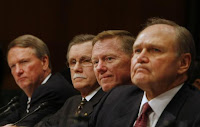
The first and most obvious sign of this is the G20 Summit. Not only did Obama wholeheartedly support the conference, but he supported mandates to regulate global trade, support the International Monetary Fund, and encourage government spending to end the global recession. This is a far cry from “Reaganomics,” where government is viewed as the problem, not the solution. Next, Obama has clearly stated his intent of guiding American industry and banking to prosperity. He demanded the resignation of a prominent auto executive, and has supported bailouts for banks and financial institutions, something even Democratic Presidents would be hesitant about.

These signs (warning signs, to conservatives) hint at a future paradigm shift in American economic policy. Clearly, Obama is planning to re-invent capitalism and the way America interacts with the world, probably through legislation.  

When will these changes occur? I don’t know for sure, but I believe it will be soon. Recall that immediately after the election Obama promised to “fix” the US economy and declared that the American people could hold him responsible for the result of his administration. What this means is simple: he acknowledges that if he can’t “fix it” in 4 years, he won’t be re-elected. However, it is probably impossible to bring us back to where we were in 2008 in 4 years, so many Americans will be unhappy even if Obama manages to slow or stop the recession (and decide not to vote for him again anyway). Also, Obama probably realizes that if things do not begin to turn around by 2010, the Democrats may lose their majority in Congress. Thus, I believe that Obama plans to implement his reforms sometime the next year or so. I am not sure exactly how or even what he plans to do, but I think we are going to see a major economic policy shift in the next few years. 

Will Obama’s reforms be for the best? This is a very difficult question, and we can only speculate. For one thing, it is obvious that the world is no longer going to depend on the US economy as much as it used to. Though this reduces our role in world politics, I believe it is for the best because our economic growth can no longer match that of developing countries. However, this economic influence may be crucial in the potential cold war against China, in which the US will probably be hard-pressed (once again) from preventing an authoritarian government from expanding its influence. As always, though only time will tell the real result of Obama’s reform. One thing is clear, though: we will see change soon, be it for the better or worse.  

Wednesday, April 1, 2009

On the G20 summit

The G20 Summit has just begun, so I would like to take the day to discuss it.

First, I would like to give some background information on the G20. In simple terms, the G20 is an enormous conference centered around economic issues. The “20” in G20 refers to the 20 nations that make it up. These include the US, most of the EU, Japan, Brazil, Russia, and Argentina, among others. Obviously because of the pressing economic situation, the G20 is probably going to determine how quickly we can resolve this financial crisis. 

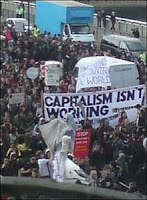
Next, I would like to talk about the protests surrounding the event. I can’t think of the last time I have seen such controversy and violence surrounding a political event—protesters have stormed banks, pitched tents, damaged financial buildings, and fought with London police. The protestors consist of various factions, from environmentalists to anti-capitalists, but most are probably just people who are angry at financial institutions. Some have called on people to “lay siege” to banks and other buildings. Overall, I am amazed at this wave of angry populism. Though I knew the event would be shrouded with controversy, I certainly did not expect large-scale riots. However, I doubt that these protests will have any bearing on the results of the conference, but they are an interesting litmus test of the economic climate. As Barack Obama put it, they instill a “sense of urgency” in the G20 leaders, reminding them how important this summit is.

Also, I would like to talk about what is going on at the summit. As you may have already heard, France is adamantly demanding extremely strict economic regulation. As of a few hours ago, Germany has sided with France; the German Prime Minister is also calling for strict regulation of international trade. However, a second faction has emerged: the UK and US are both demanding heavy government spending. I do not believe that these groups are going to divide the G20 and bog it down—France and Germany’s goal is certainly compatible with the United Kingdom and the US’s. Instead, I think that these two groups are going to be the ones who influence the final agreement the most. What come out of the G20 will probably have both heavy regulation and heavy spending.

Also, one of the main focuses of the G20 is probably going to be the IMF, the International Monetary Fund. The IMF will probably have its funds increased dramatically as a result of the G20, and they will probably be given more control over trade as well. The IMF has often come under criticism, since many believe that it disregards human rights concerns and manipulates the world economy. It is true that the IMF is not hostile towards dictatorships, but claims of conspiracy are probably unfounded.

Overall, I support the G20 and believe that it will bring results. Hopefully the summit can also stem the wave of angry populism banging on its doors. Even if the treaties and agreements signed at G20 have little effect on the global recession, the conference may be able to restore consumer confidence. One thing is very clear, though: this is the end of capitalism as we know it. The system that will emerge from G20 will be similar but not the same as the system we use now. Regulation and government spending will be increased, and government will have an enormous role in globalization. Is it for the best? Only time will tell.

I will probably write about the G20 again, most likely after it ends. 

Thursday, March 5, 2009

Communism: insufficient data

Americans are quick to point to Russia and China as examples of why communism and socialism cannot function on a large scale. However, I believe that Russia and China are not qualified to be considered case studies for communism, for reasons I shall explain.

The main reason Russia is not a sufficient example is very simple: Stalinism. When the Soviet Union began, Russian politicians such as Stalin and Lenin transformed the Soviet Union into something Marx would never have approved of. They crushed liberalism and suspended human rights, turning the country into a dictatorship in the name of prosperity. What Stalinism created was communism, but not in the liberal, democratic form Marxism envisioned. 

Also, note Russia was forced into communism—it did not develop naturally according to Marx’s theories. Marx believed that eventually the proletariat would revolt against capitalism and form a socialist republic. Eventually this would turn into a communist entity simply because Marx believed the latter is more efficient. In Russia, though, this did not occur: after the Revolution the nation was forced into communism.

In China, the situation is a bit different. Though the Chinese government is known for its human rights violations, its governmental philosophy is not nearly as “Stalinistic” as Russia’s. However, they too were forced into communism, negating Marx’s predictions on how communism would arise. Additionally, China is incorporating many capitalist aspects into their economic system, probably because of the necessity to trade with Western societies. Their system is no longer “pure communism,” which also indicates that it cannot be used as a case study for the economic validity of communism.

Because of these factors, we cannot consider Russia or China as case studies for communism, nor can we dismiss communism as a political theory because of the USSR’s collapse. Instead, we must look at smaller examples. I would like to take a moment to discuss a few of these:

The most successful applications of Marxist theory I can think of are the Israeli kibbutzim. These are small socialistic/communalistic communities, usually in rural areas. The residents of a kibbutz often reside in a single, communal living area, and most of them are employed in producing the main product that the kibbutz sells. Kibbutzim are remarkable successful, and they certainly prove that socialism is very efficient in small communities. They also lend some support to the Marx theory of “natural communism,” though I would not consider them alone a proof of this.

The next example is Cuba. Like Russia, Cuba was forced into communism, and like Russia, Cuba is lacking in the liberalism that Marx stressed. However, Cuba’s isolationist policies do make is something of an example of communist economics, and the results are not pretty. Though Cuban communism does have positive aspects, such as healthcare, much of the population is unable to rise out of poverty.

So for now I am holding my evaluation of communism and socialism until a time when we have more concrete examples. However, one trend is clear: communism and socialism often lead to obsequious, servile state-worship, which in turn often leads to unexpected negative consequences. But in terms of evaluating economic prosperity we will just have to wait until someone tries again.


Friday, February 27, 2009

Something a little bit different (continued again)

Today I am going to continue the discussion I had on Tuesday and Wednesday: my idea of an economic system, called Applied Monetary Management, that uses fiat money to create economic prosperity. If you have not read Tuesday or Wednesday’s posts, I strongly recommend doing so.

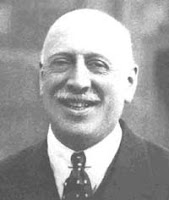
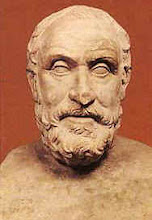
I would like to respond (again) to the claim that AMM is socialistic/communistic and suffers because of it. As I have stated before, the national dividend is not enough to live off of, meaning that it will not cause anyone to work less. Also, the dividend does not have to be distributed equally—as I discussed previously, this is up to policy makers, who represent the will of the people. Also, after re-reading parts of C.H. Douglas’s book Social Credit, I noticed that even Douglas (pictured on right) suggests not giving the dividend to someone who has not worked in a long period of time. So, AMM is not communistic—like Social Credit, it is a “third way” between capitalism and socialism, incorporating aspects of both.

On a similar vein, an interesting thought occurred to me today: AMM can be used as a “bridge” to communism (or something like it), and because of the way AMM works the country implementing it would only reach communism if it was economically viable. As I explained on Wednesday, AMM distributes a national dividend to everyone to increase the public’s purchasing power. This dividend is not enough to live off of, so it is only a supplement to a person’s income. However, as technology increases the amount of labor required to create a product decreases—as we get closer an closer to the technological singularity, the amount of time it take to produce goods will decrease dramatically. When this happens, the result in an AMM society would be that the national dividend would increase sharply, as less people are working but there are more goods to consume. Eventually, society would reach a point where the only people who still worked are people who want to. At this point, incidentally, the national dividend would be enough to live off (think about it: no one else can be dissuaded from work by the dividend, meaning that it is enough for everyone else to live off of. Do the math if you don’t follow my logic.) The result is communism, or at least something like it. But unlike every other attempt at communism, which has failed because the society was not economically prepared, AMM only evolves into communism when the society and technology the society possesses is ready. I doubt this will ever happen—technology may never reach that point, and when it does society may not let the economy become a communistic one. But is an interesting thought.

Next, I would like to explain where AMM differs from Douglas’s Social Credit. Though the systems are similar, I have removed Douglas’s “Just Price” mechanism, which freezes prices, and replaced it with an optional government subsidy to lower prices. Also, AMM nationalizes trade, creates a powerful national bank, and places harsher restrictions on privately owned banks. (To those unfamiliar with the details of Social Credit, it might seem that AMM and Social Credit are exactly the same, and I wanted to correct this notion.)

This ends my five-day series of posts about economics and economic philosophy. However, this is certainly not the last you will hear about AMM or economic philosophy in general.

Thursday, February 26, 2009

On Obama’s words of wisdom

On Tuesday President Obama spoke to Congress about the state of the economy. In this speech, he justified his economic stimulus plan and explained why America needs it. There are a few comments I have about the content and delivery of the speech that I would like to discuss.

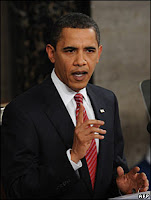
Overall, I was impressed with Obama’s tone and delivery of the speech. He did not shy away from telling us what we needed to hear, but neither did he say anything that would make Wall Street panic again (or at least it didn’t sound like it). I did find the incessant applause breaks annoying, though. A few times I found them quite reminiscent of those during speeches given by fascist leaders, particularly because of the fact that they were scripted. (I am not calling Obama a fascist—I am just making a comparison.) Though Obama does need to “sell” his plan to us, are theatrics really necessary? Besides, the applause breaks give Obama’s opponents a chance to snub him by not clapping at the appropriate moments (which many did). Beyond that, though, I have no complaints about the delivery of the speech—as always, Obama is an erudite orator.

Throughout the speech, Obama had outlined where his plan’s money was going and why. I found most of his explanations satisfactory. But after the speech, I had a startling thought: Who the heck is paying for all this? And when? At one point in the speech, he states that “we cannot leave the deficit my administration inherited for future generations.” Fine, fine. But then he goes on to say, “families making under $250,000 a year will receive a tax rebate and no tax increase.” He went on to talk about other tax cuts included in his plan. But if he is not raising taxes, who is going to pay for this? Yes, Obama is raising taxes on the rich, but surely this will not pay off $800 billion + the existing deficit + however much Gietner’s absurd plan is going to cost. Though I am a supporter of fiat money, Obama must “play by the rules” and pay back any debt he creates. So, is he going to leave some of this debt for future generations anyway? Or does he have something else in mind?

In general, I do agree with Obama’s stance that we must avoid the “politicians’ fallacy” (known as the Thatcherite fallacy in the UK) when dealing with the recession. For those unfamiliar with this logic error, the proof looks something like this:

1) We must do something.

2) This is something.

3) Therefore, we must do this.

Instead, Obama has always stated that we cannot afford to make a mistake here. Though action is necessary, it must be the right kind of action. With any luck we will eventually reap the benefits of this stimulus plan, which the President has put so much faith in. 

Tomorrow I will return to what I was discussing yesterday: Applied Monetary Management. 

Wednesday, February 25, 2009

Something a little bit different (continued)

Today I am going to launch into a more detailed explanation of the economic system I proposed yesterday. If you have not read yesterday’s post, I strongly recommend it. Before I begin: for the purpose of convenience (my own), I have decided to dub the system I discussed yesterday “Applied Monetary Management,” or AMM. This name is somewhat appropriate, and it will spare me some lengthy sentences.

I would first like to discuss overproduction in more detail, since this is one of the central points I brought up yesterday. Overproduction is a condition in which a nation produces more products than it can consume. In a capitalist system, this is disastrous to the economy if the country suffering from overproduction cannot find an economically viable way to get rid of the excess. In most cases, though, the philosophy of “favorable balance of trade,” in which countries are encouraged to export more than they import, has countered overproduction in most cases. Today, the concept of foreign aid has been added to this as a way to alleviate overproduction. But where there are no more markets for the excess goods, prices plummet and the economy crashes. (This is what happened during the Great Depression—demand dropped because Europe could no longer afford to buy our goods and did not need war materiel, so the US was left with a surplus we were unable to get rid of.) According to C.H. Douglas, overproduction—or at least shortage of money—occurs naturally in capitalism. Douglas explained this idea in his A + B Theorem. In this proof, Douglas explained that a product’s cost is made up of two parts, A, the cost of wages to pay the employees who produce the product, and B, the cost of the materials (including land) needed to produce it. Thus, the price of the product must be A + B + C, where C is the profit. But how can the public possibly purchase all the products created if the collective purchasing power is equal to A when the collective price of all products is equal to A + B + C? The answer: they can’t. This is the rationale for Douglas’s Social Credit as well as for AMM—if more money is pumped into the economy, overproduction can be turned into an advantage rather than a liability.

Next, I would like to talk about taxation and investments in relation to my AMM system. Taxation is entirely useless, as it withdraws money from circulation. Since the national dividend is the opposite of taxation and the government can just print fiat money anyway, taxation is useless. Investments detract from the productivity of an AMM nation, since money used to buy insurance or invested cannot be used to purchase products. Thus, both of these would have to be discouraged and perhaps more strictly regulated (though not banned) in an AMM system. 

I would also like to briefly touch on trade in an AMM system. As I mentioned yesterday, all trade is to be controlled by the government because of the fact that the AMM nation’s currency would probably be worthless elsewhere in the world. Thus, the government will use the barter system to get what it needs from other countries and foreign companies. Though this is somewhat cumbersome, it adds to the power of the government in terms of economic control, which is central to the success of the AMM system as a whole. This does make it difficult to travel to other countries, but this is a minor concern in the big picture.

I would now like to counter some of the standard arguments that are used against C.H. Douglas’s Social Credit, as many of them apply to AMM, the system I am proposing.

Firstly, I would like to counter the argument that AMM suffers because it is overly socialistic. Though it is true that the concept of the national dividend is somewhat socialistic, it does not make anyone’s job into a sinecure. As I briefly touched on yesterday, AMM accounts for the cultural factor that is often the downfall of socialistic systems: lack of incentive to work.  Recall that the national dividend can be distributed either in a more socialistic way (more equal) or in a more capitalistic way (rewarding hard work). Also, remember that it is elected officials who determine how the dividend is doled out. Thus, whichever way the cultural pendulum swings, the distribution of the national dividend can account for it.

Secondly, I would like to further discuss the issue of hyperinflation. As mentioned in the paragraph above, AMM can account for the cultural factor present in the downfall of socialistic systems. Also (and perhaps more importantly) AMM creates perpetual, unlimited demand. This, in turn, creates more production, and hence more work. Also, remember that the government also controls prices to a certain extent. (This is one of the fundamental differences between AMM and Social Credit—Douglas proposes freezing prices, which he calls the “Just Price” system; I propose giving an option fiat money subsidy to lower prices. Companies would prefer to accept this, because not only ensures that they will be paid well for what they produce, but also because the lowered cost (coupled with the national dividend) ensures that they will not have excess goods.

Lastly, I would like to explain my apparent grudge against bankers and capitalists. As I discussed previously when talking about the automakers’ hearing in Congress, the self-declared motive of any capitalist is to seek wealth and personal gain. I am not begrudging selfishness as a personal philosophy, though; I see no problems with selfishness or egoism in general. The problem is that when a company or a few companies are the only major ones in their industry, the executives of those companies have an enormous social responsibility thrust upon them: they are now charged with ensuring the continued prosperity of that industry. But what have they done to earn this position? Though many hold that their ability to succeed in their industry is what qualifies them—however, this is only half true. Though having proficiency in running a company of a particular industry does qualify that person to manage the industry, it does not change the fact that that person is self-serving, not a public servant. Instead, controlling the direction of an industry (as opposed to directly managing it) is a job that should be taken up by the government, which serves the people.

I have also expressed my distaste for powerful privately owned banks and other financial institutions; I would like to explain my reasons for this as well. Banks and other financial institutions are among the most powerful organizations when it comes to determining the value of money; banks can even create money using fractional-reserve banking policies. This is dangerous because banks, like capitalist individuals, have selfish motives. To allow organizations with selfish motives to have so much power over the monetary system is clearly very dangerous. Instead, the government should ensure that it has the most control over the monetary system by forcing banks to utilize commodity money-based polices. Once again, since the government serves the people it is a far better candidate to control the value of money than a bank owned by a self-serving capitalist.

I would also like to discuss some of my influences and some recommended reading on this subject. For information on the economic philosophy of Social Credit, I recommend reading three of C.H. Douglas’s books, Social Credit, Economic Democracy, and Credit-Power and Democracy. Though these aren’t among the most gripping or entertaining books out there, they explain Douglas’s ideas and are very thought provoking. I would also recommend Robert A. Heinlein’s 1939 novel For Us, the Living, which is more of a lecture than a novel, in which Heinlein offers his own take on Douglas and applies to philosophy of Social Credit to culture.

**As a side note: Any real economists reading this are probably laughing at me. I have thus far failed to provide any hypothetical examples, case studies, or any other proof besides logic to back up my arguments. My theory is based mostly off of early 20th century thinkers rather than modern economics, which probably makes it obsolete. I admit, I am quite a neophyte as far as economics goes—this is mostly the reason I approached this problem from a philosophical standpoint rather than an economic one. But this theory is the best one I’ve got, and I suspect there is actually some validity something to it. In the future, I will do some research and try to provide some tangible proof for what I am saying. 

Tomorrow I may or may not continue on this subject—I may decide to take a day off from it to discuss the global economic crisis instead, in particular President Obama’s recent speech. 

Tuesday, February 24, 2009

Something a little bit different

I realize that today’s post is quite long. However, I think it makes up for this by being perhaps the most interesting blog entry I have ever written; I urge you to read it if you have the time. Today, as I promised yesterday, I am going to outline my own views on economics. I believe that an economic system can be analyzed by asking two key questions about it. I shall submit my own system to this analysis so as to best explain how it works and its moral justifications.

The first question we must ask when discussing economics is “what is the purpose of a particular economic system?” As odd as this may seem, it is actually a key question to understanding why certain economic systems function the way they do. For example, the purpose of capitalism is to allow land, labor, and capitol to be privately owned and traded. Communism, however, has a different goal: the development of a classless society. Because of the fundamental difference in why these systems exist, each functions in very different way. So, what is my answer to the question regarding the purpose of economics? Simply this: The purpose of an economic system is to allow the greatest amount of prosperity in terms of goods and services, and to allow these to be distributed to the constituents of society in a utilitarian manner. This sounds complicated, but is actually quite simple: the system’s chief goal is producing the most/highest quality goods and services (don’t worry about how for the moment) and distributing in a way that allows the most happiness for the most people. This leaves some room for flexibility, as it calls for an equal distribution of goods, but only to the point where this does not affect prosperity. This allows for the system to change as the culture of the society does (as the society fluctuates from considering classlessness as a virtue to considering the labor theory of value a virtue). The rationale for this goal—the “why” behind the “why”—is also relatively simple. To quote the economist C.H. Douglas, who is perhaps my most important influence as far as economic philosophy, “Systems were made for men, and not men for systems, and the interest of man, which is self-development, is above all systems.” The reason I encourage prosperity in terms of goods is simple: imagine what happens when an economic system is mismanaged and loses track of this goal. The best example I can think of is this: during the Great Depression, farmers were paid to destroy their crops so that the overall price of crops would rise. This is sacrificing goods for the sake of money; in my mind, this is incredibly foolish, as it means a decline in overall prosperity and wealth (it obviously means this because goods are being destroyed). Thus, seeking wealth and prosperity in terms of goods and services is a better goal for an economic system, as it means that this system works for the utilitarian benefit of all.

The second question we must ask when examining economic systems is “how does the system achieve its goal?” In some cases, there are multiple ways of a achieving the goal; communism, for example, could work toward a classless society by encouraging private ownership rather than collective ownership. Thus, you may agree with my opinion on the best purpose of an economic system but not the way I plan to achieve this purpose. I propose a system similar to C.H. Douglas’s “Social Credit.”

But before I explain the nuances of this system, I would like to quickly explain the nature of money, as it is crucial to understanding what I am about to propose. Money is defined as anything that can be exchanged for goods or services (that is not already a good or service, of course). Also, money is not an absolute; it has no value except in relation to human beings, and it is human beings who decide the exact value of monetary units. Similar to the reason that “dog” only means “dog” because we so choose, a dollar means more than a scrap of paper because we, the general public, have decided that it has a certain value. This value often (but not always) correlates to the quantity theory of value, better known as the idea of supply and demand. Of course, like any other commodity, the value of money to each particular person varies and fluctuates—but because it has at least some value to most people it can function as a part of society. Often, though, organizations such as the government or banks have more control over the value of money than individuals. Money generally functions as a medium of exchange, but, in some instances, it can take on other purposes. The main point, though, is that money is not made “in a factory”—in direct correlation with the production of goods/services—as fiscal conservatives claim, but instead by whoever controls its value (i.e. the government, banks, the people, etc.)

So, here is the system I am proposing: The government should take an extremely active role in economics for the purpose of encouraging overproduction. Though in capitalist systems overproduction is disastrous (it was one of the main causes of the Great Depression), it can be handled easily in “my” system. The government can achieve this by severely restricting trade of goods that can hypothetically be consumed domestically and by providing stimuli (in the form of payments and loans) to encourage the production of goods that can hypothetically be consumed there as well. The government also discourages imports with protectionist tariffs or similar measures. As I mentioned before, this encourages domestic overproduction. Once this occurs, the government is to offer a subsidy to companies to lower prices of their goods. Next, the government issues a “national dividend” to all citizens, giving them the money to purchase the all products produced that can be consumed. This also creates a perpetual demand, which will encourage more production in the next term, but will not alter prices because of the government’s pre-existing subsidy. This subsidy/dividend system ensures that most, if not all of the good produced domestically than can be consumed domestically are purchased and consumed. As I mentioned above, how the dividend is distributed depends on cultural factors (which is fine, because it is determined by politicians, who are elected officials). But where does all this money come from? Very simply—and this is the single most important aspect of what I am proposing—this money is fiat money. It is not backed by gold or any other standard; the government simply prints it at a mint and issues it. It appears that this would cause inflation and collapse, but, as I shall explain two paragraphs below, this is not so.

Additionally, as a matter of policy, the government is the only organization allowed to coin money and regulate its value. Private banks and other financial institutions must deal with money as if it were a physical commodity: under no circumstances may a bank loan more money than it physically possesses. (Today, believe it or not, banks can loan out more money than they actually have; the process is known as fractional-reserve banking.) Also, there is to be a single national bank, which can serve all of the purposes a conventional bank. This bank, however, being a part of the government, does not have to deal with money as a commodity like privately owned financial institutions. This national bank also serves to distribute the national dividend and handle the subsidies used to lower the cost of domestic products.

At first glance it appears that this system suffers from numerous practical flaws, the most prominent being that it encourages hyperinflation. However, remember that companies are paid a subsidy to lower prices and the national dividend creates unlimited demand and purchasing power—this ensure that all the goods produced that can be consumed are purchased. The only instance in which the system encourages inflation is in instances in which the government overcompensates and the national dividend is far greater than the total quantity of products produced. Also, it would appear to be worthless to a country such as Venezuela, which relies heavily on one or two exports. However, the government can deal with this by purchasing quantities of this product with fiat money (or just nationalizing that industry) and bartering with other countries for the products needed (few capitalist countries would want to work with a currency that is not backed by gold and is under the thumb of the government). Also, remember that the currency is only used inside the particular country utilizing the system, and that privately owned banks are very weak compared to those today, meaning that the government has an enormous degree of control over the value of the currency. This should prevent the currency from inflating, though I am sure that some inflation is going to occur. However, as long as there is only a minimal amount of inflation and it does not detract from the efficiency of the system as a whole, it is not much of a concern. Also, it appears that the system would not work for a country that relies heavily on imports. This is true, but, as I suggested above, there are methods by which a country can stimulate its own economy provided it has the natural resources to do so. Another complaint is that this system encourages wastefulness. Though this is a valid argument, the same can be said of capitalism; my system is no more wasteful than a capitalist one.

I welcome any comments on this topic; tomorrow I shall go into more detail and perhaps provide a hypothetical example of how this system would work. Again, sorry about the length of today’s post—I realize it was a bit hard on the eyes. 

Monday, February 23, 2009

Fiat power, fiat money

Unfortunately I was unable to write anything this weekend, as I was quite busy. However, I was only off for two days, which is really not that much in the big scheme of things, and two days is as close to a hiatus as my blog has ever come. But I have devoted this week to discussing topics related to economics, and for the next five days I am going to type out some very interesting posts. Today, the series on economics begins with a discussion of the legality of fiat money.

In these stressful economic times, all eyes are on Obama and his stimulus plan, which just passed through Congress. However, many conservatives are fundamentally opposed to the bill because it requires huge government spending at a time when the government is already very far in debt. Many hold that the government can never engage in deficit spending or even “meddle” with the economy at all. But I believe that economic “meddling” is legally justifiable in the US; whether it is morally justifiable or practical is regardless. Furthermore, I believe that many banks are actually violating US monetary laws with some of their policies. Today, I would like to briefly explain these concepts.

In the US Constitution, there is a line in Article 1 that states, “Congress shall have the power to coin Money, regulate the Value thereof, and of foreign coin.” This is the main piece of evidence on which my argument is based. This authorizes Congress to print as much money as it desires, including fiat money, or currency not backed by gold or any other standard. Furthermore, nowhere in the Constitution is deficit spending forbidden, and I believe it is implied in the phrase “regulate the Value thereof,” as this allows the government to deal with money in any way it wishes. Thus, the government can print as much money as it wishes, and demand that people accept it. 

However, though the government is allowed to do all of these things, banks are not. I take issue with some of the polices of banks, as many of them mess with our economy more than we think. Perhaps the most dangerous is the fact that banks are not required to possess all of the money they loan out; some of it is simply “checkbook money,” not true commodity money. What this means is that banks can give you money that they never really had in the first place; they get away with it by assuming that you are eventually going to pay them this money, plus interest. In doing so, they are coining money, which only the government is allowed to do. Banks also (indirectly) control the exchange rates of foreign currencies. This, too, is technically not allowed as per the quote above; only the government should be allowed to tell people how much of a foreign currency their US dollars are worth (in accordance with the “regulate the value of foreign coin” part).

Of course, these claims sound silly in today’s world, in which our financial system is based on credit, non-commodity money, and imaginary market values. I realize I probably sound like one of those crackpot economists from the 1930s who suggested all kinds of radical schemes, such as printing huge amounts of fiat money or abolishing the stock market. However, remember that credit and the other fundamentals aspects of our economy are what contributed to this crisis in the first place—perhaps it is time to look closely at our economic system and see if it truly works the way we want it to. Also, remember that if we allow banks to have the power to manipulate the economy by being able to regulate the value of currency (directly or indirectly), we are surly headed for disaster—because bankers and capitalists, by nature, serve themselves. The government, however, does not, and allowing it to regulate currency, as it is supposed to, is perhaps our most important weapon against economic disaster. 

Tomorrow, I will discuss my own economic views and their justifications. 

Tuesday, January 6, 2009

Our growing world

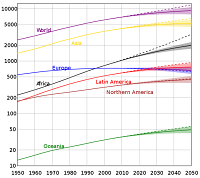
In 2010, the UN predicts that the world population will be approximately 6,830,283,000. In 2020, it will be 7,540,237,000. In 2030, it will be 8,130,149,000. And in 2050, it will be 8,918,724,000. In other words: our world is undergoing a population explosion. In a matter of centuries—a blink of the eye in relation to human history—the world will be packed with human beings.

How did this happen? How did we, as a species, manage to break out of our early years as hunter-gatherers and form such large, complex societies? The answer, as Jared Diamond explained in his groundbreaking book Guns, Germs, and Steel, is agriculture. Once agriculture was developed, societies could support large populations and specialization, leading to more complex and larger groups of human beings. Over time, fertility rates increased as a result of this newfound food supply, eventually creating the population explosion that formed the modern world.

But the “why” is irrelevant—the issue this population forecast raises may be the most important question of our time: How do we deal with it? How do we support a world population of 10, 20, or 30 billion?  This is obviously a problem of resources: Today, I would like to go down the list of resources essential to our survival, and discuss possible solutions.

The first and most important resource is water. Fresh water makes up only a small fraction of the total amount of water on this planet—and we have an endless demand for it. Remember that water is not only for drinking—even more is needed for agriculture, industry, and infrastructure. Fortunately, desalination is a viable alternative—Israel, Saudi Arabia, and other countries have the technology to desalinate a cubic meter of water for about 50 cents. In other areas of the world this technology is more expensive—so, in order for the world to begin transitioning to desalinated water, the technology must be made cheaper and more readily available. However, this is not as easily achievable as it sounds, and I would not be surprised if fresh water becomes the cause of resource wars, especially in Africa or the Middle East.

The next resource, which is equally important, is food. The future of agriculture does not look as bright as the future of water—even as far back as the 1800’s, the economist Thomas Malthus predicted that overpopulation would eventually result in an food crisis, since he believe that food production increases at a linear rate and population increases at an exponential rate. Though this theory has been proven wrong, Malthus’s prediction is right: food production has not been increasing as much as it needs to be. Even in the past few years, food riots have occurred in areas like the Philippines, where he price of wheat has skyrocketed due to shortages. Looking forward, it is obvious that land is going to become an issue for the food industry. North America and Asia have already used of most of their arable land, while Africa and South America have more untapped potential, especially Africa. In order to ensure a more stable food supply, the world must encourage a major agricultural revolution in Africa. Furthermore, in order to grow food more efficiently, high-density crops such as lettuce must be grown in place of more inefficient ones. Next, the effects of global warming (regardless of whether it is natural or man-made) will have a huge impact on the future of agriculture. If it reduces the amount of arable land in the world, we may have a much harder time supporting a large population. Though hydroponics and vertical farming can counteract this to some extent, the loss of arable land could seriously cripple farmers, which could leave the worldwide agricultural industry in a slump. Also, the food industry is linked to the water supply—if water desalination does not progress enough, agriculture will suffer regardless of any other factors. Additionally, this is linked to the problem of fertilizer—modern fertilizers use a large amount of petroleum, and if peak oil is true and/or the oil industry crashes a food crisis will occur, hurting the agricultural industry even more. Fortunately (and somewhat surprisingly) the amount of land area occupied by human dwellings is not much of a threat to agriculture—cities are predicted to become even denser, and the UN predicts that in the next 20 years 3 out of 5 people will live in a city. Even so, there are a multitude of problems confronting the food industry, and unless these can be solved we are almost certainly headed for a Malthusian catastrophe.  
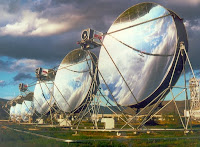
The next resource we need to worry about is energy. I am not as worried about this one as I am about an impending food crisis, but energy is still an issue we need to consider. The first step is to gradually transition to renewables, but this is not too much of a problem because many countries are motivated by global warming to do so anyway. Obviously relying on a non-renewable resource in unwise, and with the world population expanding so quickly a finite resource can run out startlingly fast. However, I am not worried because the technology of renewable energy will continue to increase over the next few decades, and very soon renewables will be economically superior to finite sources of energy.

In addition to these, overpopulation has other adverse effects on our planet. I would like to take a moment to discuss these as well.

The main problem posed by overpopulation is the danger to the environment. Deforestation and desertification will most likely increase as the population rises, which will harm ecosystems and my result in mass extinctions. Also, air pollution may be a result on an increased population unless filtering technology increases dramatically. If global warming is man-made, overpopulation may very well drive it over the edge. This would not only hurt the environment even more, but it would also make things more difficult for the agricultural industry.

Next, overpopulation may result in widespread poverty. Even if we manage to handle the resource problems well, I doubt we can deal with them well enough to allow however many billion people there are to live in prosperity. This may make it harder to ensure we have enough of the resources listed above, and it might lead to an increase in crime or other factors that lower quality of life. Malthus would have us believe that we should welcome this—he famously stated that when people allow themselves to expand, nature will take over and do the job for us. However, I hope we can avoid poverty to the point of starvation by implementing our own, more peaceful solutions to overpopulation and by ensuring that the human race has enough food.

Because overpopulation makes our future looks quite bleak, many intellectuals have suggested ideas to curb the population, preventing this Malthusian crisis from occurring. Though most of these ideas are wildly impractical or controversial, I would like to talk about them because they may be our only hope for the future.

One of the more popular—and also more controversial—solutions to the overpopulation problem is eugenics. Many groups have advocated a “one-child rule” for the entire planet, in the hopes that this will curb the exponential trend of population growth. This is probably the most viable of the solutions offered, and even though the rule would be ignored to some extent it might be able to reduce population growth somewhat. The main problem with this program, though, is that it would be very difficult to implement—the UN is not influential enough to convince many nations to submit to the program, so it would have to come from an international agreement like the Kyoto Protocol.

On a similar vein, some have suggested that we must make changes to our social structure, such as the elimination of marriage or even polygamy. These are probably not as effective, and since they are so radical I doubt many countries would implement them. However, plain old feminism may be good enough to reduce the population growth rate, coupled with an increase in the availability of contraception. Overall, though, none of these are true solutions, since they are probably not powerful enough to really curb the growth of the world population.
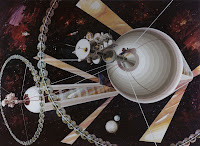
Other scientists and economists have offered more radical solutions, such as space colonization. Though this would solve the population problem, it is far from a practical solution. Space travel remains exorbitantly expensive, making it impractical to transport large populations to other worlds. Also, not means of space travel currently exists that can transport human beings outside of the solar system within one lifetime, and astronomers do not even know if other planets capable of supporting human life exists. However, outer space may be a viable source of resources—the Moon, for example, contains a variety of useful metals, and lunar ice could be a potential source of fresh water. For now, though, this solution to the population problem resides only in the realm of science fiction.

Fringe groups are also suggesting that vaccinations should no longer be issued, so that healthcare will decrease, causing people to die “naturally.” This will create a sort of social Darwinism, which will gradually reduce the population. Though this may be effective, it is hardly a desirable or practical solution. No country is going to willingly give up vaccinations, and no one wants to hear that the solution to overpopulation is to allow a large amount of the population to die.

So, what is the verdict on overpopulation? Simply this: we should be worried. Though the dreaded Malthusian crisis may not happen in our lifetime, our children and our children’s children may have to deal with it. We should work towards ensuring that our supply of food, water, and energy is secure, so that we can deal with overpopulation as smoothly as possible. Unless space colonization becomes viable, we are going to have to figure out how to stabilize our population. Overpopulation is often over looked, but very soon it is going to determine whether we as a species are able to survive as a large and complex civilization. The sooner we start dealing with it, the better. 

Monday, January 5, 2009

The sign of the dollar

Warning: Over the past few weeks I have been reading Ayn Rand essays and Atlas Shrugged. As a result, today’s post may appear overly Objectivist.

In recent history, it has become a common trend to slander rich capitalists and call money “the root of all evil.” Today, I would like to address these claims.

First, I would like to reiterate the theme I discussed in a previous post. During the auto bailout hearing, many Americans were shocked to discover how blatantly greedy the auto company executives actually are. However, as I stated previously, we should not be fooled; obviously, these executives got to where they are by being shrewd, profit-seeking businessmen, not public servants. However, many would argue that this is a virtue, not a sin. In a capitalist society, business owners are the true “prime movers” of the world (though our “mixed” economy dilutes this somewhat). Again, some would consider this a good thing, but others would disagree.

The main argument for this concept of industrialists as prime movers stems from egoism, particularly the egoist refutation of altruistic theories of morals. According to egoism, a person’s purpose is to act in his/her own self-interest. Rational egoism alters this definition somewhat, stating that a rational action is one that is in one’s self-interest; Objectivists and others have altered this definition to include certain other qualities such as self-esteem. In any case, according to egoism there is no reason follow any doctrine that involves justifying one’s existence to others. Thus, (if egoism is correct) charity is not a moral or virtuous action. For egoists, this “proves” that there is nothing morally wrong with profit seeking. Rational egoists would add that it is necessary to be rational in order to create anything of value to human beings. Thus, an irrational person cannot create anything of value (including food) and is therefore at the mercy of those who think rationally. In terms of economics, irrational people are parasitic dependents who live off of others by seizing goods or receiving them as charity. However, for better or worse, this viewpoint is not a very popular one in today’s world.

Second, I would like to address the topic of “money” itself. In essence, money can be defined as “anything that is not a good or service that can be exchanged for goods or services.” This means that money is simply a medium of exchange, or a form of credit. In other words, it is not an absolute—it only has value in relation to human beings in particular scenarios. Its value is determined by a society as a whole.

A society with money has obvious advantages over a society that uses the barter system; thus, a society with money is usually superior to a bartering society. Also, if money is present in a particular society, certain aspects of that society’s moral code and status can be inferred. For example, if a society has paper money, this means that the society is orderly and civilized enough to handle it, which means the society is stable (remember that money completely loses its value in times of crisis, since it simply becomes worthless paper). (According to Objectivism, the value of money in a society is also a gauge of how capitalistic the society is: in theory, a society that values money more has less of what Ayn Rand calls “looters” and “moochers,” meaning it is also more laissez-faire. However, this is not always true, and there are numerous counterexamples that disprove this. That, though, is a discussion for another day.)   

The point is, in light of all this the claim “money is the root of all evil” looks absurd. This should be no surprise, though, since the phrase was most likely coined to lash out at the rich. In this context, the phrase can be considered half-true since the imbalance of wealth probably perpetuates class differences (according to Marx), but money itself is not the root of the problem. 

**On the topic of Objectivism: it turns out that Alan Greenspan was an Objectivist and a personal friend of Ayn Rand's. Scary! 

Saturday, November 15, 2008

Karl Marx and the American Dream

You may be wondering, what does Karl Marx have to do with the American Dream? Actually, quite a lot.

Marx is famous for his Communist Manifesto, the anathema of all rich capitalists. In this paper he outlines his system of communism, and tries to examine the course of history though this new lens. However, what many people do not realize is that his system is based on the labor theory of value. (This is mostly because it is hidden in cryptic and archaic language in the first section of the paper.)

Labor theory of value is the idea that the value of a product is directly related to the amount of work needed to create it. However, this idea is obviously false, as modern economics have shown. This is mostly because it does not take into account technological advancements and the simple laws of supply and demand. For example, consider a shoemaker who uses an awl, a wooden bench, and leather to make shoes. He must work for several hours to produce one pair of low-quality shoes. A factory worker, on the other had, can churn out thousands of high-quality rubber shoes per day with little effort by using modern machinery. The shoemaker’s shoes required much more labor, but they are far less valuable than the factory worker’s shoes. However, the shoemaker’s shoes can greatly increase in value if the demand greatly increases; likewise, the factory worker’s can depreciate in value if the demand decreases. Marx’s labor theory of value does not account for either of these factors, so it is obviously flawed.

But how does this relate to the American Dream? Remember the main principle of the American Dream: If you immigrate to the US and work hard, you will be successful and wealthy. This obviously parallels the American dream idea of “the harder you work, the better off you will be.” For this reason, the American Dream is just as fictional as the labor theory of value, as countless manual laborers can confirm. Though it isn’t entirely false—capitalism does reward hard work to some extent, it by no means the guarantee many people believe it to be.

It may sound as if I am disparaging immigration—I’m not. America is a nation of immigrants, and immigration is an integral part of our past and future. However I am skeptical of the idea that anyone can immigrate to the US and be successful by working hard. 

Monday, November 3, 2008

Robot economics

Yesterday I reread Isaac Asimov’s science fiction novel The Caves of Steel, which is about a murder mystery in a futuristic setting. According to the book, robots will begin to take both blue-collar and white-collar jobs, resulting in mass unemployment. Combined with overpopulation, this will create a huge economic crisis. Asimov believes that the solution is mass emigration to other planets, solving the population problem. In his later books, he describes how sparsely populated colonies on other planets can create a kind of feudal system, with each family owning an estate and enough robots to work it. 

However, as I described in a previous post, space travel might not be viable until long after this crisis occurs. This made think of the question: Is there any way that this crisis can be resolved without the colonization of other planets, i.e., in a “closed” system?

To do this, some manipulation of economics by the government is probably necessary. I have always believed that an economic system is at optimum efficiency when “Anything physically possible can be made financially possible.” (C.H. Douglas) Our current economic system is not even close to this state, and it is unlikely that it will be any better if/when this technological crisis occurs. Beyond that, though, there are a few options we can probably rule out:

Asimov’s feudal system can be eliminated right away. It requires a low-density population, which obviously does not exist on Earth. The only way to reduce Earth’s population would be to “eliminate” a large number of people by draconian means—not a very desirable solution.

Technological regression can also be eliminated. Though many people probably do not want robots integrated into society because of the effects on the labor pool, corporations would probably find them very desirable because of the decreased cost of labor. Because of this, it would be very difficult if not impossible to get rid of robots entirely.

So, what are we left with? I believe the answer is Social Credit. This economic system, designed by C.H. Douglas during WWI, was supposed to deal with the problem of overproduction in a closed system. In order to ensure the excess goods are consumed, Douglas recommends a government subsidy and a welfare check for everyone (to increase the net amount of purchasing power). In our robot scenario, it is reasonable to assume that there is a large amount of overproduction. Today the US suffers from chronic overproduction, but we resolve it by dumping foreign aid on African nations and selling goods below cost overseas. If robots are replacing jobs, it is likely that this overproduction has worsened (since both people and robots would be working if there were underproduction, except in unlikely circumstances). Thus, Social Credit is probably applicable.

But how would it be implemented? Almost definitely by the government; corporations are far too selfish to do it themselves (I’m not criticizing them; it is the nature and purpose of a company to be selfish—they must make money, after all). However, note that Douglas recommends that the money the government uses to pay for all this comes right of the printing presses with no gold or silver backing—fiat money. Wall Street will immediately label this as “inflationary” and “striking at the roots of our institution.” The government must persevere and go ahead with this—if Douglas is correct (which he probably is) this fiat money will not cause inflation at all. This is because this extra purchasing power is “needed” by the corporations (they do not want to waste goods) and by the people (they do not want to starve).

As time progresses, robots will probably become more prevalent, and as a result the nation dividend (welfare) must increase as well. If the system is balanced, the dividend will become enough for everyone to live on at exactly the same time that robots take over every job (thus creating communism). At this point the crisis has ended, and people will no longer have to work at all.

I suppose this is overly optimistic and highly unlikely. It is far more reasonable to assume that if this crisis occurs we will simply go into a worldwide depression, which we will not recover from until we have regressed technologically or thought of some other solution. If it does happen, though, I hope we will at least consider Social Credit—it may be the best and most desirable way out of this inevitable labor crunch.   

Sunday, October 26, 2008

Apocalypse now (maybe)

I recently found out the next book in a science fiction series I have been reading has been published. The series is called the Emberverse series, the author is S.M. Stirling, and the first book is Dies the Fire.

The basic premise is that all technology stops working, sending the world back to the Stone Age. The book talks about how 99% of the world dies within a year, because the loss of technology causes anarchy and prevents people from getting food. Since most people, especially city dwellers and suburbanites, do not have their own source of food or potable water, they starve when the system collapses.

After this gritty, chaotic time, though, a more halcyon period begins, as only a small percentage of the population is left (though some small pockets of violence still exist). The book goes on to describe what happens to these remaining people, who are mostly people who live in rural areas and who are not as dependent on centralized food production. Specifically, it follows the pursuits a few tribe-like societies and their plight to defeat a would-be warlord and his ex-gangster minions. A few characters from Stirling’s other book series, the Nantucket series, also make cameo appearances.

This got me thinking: If the current recession worsened, could it cause a similar disaster scenario? Though recessions and depressions have happened many times before in almost every country, globalization is relatively new, and its effects on the current economic problems may be enormous. If globalization creates a kind of negative feedback, the effects of the recession will be minimal and our economy will soon bounce back. But if it acts as positive feedback, the recession will spiral out of control and plunge the world into a terrible depression.

But, will this create the kind of disaster scenario described in Stirling’s books? Remember that the US has been through many depressions before. We suffered though a about 1 depression every decade in the 1800s, and we have also had a few modern economic paroxysms, which we have recovered from as well. Even in the Great Depression, in which millions of people lost their jobs, the government did not collapse and the effects were not permanent. For our government and our infrastructure to completely collapse, we would probably have to be attacked by a foreign nation—mass unemployment, though unfortunate, is a far cry from anarchy. 

The only place where this kind of scenario could occur is in an area like the Balkans or the Middle East. If one country’s government is weakened by the recession, a neighboring country could invade it, creating chaos. The US, though, has no belligerent or militaristic neighbors, making the scenario unlikely.

But preparation for this kind of scenario should not be held in abeyance—it is something we should continue to watch out for and be aware of. It may be closer than we think.