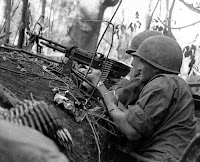
 Today I would like to discuss a topic related to the Vietnam War. Specifically, I would like to focus on the Viet Cong, the unorganized bands of North Vietnamese civilians who were the American troops’ fiercest enemy for the majority of the war. The VC gained a reputation for their cunning guerilla tactics and for the brutal atrocities they committed against South Vietnamese civilians. Ever since, most Americans consider the VC an object of contempt and hatred. The North Vietnamese, on the other hand, are grateful for the VC’s actions, which they believe to be valiant and just.
I would like to pose the following question: Speaking from a purely neutral perspective, how can we assess the VC? Are they heroes and martyrs, or are they brutal murderers who deserve only contempt?
Unfortunately, I believe that it is almost impossible to answer this question because of the problem of perspective. To Americans, the VC should be considered evil because they committed heinous war crimes against civilians and brutally murdered American soldiers with barbaric booby traps. To the North Vietnamese and communist Chinese, the VC are heroes because they did everything in their power to defend their homeland from foreign invaders. They justify the brutality by stating that it was necessary, which is certainly true—the VC recognized that the Americans were far superior militarily, so they saw the need to wear down the American resolve.
This issue of perspective is more permeating than one might think. For more examples, look at American history. During the American Revolution, American soldiers broke the previously established rules of war and did what was necessary to repel the British, who are clearly depicted as the villain of the whole affair. The image of the “minuteman” became glorified in American culture ever since. But how is this any different from the VC doing what is necessary to repel the foreign invader that was the United States? How is the image of a Viet Cong soldier—a rice farmer who, when necessary, will defend his homeland, different from the glorified minuteman? Next, look at the American Civil War. One of the events that helped to solidify the North’s victory was “Sherman’s March to the Sea,” in which Union troops burned Georgia to the ground to destroy the South’s economy. This, surely, is just as much of an atrocity as those the VC committed—but in America Sherman’s March is glorified, not mourned.
I suspect that Vietnamese history—and the history of every other country or ethnic group—embellishes details in similar ways. Vietnamese culture is based around their geography, which lends itself to frequent invasion. The Vietnamese have a spirit of endurance, which has managed to triumph over all of the other nations that have attempted to conquer it. Thus, the Viet Cong are undoubtedly seen as heroes, as they simply carried on the tradition of resisting foreign invaders.
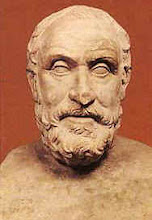
This issue of perspective makes it extremely difficult if not impossible to truly assess the Viet Cong. As the Greek poet Aeschylus put it: “In war, truth is the first casualty.” This moral ambiguity is probably part of the reason why most Americans are averse to looking back at this period in history. Americans do not like to see themselves as the villains in history, but the Vietnam War puts us in exactly that position. Sadly, it is this war on truth that perpetuates war—if we are ever going to outgrow armed conflict, we must first outgrow our obsession with embellishing it.

 Today I am going to discuss some of the subtle philosophical and political commentary in Zach Snyder’s film adaptation of the Alan Moore graphic novel Watchmen
 In the past I have mentioned my libertarian views on government in the social sphere and my firm belief in a complete separation of church and state. However, what many people do not realize is that even the most secular administrations in the US haven’t even come close to a true separation of church and state. I am disgusted that cultural and religious minorities are ostracized and prevented from practicing what they believe in. But that’s old news—if you are interested in hearing the long litany of government violations of the First Amendment, see
 The series on justice systems continues with a discussion of the relationship between justice systems and utilitarianism. Last time, I briefly delved into the subject of which is more desirable in a justice system, utilitarianism or fairness. I now realize that I was somewhat biased towards utilitarianism, and I assumed that it is true in order to use it to refute the justification of revenge-based justice systems. Today, I would like to delve into this topic in more detail.
 At last, here is the long-awaited continuation of the series on justice systems. This time, I would like to discuss justice systems, particularly the ones I previously mentioned, in relation to the concept of fairness. Fairness can be defined as being “just or appropriate in the circumstances.”


 This is my second post on the topic of how the justice system could be better organized. Last time, I discussed three alternatives to the current justice system.
 Though we often forget it, our current justice system dates back to the Bronze Age, with Hammurabi’s Code “An eye for an eye.” Since then, revenge-based justice systems have dominated the world. This is also reinforced by our non-deterministic view of the universe in general—we treat society/people as though they have free will, even if they really do not. Today, our justice system in the US suffers moral problems because of this along with practical problems because of some of the system’s other aspects. In this post, and possibly a few following it, I would like to discuss alternative systems that would better suit our needs.
 As anyone in America knows, as soon as Thanksgiving rolls around a Christmas tree will appear in front of every town hall. I am not the first to bring up this controversial issue—atheists, Muslims, Jews, and many other have hectored mayors and town officials about this public display of religion. For the most part these people have simply been viewed as liberal malcontents who need something to complain about. Unfortunately, this is true of some of them, but others are civilly demanding equal representation, and rightfully so.