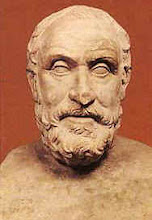
Are all wars caused by population pressure? Do all conflicts between adjacent societies have their roots in population overflow and the subsequent expansion that this overflow requires? Are cultural and social causes, such as the religious fervor found in wars such as the Crusades, merely side effects of conflicts that are inevitable because of population pressure?
Before I answer let me explain the importance of these questions. Besides that fact that a “yes” would simply anthropology and sociology immensely, it would be justification for imperialism and imperialistic Social Darwinism. You see, the most famous person to answer “yes” to this question was Adolf Hitler, who used it alongside his racist attitudes as an excuse for WWII.
But don’t worry—I am pretty sure the answer is no. Though sociologists, anthropologists and social scientists have found that economic causes are usually the underlying reasons for many conflicts, population pressure is not always the determining factor in war. Consider, for example, the conquests of Alexander or Genghis Khan—both captured areas that were far beyond what was necessary to feed the expanding populations of their empires. Also, look at the US during WWI and WWII—on both cases, the US only entered because of trade agreements an policy—population pressure was not a factor at all; the US had—and still has—an enormous tract of unsettled land in the West. Lastly, the Crusades were clearly caused by Pope Urban’s mandate, not overpopulation, as most historians will tell you. There are countless other counterexamples to this theory; if you are interested, look at the causes of almost any conflict—I think you will find that for most of them population pressure is only a minor factor if a factor at all.
Also, consider warfare in the modern world; here the population pressure explanation really breaks down. For example, the Vietnam War and Korean War were fought to prevent the spread of communism; the US did not seek to gain any land or resources from them. Additionally, nuclear war shatters the analogy entirely—it destroys resources and land, and even though it may reduce the total world population it offers nothing in the way of reliving population pressure for the people who are alive after a nuclear war.
However, there is a little merit to the population pressure theory—a conventional war cannot be fought without at least a little population pressure—otherwise, there would not be enough people to go off to fight the war in the first place. Also, recall that in most societies in the past, during wartime, (even in recent wars such as WWII) it was considered virtuous to have many children and send them off to war. Thus population pressure was certainly a factor in conventional wars in the past, especially longer ones, but it was by no means the underlying cause.


 In the past I have mentioned my libertarian views on government in the social sphere and my firm belief in a complete separation of church and state. However, what many people do not realize is that even the most secular administrations in the US haven’t even come close to a true separation of church and state. I am disgusted that cultural and religious minorities are ostracized and prevented from practicing what they believe in. But that’s old news—if you are interested in hearing the long litany of government violations of the First Amendment, see
 The quote above comes from Orson Scott Card’s science fiction novel Ender’s Game
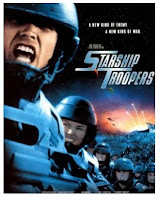
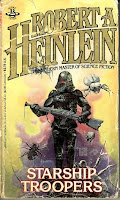 I realize I have been discussing a lot of Robert A. Heinlein's fiction on this blog, and I would like to justify it. I have a strong predilection for Heinlein's works, mostly because of his remarkable ability to blend philosophical topics and entertaining science fiction. After all, he did help found the genre of "classic" science fiction, and because of the nature of what he discusses in his works, Heinlein novels are the perfect topics for this blog. Anyway, on to business: today I would like to talk about some more of the political concepts Heinlein explores in Starship Troopers
 Today I am going to discuss some of the philosophical aspects of Robert A. Heinlein’s Starship Troopers

 I have briefly discussed the concept of MAD, or mutually assured destruction, here on this blog before. To review: during the Cold War, the US and the USSR followed a policy of “deterrence”—they realized that MAD would occur if either side attacked the other, so they tacitly agree to not take military direction against each other. But, as the Cold War proved, there are many ways to work around the policy of deterrence and MAD, as well as flaws in the theory itself.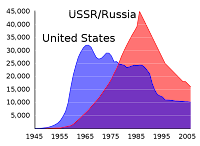
 Today’s post is very different from the philosophical topics I usually discuss here, but it is a somewhat pressing cultural issue so I believe it deserves mention.
 “Quiet! Your leader is going to speak now. Everyone turn off your mind.” –Chad Urmston