 To celebrate this post being the 100th ever published on this blog, I would like to spend today’s semi-humorous discussion talking about numbers. An interesting BBC article piqued my interest on a number-related subject, and I would like to share what I read. I am pleased to report that “trillion” has surpassed “billion” as the really big number that people have a hard time grasping. One trillion, also known as a million millions, was once a number only astronomers used. But today we find ourselves using it more than ever, and not usually in positive ways: take the US national debt, for example: $11,000,000,000,000. Or the national deficit: $1,750,000,000,000. And remember when “millionaire” signified a person with unlimited riches? It turns out that there are over 10 million millionaires in the world today, making the term somewhat obsolete.
But the problem with this is that the human mind has some difficulty grasping the sheer magnitude of one trillion. “Trillion” is not a number we use in our daily lives, and until recently it was barely spoken of at all. As Kevin Connolly of the BBC puts it: “It is hardly surprising that politicians and pundits on American discussion programmes often jumble up the millions, billions and trillions - we are still in the process of adjusting to a frightening order of magnitude.” Trillion is just such an astronomical number that it is very difficult to use casually, and it makes it very hard for us to come to terms with concepts like the national debt.
Is there another way to look at a trillion to make it more understandable? Possibly: a trillion is a million millions, or a billion thousands, or 10 to the 12th power. But this doesn’t really convey the awesome size of one trillion—here is a more practical example: Imagine you have a trillion dollars, and you decide to spend one billion dollars every day. It would still take you 1000 years to spend all of your money. This is why I stand in awe whenever the government is talking about recovery plans that require trillions of dollars—it’s easy to forget just how much one trillion is, and when we are reminded it often comes as a shock.
What’s next? The quadrillion, apparently, which is a billion millions or 15 zeroes. I admit, I had to look up the next term, quintillion, which has 18 zeroes. But hopefully inflation (or the national debt) will not force us to use those numbers anytime soon.


 Sorry, “
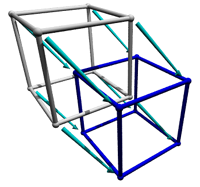 I find it extremely amusing that this series, which is now tied with the “law and order” series for the most posts, is about math. I am by no means a math-oriented person. However, as I have said before I find this topic fascinating, and for that reason I feel it deserves this many posts. But I’m digressing. The point is: today’s post will cover the following in topics in four dimensions: water and islands. If you have not read posts 2, 3, and 4 in this series, please do so before reading this one.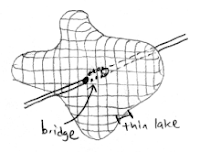
 For the past two days I have been talking about the fourth spatial dimension and its implications. Today, the series continues with four-dimensional levitation, rotation, rolling, and truncation. If you have not read parts 2 and 3 of this series I strongly recommend doing so, and reading part 1 wouldn’t hurt either. Otherwise, today’s post is probably going to be very confusing.

 Last time, I explained the concept of the fourth spatial dimension and a few applications of it. Today, I would like to discuss more of what the fourth dimension would be like. I advise against reading today’s post without reading yesterdays, and reading part 1 of this series is also advisable, though not as necessary.


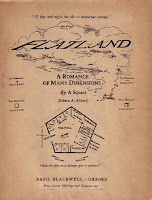 Today I would like to talk about Edwin Abbot Abbot’s famous 1884 science-fiction novel Flatland