Sunday, March 15, 2009

Jon Stewart on CNBC

I can honestly say I have never seen Jon Stewart angry before. The hilarious host of Comedy Central’s “fake news” program The Daily Show occasionally gets frustrated or annoyed by certain current events or guests on his show, but until the other day I had never seen him truly outraged.

Here’s what happened: On March 4, Stewart did a 5-minute Daily Show segment bashing CNBC and some of their news anchors. In the first few minutes, Stewart lampooned several of them for not seeing the obvious signs of the recession, particularly after Lehman Brothers crashed. He then showed clips of CEOs of financial firms on various CNBC shows, such as the CEO of Bear Sterns, talking about their company’s financial situation. These CEOs were obviously lying and several of their statements, but the CNBC anchors did not pursue the issue. Stewart concluded the segment by blaming CNBC for “dumbing down” finance news and making people believe their investments are somehow unaffected by what is going on in the stock market.

The show unintentionally sparked a small media frenzy. On CNBC, various anchors were lashing out at Stewart’s portrayal of their news station, calling him an “entertainer” and a “fake. ” CNBC’s Jim Cramer took it very personally, and he appeared on various CNBC shows (in addition to his own) to bash Stewart alongside his fellow anchors. Even Martha Stewart joined in—she jokingly told Cramer on her morning cooking show to hit a piece of dough with a rolling pin and pretend it was Jon Stewart’s head.

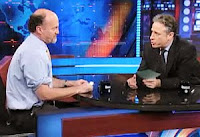
Then, on Thursday, the unthinkable happened: Jim Cramer appeared as a guest on The Daily Show. The interview came to dominate the entire episode, with Jon Stewart grilling Cramer about various financial topics. If you haven’t seen the interview, I recommend watching it here. For the first time, though, Stewart was legitimately angry. His typical routine of insulting his guest and then hiding behind the guise of being a comedian was gone—Jon was arguing and debating with Cramer, aggressively and seriously. 

In addition to shaming Cramer by bringing up embarrassing details about his past, Jon Stewart made a one point I would like to discuss. First, he blamed CNBC as a whole for simplifying financial news and not reporting what was really going on. As evidence, he showed the introduction to Jim Cramer’s show, Mad Money, which depicts Cramer as a mock Christ-like figure, along with clips of Cramer on Mad Money using various props and yelling at the camera for emphasis. He went on to replay clips of CEOs lying on various CNBC shows. Lastly, he blamed CNBC for perpetuating the illusion that there are “two markets,” one that holds people’s long-term investments and the other that is the stock market. Instead, says Stewart, CEOs went on “Sherman’s marches through their companies financed by our 401(k)s,” and CNBC said nothing.  

Here I agree with Jon Stewart—CNBC has not really analyzed the financial as much as their should, and they did not really get to the bottom of certain stories that the public deserved to hear. But I do disagree with Stewart’s claim that they should have predicted the financial crisis—though it was 10 years in the making, it took many people by surprise.

But what should CNBC really be doing? What is their responsibility as the sole reporter of financial news on cable television? According to Stewart, it should be to stop dumbing down their programming and do serious analysis rather than recommending certain stocks and interviewing CEOs. Though this is a noble goal, remember that CNBC does have to stay in business. If their programming is no longer entertaining as well as informative, their ratings will drop drastically. Rather than become a financial C-SPAN, CNBC needs to change its format to something like one of the “Big Three” networks: news-desk style programs rather than financial advice shows like Mad Money. Hopefully this format, which has kept the major networks alive can allow CNBC to better educate views while maintaining its ratings. 

Friday, March 13, 2009

Death of the GOP?

Is the Republican Party on its deathbed? 

Interestingly, a few years ago this question would have seemed silly. But today I think the question is a legitimate one that deserves serious analysis.

The answer is most likely very dependent on how the financial crisis is resolved. If President Obama’s stimulus plan works, it will mean a huge blow to fiscal conservatism. The days of Alan Greenspan and “Reganomics” will no longer be looked at with nostalgia. The Democrats will undoubtedly rub this in the Republican’s faces, Republican Congressmen who are currently in opposition to the plan will not be thought highly of. Obama will certainly be re-elected, and I would not be surprised if several more Democratic Presidents are elected after him. But if the plan fails, Republicans might have a chance at rebirth. The GOP use Obama’s failed policies as a campaign tool that would probably win them many seats in Congress and possibly the Presidency in four years.

However, the economy is not the only variable in this equation. Social conservatism, an extremely important tenet of the Republican Party, may very well be on its last legs. I am not suggesting that the movement is going to die out, but I believe that the majority of Americans will no longer consider themselves social conservatives or vote for an overly conservative candidate. The best example that comes to mind is former Vice Presidential candidate Sarah Palin, whose popularity rating was around 30%. Palin’s radically conservative views repulsed most Americans, particularly her anti-intellectual sentiments. However, the social conservative base rallied around her views, despite the fact that they are at odds with those of many other Americans. Also, immigration and globalization are rapidly changing the face of American values. Latino immigrants are more likely to be liberal and vote Democratic, increasing the liberal majority by a significant amount. Also, the GOP’s current leader, Michael Steele, called for numerous reforms as a part of his wants to make the Party more attractive to the average American. If he succeeds, he may end up killing social conservatism as we know it. (On a humorous note: Steele said he even wanted to make the GOP attractive to “one-armed midgets.”)

Finally, the GOP currently lacks any semblance of strong leadership. Michael Steele is essentially a figurehead, and I suspect that many conservatives will work against he attempts to give the Party a “hip-hop makeover.” On the other hand, a very dangerous individual’s influence is waxing, so much so that conservatives everywhere are apologizing for any negative comments they may have said about him previously. I am talking, of course, about Rush Limbaugh. Even Michael Steele was forced to apologize to Rush after calling him “an entertainer.” Rush is a radical social conservative, and one of the most hard-line right wing authoritarians I have ever seen. In the future, Rush may be a rallying point for conservatives, but the media’s denouncement of Rush may hurt his popularity in the country overall. In other words: though Republicans may rally around him, centrists and liberals will do everything they can to stop him.

So is the Republican Party dead? Not yet, but if Obama fixes the economy they may hit they lowest point in decades. Though I am a Democrat, I do not welcome the GOP collapsing: a one party system makes government far more efficient for my taste. A two party system offers just enough impediments to government to create a balance of limited government and strong government. 

Tuesday, March 10, 2009

Trillion: the new billion

To celebrate this post being the 100th ever published on this blog, I would like to spend today’s semi-humorous discussion talking about numbers. An interesting BBC article piqued my interest on a number-related subject, and I would like to share what I read. I am pleased to report that “trillion” has surpassed “billion” as the really big number that people have a hard time grasping. One trillion, also known as a million millions, was once a number only astronomers used. But today we find ourselves using it more than ever, and not usually in positive ways: take the US national debt, for example: $11,000,000,000,000. Or the national deficit: $1,750,000,000,000. And remember when “millionaire” signified a person with unlimited riches? It turns out that there are over 10 million millionaires in the world today, making the term somewhat obsolete.

But the problem with this is that the human mind has some difficulty grasping the sheer magnitude of one trillion. “Trillion” is not a number we use in our daily lives, and until recently it was barely spoken of at all. As Kevin Connolly of the BBC puts it: “It is hardly surprising that politicians and pundits on American discussion programmes often jumble up the millions, billions and trillions - we are still in the process of adjusting to a frightening order of magnitude.” Trillion is just such an astronomical number that it is very difficult to use casually, and it makes it very hard for us to come to terms with concepts like the national debt.

Is there another way to look at a trillion to make it more understandable? Possibly: a trillion is a million millions, or a billion thousands, or 10 to the 12th power. But this doesn’t really convey the awesome size of one trillion—here is a more practical example: Imagine you have a trillion dollars, and you decide to spend one billion dollars every day. It would still take you 1000 years to spend all of your money. This is why I stand in awe whenever the government is talking about recovery plans that require trillions of dollars—it’s easy to forget just how much one trillion is, and when we are reminded it often comes as a shock. 

What’s next? The quadrillion, apparently, which is a billion millions or 15 zeroes. I admit, I had to look up the next term, quintillion, which has 18 zeroes. But hopefully inflation (or the national debt) will not force us to use those numbers anytime soon.

Monday, March 9, 2009

China: still a threat to democracy

Previously I discussed China being a threat to democracy because it refuses to address human rights issues and set a good example for the nations around it. But because of the economic crisis, shifting populations and some current events, China’s authoritarian threat is even greater than ever.

China recently pledged itself to “never adopt a Western-style democracy” (see here). Worse still, they have refused to accept any liberalization at all—instead, they vowed to strengthen the Communist Party’s leadership. I suspect the Communist Party will stay true to this statement—as a ruling body, they have little to gain by Westernizing.

The economic crisis will also affect the situation. The downturn will slow down China’s huge growth, causing many migrant workers to lose their jobs. This, as the BBC suggests, will cause social unrest and possibly protests. If this occurs, it will not cause the government to weaken but instead will provide an excuse for more human rights and privacy violations. If China’s economy suffers even worse than expected, they may increase the size of their military or resort to protectionism, which could seriously damage the many countries (especially the US) who purchase goods from the Chinese.

The fact that China possesses more than one-fifth of the world’s population will also come into play. China is very dependent on the rest of the world for food, and as their population increases this may come to hurt them economically and structurally. Remember the food riots in the Philippines last year? If a similar food shortage happened in China, much larger and much more severe riots would break out. This, too, would cause China to revert to an even more authoritarian stance. If the population problem continues to worsen, China may even go to war with some of the surrounding nations for resources, or at least threaten them until they give China what they want.

So how can the West—and the rest of the world—protect itself from the overshadowing threat to human rights and democracy that is China? Unfortunately there are very few options. Though China may be changing their economy to a slightly more capitalistic system, they are not liberalizing. Western nations cannot really threaten then militarily, as China possesses a considerably large standing army, and the UN cannot pressure China because it is on the UNSC. The only road to change may be though Chinese culture, which is becoming more and more Americanized. Hopefully this influence will permeate throughout Chinese culture and make it more democratic. With luck this will increase the pressure on the government to Westernize or possibly influenced the government directly. Beyond that, though, there is little the West can do to stop China. For the time being China is on the rise, and there is little the West, whose influence is fading, can do about it.   

Saturday, March 7, 2009

American fascism

No, I’m not suggesting that the US government is fascist. But I would like to speculate on what it would take for the US to lapse into fascism. Though I am not concerned it will happen, I think it would be interesting to discuss.

To fully examine this problem, we should first look at what caused the rise of fascism in other nations. The best three examples I can think of are Germany, Italy, and Japan during the early 1930’s. I believe that the ascent of fascism in these states was caused by three classes of factors: economic, political and cultural.

The economic aspect is probably the easiest to analyze: all three countries were in a state of abject poverty before the fascists took power. In Germany, at least, this was directly related to the appeal of fascism: Hitler promised a “National Socialism” (which was nothing like Marxian socialism) to fix the German economy. Italy had a similar situation, and Japan was lacking in natural resources and needed economic expansion. This need for more natural resources would have fitted in perfectly with the fascist principle of imperialistic Social Darwinism, making fascism economically ideal for the Japanese. 

The political aspect requires a brief look at the post WWI period. In Germany, the treaty of Versailles had crippled Germany’s economy by demanding huge reparations, and many important areas of the German Empire—Poland, the Rhineland, Danzig, the Sudetenland—were under Allied control and were then allowed to become autonomous. Fiercely nationalistic Germans in these areas and in Germany demanded that the territories be returned to Germany, and many others wanted revenge against the Allies. Hitler must have seemed extremely desirable to both of these factions, as he promised to encourage more defense spending and expand Germany’s military. In Japan, the Showa movement was nationalistic faction devoted to the destruction communism, socialism, anarchism, etc. The organization played on similar national sentiments, vowing to instill a sense of nationalism and patriotism to Japan; group eventually evolved into Japan’s fascist government. In Italy there was something of a power vacuum—many were afraid of a communism revolution, and the fate of the country was uncertain. Mussolini promised a strong (and anti-communist) government, which must have  been very appealing to worried Italians.

The cultural aspect is the most intangible but perhaps one of the most important. In Germany and Japan the cultural aspect was obviously significant: in Japan, most Japanese people revered their ruler and treated him like a god; in German Hitler aroused anti-Semitic sentiments to unite the German people. Additionally, the Japanese saw their race as the Asian “master race,” a concept similar to the German superiority complex of the time. In Italy the situation was a bit different: the public supported Mussolini’s “blackshirts” because they were the only ones able to defend the country from the hated pro-labor liberals, including communists, socialists, trade unionists, and anarchists. However, the recurrent theme is that in all three countries the ascending government was able to use the culture of the society to facilitate their rise to power by improving their appeal.

So, what can this tell us about the possibility of American fascism? Right now, at least, America is safe from a totalitarian threat: America is not suffering from serious economic woes (compared to those of the 30’s, I mean), its government is secure and has a high approval rating, and there are no cultural constructs that challenge the current democratic system. However, it is possible that if the economic situation worsens fascism might seem to be a more desirable option, at least to some.

For example, if the economy worsens severely, Americans might become more sympathetic to economic policies that involve government intervention. Also, many Americans would want a stronger justice system to combat the crime that usually goes along with a depression. Additionally, if religious fundamentalism increases, this could provide a platform for a right-wing authoritarianism leader.

But remember that the cultural factors are clearly against fascism. Americans are strictly opposed to anything that limits their natural rights. We are obsessed with democracy, and fiercely proud of the fact that we are a democratic nation. Also, we still vividly remember the WWII years, in which we saw the horrors that fascism created.

Because of this, I am not sure that American fascism could ever develop. If it does, however, it would have to be many years in the future, since it would take a lot of time for fascism ideas to catch on in such a democratic nation.  

Thursday, March 5, 2009

Communism: insufficient data

Americans are quick to point to Russia and China as examples of why communism and socialism cannot function on a large scale. However, I believe that Russia and China are not qualified to be considered case studies for communism, for reasons I shall explain.

The main reason Russia is not a sufficient example is very simple: Stalinism. When the Soviet Union began, Russian politicians such as Stalin and Lenin transformed the Soviet Union into something Marx would never have approved of. They crushed liberalism and suspended human rights, turning the country into a dictatorship in the name of prosperity. What Stalinism created was communism, but not in the liberal, democratic form Marxism envisioned. 

Also, note Russia was forced into communism—it did not develop naturally according to Marx’s theories. Marx believed that eventually the proletariat would revolt against capitalism and form a socialist republic. Eventually this would turn into a communist entity simply because Marx believed the latter is more efficient. In Russia, though, this did not occur: after the Revolution the nation was forced into communism.

In China, the situation is a bit different. Though the Chinese government is known for its human rights violations, its governmental philosophy is not nearly as “Stalinistic” as Russia’s. However, they too were forced into communism, negating Marx’s predictions on how communism would arise. Additionally, China is incorporating many capitalist aspects into their economic system, probably because of the necessity to trade with Western societies. Their system is no longer “pure communism,” which also indicates that it cannot be used as a case study for the economic validity of communism.

Because of these factors, we cannot consider Russia or China as case studies for communism, nor can we dismiss communism as a political theory because of the USSR’s collapse. Instead, we must look at smaller examples. I would like to take a moment to discuss a few of these:

The most successful applications of Marxist theory I can think of are the Israeli kibbutzim. These are small socialistic/communalistic communities, usually in rural areas. The residents of a kibbutz often reside in a single, communal living area, and most of them are employed in producing the main product that the kibbutz sells. Kibbutzim are remarkable successful, and they certainly prove that socialism is very efficient in small communities. They also lend some support to the Marx theory of “natural communism,” though I would not consider them alone a proof of this.

The next example is Cuba. Like Russia, Cuba was forced into communism, and like Russia, Cuba is lacking in the liberalism that Marx stressed. However, Cuba’s isolationist policies do make is something of an example of communist economics, and the results are not pretty. Though Cuban communism does have positive aspects, such as healthcare, much of the population is unable to rise out of poverty.

So for now I am holding my evaluation of communism and socialism until a time when we have more concrete examples. However, one trend is clear: communism and socialism often lead to obsequious, servile state-worship, which in turn often leads to unexpected negative consequences. But in terms of evaluating economic prosperity we will just have to wait until someone tries again.


Wednesday, March 4, 2009

One step forward, a million steps to go

In today’s second post, I am going to briefly discuss the International Criminal Court’s arrest warrant for Omar al-Bashir, the President of Sudan.

The ICC proclaimed that the President was guilty of numerous crimes against humanity, most of them relating to Darfur. They called on Bashir to surrender to the UN, and asked any country he visits to detain him. The US State Dept. and the EU gave the ruling full support, and UN Secretary-General Ban Ki-Moon urged Sudan to cooperate as well. Human rights groups celebrated as well, declaring the day a "victory".

Bashir’s response was quite predictable: he refused to acknowledge the ICC’s decision, and has blatantly stated that he will not cooperate with the warrant or with the UN. He has scorned the UN and the ruling, and he will almost certainly not surrender to the ICC. Bashir then proceeded to call the ICC a “neo-colonialist” organization that has no right to arrest him. Interestingly, Egypt has sided with Bashir, and has called for an emergency meeting on the UNSC to “defer implementation” of the ruling. Also, the AU (African Union) stated somewhat cryptically, “We support the fight against impunity. But we say that peace and justice should not collide, that the need for justice should not override the need for peace.” By this I assume that the AU is unhappy with the ruling but does not   

Though this is a step in the right direction, it is far from a resolution to the Darfur conflict. UN troops will continue their usual attempted “peacekeeping” effort, and the genocide will continue. Even if Bashir is apprehended, the conflict will not stop. Though Bashir is undoubtedly linked to the genocide, his arrest will not destroy the janjaweed, the poverty, the tribal structure of the region, or the racial prejudice that caused the Darfur situation in the first place. This would probably take serious UN or AU intervention, and intervention is an unrealistic hope because the AU never wants to get involved and the UN doesn’t want to take on such a big task. Besides, peacemaking would violate the UN’s current Darfur policy of peacekeeping.

I am not suggesting that the Western world is wrong to point their fingers at Bashir—he definitely deserves the ICC’s ruling. But he is not the main cause of the conflict, nor will his arrest change the political situation in Sudan. Some of the overly optimistic human rights groups seem to thing that a large portion of the conflict will end with Bashir’s arrest. Instead, this is only the beginning.  

One thing is sure, though: if Bashir is caught he will never be exculpated or released. That, at least, is some comfort. 

Adam Roberts on TMIAHM (2)

Today I am going to continue my discussion of Adam Roberts’ review of Heinlein's The Moon is a Harsh Mistress.

First, I would like to focus on the main theme of Moon, libertarianism. Roberts conclusion about Heinlein’s opinion of libertarianism is similar to mine: Heinlein clearly supports it, but in Moon he points out some of its flaws. At first, this conclusion seems a bit off-base—throughout the book, the narrator glorifies small government and personal liberties. However, I believe—as does Roberts—that Heinlein portrays it this way because the reader is supposed to realize that he is hinting that such a society is too to be true. This is similar to the approach he used in Starship Troopers: the narrator raves about the advantages of fascism and militarism, but Heinlein expects the reader to see through his false arguments. The same can be said of his approach to polygamy and group marriage in Moon: thought Heinlein believes in both, he pokes fun at certain aspects of group marriage by portraying it as too perfect.

In the first half of the book, Heinlein focuses on the libertarian revolution itself. Again, though the narrative voice glorifies the revolution, in reality it is far from romantic. The revolution is not libertarian at all—from start to finish two or three individuals control it. The revolution is carried out with much help from the almost omnipotent computer Mike, who is almost certainly too good to be true. Heinlein leaves out all the messy details of revolution—for the most part the revolution is bloodless and pain-free. In other words: Heinlein is showing us a caricature, a parody of real revolution.  The revolutionaries themselves are far less respectable under the microscope as well—at first they appear to be a merry bunch of romantic idealists, but a closer look reveals that they have more in common with terrorists.

Later on, this satirical theme is still present. The small gang of characters who organized the revolution creates a mock-up of a democracy while they silence all opposition. Anyone who attempts to interfere with their policies in Congress is dubbed a “yammerhead” and is silenced by their majority. They rig an election to re-elect themselves, while at the same time declaring their support for democracy. This is certainly not a libertarian government in any sense—it reeks of authoritarianism and oligarchy. Interestingly, Heinlein portrays the blatant authoritarian rule as benevolent—he shows how a group of super intelligent overachievers could rule society very efficiently. This odd contrast makes the overall message of the novel somewhat unclear. I agree with Robert’s analysis: Heinlein is taking “relocating the political dynamic [of libertarian revolution] to the twenty-first century.” It is a utopian satire, but Heinlein is not fundamentally opposed to the system he is criticizing. 

Tuesday, March 3, 2009

Adam Roberts on TMIAHM (1)

Though I’ve talked about it again, again, and again, but I can’t resist. By “it” I mean Heinlein’s The Moon is a Harsh Mistress, my favorite novel. After skimming through it again and reading a review and analysis by the literary critic Adam Roberts, I would like to discuss the political messages of Moon once again. The review can be found here for all those who would like to read it. Today’s post contains some plot spoilers, so if you plan on reading Moon recommend you wait and read this afterwards.

Roberts also discusses racial equality as a major message of Moon. Like in many of his other books, the main character is revealed to be a “person of color” about halfway through, after the reader already likes him as a character. Heinlein satires American racism, highlighting it with Kentucky’s violent reaction to the main character, a person with a “range of color” in his family.  Lastly, Roberts points out that Heinlein ends the novel with a “person of color” pressing the button to destroy American cities. This is quite radical for 1966, and people reading it back then probably felt differently about the ending than we do now. This is probably emphasized by the fact that Heinlein describes ending with gusto and panache—it probably comes off as somewhat offensive for less progressive readers.

Roberts then goes on to compare the revolutionary war in Moon to the Vietnam War. Roberts writes, “the whole scenario of a war between Earth (a large, populous, technologically-advanced world) and the Moon (a small, technologically-backward nation of farmer struggling for independence) presents a penetrating commentary upon the international events of 1966.” Roberts is obviously talking about the Viet Cong. Viewed this way, some of the events and quotes have a new, double meaning. Many of the Luna revolutionaries believe that Earth can destroy them, but if the revolutionaries make it look like it will be difficult to do so perhaps Earth will back off. Heinlein also uses the Moon’s lower gravity as a metaphor for the US being unprepared for Vietnam—in the novel, the soldiers from Earth struggle with the new gravity and are ambushed by the Moon-dwellers before they have time to adapt. This analogy is extended even further when Heinlein explains the difficulty the Earth armies have of finding the “Loonies” in their underground caverns—very similar to the difficult the Americans had locating the Viet Cong. Also, there is much discussion of the way news is broadcast on Earth—the media on Earth condemns the Lunar colony when they kill civilians in the war (which they did out of necessity) but it ignores the fact that they, the peoples of Earth, are trying to do the same thing. Though I doubt Heinlein had too much sympathy for the Viet Cong, Moon does put the war in a different light by showing us the war from the opposite perspective.

Roberts also points out that many of the other events in Moon speak out against the average American’s “Americanocentric” views of the time. To the Lunar colony, America is the main force that stands in the way of independence; rather than being portrayed as spreading freedom, the US is shown as an imperialist/colonialist power. Says Roberts, “Independence and freedom for Luna is not code for 'independence and freedom for America', but rather 'independence and freedom from America'.” Interestingly, this is contrasted by many of the book’s parallels to the American Revolution—the characters quote Thomas Paine, Jefferson, and Patrick Henry, draft a Declaration of Independence and Constitution, and have a very 1776-like issue with taxation. However, this is probably just because Heinlein is using this to prove is point that a true libertarian society exists along the frontier. As he hints at the end of Moon, even the Moon is becoming more and more populated and a more centralized government is evolving. Like Marx, Heinlein is hinting that history follows something of a pattern—but for Heinlein, who believes that libertarianism is ideal, this is a vicious cycle: libertarian societies exist only for short periods of time, and then the frontier moves again.

Tomorrow I will conclude this series with an analysis of Robert’s take on Moon’s main theme, libertarianism. 

Monday, March 2, 2009

What happened to libertarianism?

Ironic as it may sound, American conservatism has changed a great deal, and today it is radically different from its American Revolution-era predecessors. Originally, conservatism was very Jeffersonian: it stressed small government, agrarian societies, and social libertarianism. Though it had its roots in Christianity, American conservatism did not include any kind of moral reform or social control. Today, though, conservatism has gone in the opposite direction: today’s conservative leaders advocate Amendments to the Constitution (or laws that could be interpreted as violations thereof) to promote Christian influence and enforce moral rules as law. In other words: the movement has taken on a repressive, moralistic edge that is the complete antithesis of its libertarian beginnings. Don’t believe me? Look at today’s conservative leaders. For example, leading conservative commentators Rush Limbagh and Sean Hannity both preach excessive social control and religious influence in lawmaking. Former Vice Presidential candidate Sarah Palin, seen as a role model for neoconservatives, was famous for her rejection of Roe v. Wade, support of school prayer, and overpowering emphasis on the traditional family structure.

Furthermore, conservatism in the US has taken on an anti-intellectual edge. Conservative commentators reinforce the image of a “liberal” as an intellectual snob, This probably stems from the fact that intellectuals are often seen as challenging religious fundamentalism, especially in the ongoing debate over evolution.  As Sarah Palin proved, many conservatives consider it a virtue to lack an extensive education and mock those who do have one.

This begs the question “What prompted this radical change?” Part of the answer probably has to do with the fact that in recent years America has strayed from traditional values more than ever before. Today, the population is becoming increasingly more diverse—in many areas, whites are now in the minority. Likewise, the culture of America is straying farther and farther away from traditional values—homosexuality is becoming more accepted, feminism continues to challenge traditional standards, and religion’s influence in the public sphere is declining faster than ever. In short, America is quickly becoming a Mecca for cultural exchange and new thinking. I suspect that for many fundamentalist thinkers, this is too much change in too short a period of time. Thus, conservatives are becoming more outspoken about their beliefs rather than being blasé about the “liberal bias” in American culture. Also, remember that when libertarianism was popular (back in 1776), American culture was more homogenous, and there was great animosity toward the religious-based laws of Great Britain that discriminated against some American denominations. Hence, libertarianism. But today, as I explained, we have the opposite setup.

 The rest of the answer most likely has to do with conformism. Since the 1950's and 60’s, American youth has taken on its own kind of culture, which is mostly a culture of rebellion against the traditional. This, too, has angered fundamentalist thinkers, who see moral control as the only way to combat this noisome cultural rebellion.

The overall result is what psychologists term RWA (right-wing authoritarianism), which is the new face of American cultural conservatism. Sadly, this desire for social control is not only malevolent towards the kind of diversity that is necessary in today’s world, but also harmful to conservatism itself. The more fundamentalist the Republican Party and conservative movement becomes, the more it alienates centrist thinkers. This, in turn, may end up sabotaging the conservative movement for many years to come. 

Sunday, March 1, 2009

Skepticism and the scientific method

As I have mentioned before, I am something of a Pyrrhonian skeptic. Today, I would like to discuss the differences between pyrrhonism and the scientific method, as well the effects of this difference.

In many ways Pyrrhonian skepticism and the scientific method are quite similar. Both teach that human beings are small, Lilliputian creatures in a big and mysterious universe. Both embrace the unknown, asking people to search for answers amid uncertainty.

But beyond that, the two philosophies are radically different. The first main difference has to do with absolute truth. Pyrrhonism rejects the idea of absolute truth, stating that nothing can be known with absolute certainty. The scientific method, on the other hand, holds that absolute truth can be uncovered with experimentation. Science claims that the universe is a logical one, and certain truths can be uncovered by logic and reasoning (skepticism rejects this analysis, since the universe is not necessarily logical).

The other central difference between skepticism and the scientific method has to do with one of the later additions to the list of key principles of the scientific method, Occam’s Razor. This is the idea that if one is presented with multiple hypothesis, the simplest one is the one that should be considered the most credible. Occam’s Razor has its roots some of the writings of Thomas Aquinas. In one of his works, he states “If a thing can be done adequately by means of one, it is superfluous to do it by means of several; for we observe that nature does not employ two instruments where one suffices.” Pure skepticism rejects this analysis, since the complexity of a hypothesis is not necessarily related to its validity. Also, Occam’s Razor includes the elimination of hypotheses that are contrary to common sense. Skepticism rejects this analysis as well, since “common sense” is subjective and the popularity of a hypothesis may or may not be related to whether it is true. On a related note, the scientific method holds that an experiment should be able to replicated and any other scientist should be able to achieve the same result. (Skepticism rejects this claim as well.) 

So, are the scientific method’s divergences from skepticism strengths or weaknesses? Are they what has carried science this far, or are they foibles that have prevented science from reaching even further? I suspect that the answer is a little of both. Pyrrhonian skepticism’s rejection of absolute truth would make science grind to a halt if it were a part of the scientific method. This rejection absolute truth would also contradict the scientific principle that experiments can always be replicated, which would make experimentation pointless. Science needs some level of common sense, since it assumes philosophical Realism and Infallibilism (otherwise there would be no point to truth-seeking).

But Occam’s Razor is another matter—I believe that this principle has actually slowed science down. The main reason for this is that the definitions of “common sense” and even “simplest hypothesis” are dependent on cultural factors and religious beliefs. For example, in Galileo’s time the “simplest hypothesis” was that the Sun rotated around the Earth. Today, the scientific community often uses Occam’s Razor to shun hypotheses that seem unlikely or unpleasant to them, even if such hypotheses are plausible. Though science needs some level of common sense, Occam's Razor is going too far.