Showing posts with label movies. Show all posts

Tuesday, April 7, 2009

Philosophy in "Watchmen" (part 1)

Today I am going to discuss some of the subtle philosophical and political commentary in Zach Snyder’s film adaptation of the Alan Moore graphic novel Watchmen. If you haven’t seen the film, today’s discussion probably isn’t going to make much sense.

First, I’d like to look at some of the characters. Not surprisingly, each has his/her own extreme philosophical viewpoint, and it is these contrasting beliefs that make the film so interesting. (I say not surprisingly because Alan Moore often includes philosophy in his works, such as in V for Vendetta.) Let’s look at the characters and their views one by one.

Ozymandias: utilitarianism. Ozymandias is a classic example of utilitarian ethics. He is obsessed with the “greater good,” and had devoted himself to creating peace on earth. At the end of the film, Ozymandias destroys most of the world’s major cities to prevent the Cold War from resulting in a nuclear annihilation. In other words, he is “killing millions to save billions”—a textbook example of utilitarian morality. Likewise, Ozymandias has no moral qualms about killing off his fellow Watchmen because he is working for the greater good. Specifically, Ozymandias is an act utilitarian—he does not believe in any specific code that brings about the greater good; he believes that any action that maximizes utility is moral.

The Comedian: nihilism. Edward Blake (alias “The Comedian”) is a nihilist, at least in part. He sees the universe as random and chaotic, and states repeatedly that human nature is animalistic and chaotic. He laughs at the fact that humans are smart enough to build nuclear weapons, since they will probably lead to man’s destruction. Blake’s actions certainly reflect his nihilistic attitudes: in a sequence of flashbacks, he is shown gleefully gunning down Viet Cong in the Vietnam War, killing a pregnant woman, and shooting a crowd of protesters. However, Blake is not completely nihilistic in that he still cares for his own life and the lives of many others. Though he laughs at the inevitability of nuclear war, Blake still worries that Ozymandias’s scheme—which involves mass killing—will come to fruition.

Rorschach: moral absolutism. Rorschach, the film’s central character, is a paranoid conservative moralist, as evidenced by his narration of the film and by his actions. He believes in a clearly defined good and evil and that evil should be punished and destroyed. For the most part, his morality is act-based: an action is automatically good or automatically evil, even if it is well intentioned or brings about good results. Rorschach repeatedly affirms his hatred for what he considers to be immoral behavior, and repeatedly murders criminals mercilessly. At the end of the film, he refuses to submit to Ozymandias’ benevolent regime, and condemns his actions, which Rorschach sees as mass murder. Rorschach is also politically conservative—he states several times that he hates communists and people with “liberal sentiments.”

Dr. Manhattan: anti-anthropocentrism. Dr. Manhattan is one of the more bizarre characters in the film. After an incident in a nuclear research lab, Dr. Manhattan (as he is renamed) is given godlike powers, including the ability to manipulate matter in any way he likes. However, these powers also serve to isolate him from society—as the plot progress, he begins to distance himself from people more and more, eventually resulting in his self-exile on the barren surface of Mars. Manhattan is oddly anti-anthropocentric, his knowledge of the universe bringing him a strange sense of humility. He states at one point that the desolate surface of Mars “gets along fine without life.” He feels almost no sympathy for other human beings or for human suffering, stating that “a dead human being has the same number of atoms as a live one.” I have difficult coming to terms with this mentality—it is hard to understand what Manhattan means by a barren planet “getting along fine.” But that’s a discussion for another day. 

Later today I will examine some the film’s political commentary. 

Friday, February 20, 2009

On revisionist history

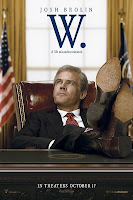
Yesterday I saw Oliver Stone’s recent movie “W.” The film chronicles the life of George W. Bush from his early days to the decision to invade Iraq. The movie was quite entertaining—thought it was almost two and a half hours long, the interesting portrayal of Bush and his advisors kept it from being soporific. However, like some of Stone’s previous works, the film reeks of revisionist history. Stone deliberately inserted some of Bush’s more embarrassing quotes into the film, often out of context. He certainly took liberties in depicting the Bush family dynamic—several of the Bushes criticized the film for this, in fact. He also included several scenes featuring confidential meetings between Bush and his advisors—the details of these are obviously unknown, so it is clear Stone made them up for the film. Overall, the film definitely has something of an anti-Bush bias—George W. is portrayed as bumbling, clueless, and overly dogmatic.

But today’s post is not just about beating up on Oliver Stone—I would like to talk about the dangers of revisionist history in general. Like “W,” much of the American media has become politically charged. Conservatives point the finger at liberal elites and the so-called “liberal media”—though they do have a point there are conservativism-based news broadcasters as well as liberal ones. But regardless of which side manipulating the facts, the fact is that the media is often not as neutral as we would like to think. And I don’t just mean news stations—as I showed with “W.” the deep divide between Democrats and Republicans has infiltrated all corners of our media. Perhaps worst of all are the films and television shows that, like “W,” pose as truth but are actually fiction. I have the same complaint about the “docu-drama,” a new genre of television that twists the facts about historical events for entertainment purposes.

Overall, revisionist history is dangerous, in both the long term and the short term. In the short term, it manipulates people’s opinions about a person or thing for false reasons. This is obviously the intent of such material in the first place; I am sorry to admit that it often works. In the case of “W,” the film probably cemented many people’s anti-Bush feelings for the wrong reasons. In the long term, too, revisionist history is dangerous. When future generations look back on our era, what they will see in our media is not the truth but fabrication; the real truth will be lost in time because our politically-charged media does not bother to cover it.

But what can we do about this? Very little, it seems. The spirit of partisanship has cemented itself in American politics and in the American media, and there is little the average person can do. I read the BBC news, as I have mentioned before, but I am not solving the problem by doing so—I am merely circumventing it, though only temporarily and to a certain extent. For now, we can merely hope that the US will someday rise above the petty partisan squabbling and resume reporting the truth. 

Wednesday, January 14, 2009

On “Paths of Glory”

Yesterday I saw the 1957 Stanley Kubrick movie Paths of Glory. This film is a compelling drama centered around the court-martial of three French soldiers during WWI. I found the film fascinating and gripping, and I would like to discuss some of its themes here today.

I would first like to summarize the plot of the movie. The first half-hour was a bit slow, as it focused on introducing the characters. These include an egotistical General Mireau, a pragmatic Colonel Dax (Kirk Douglas) and several other military persons. After this, the drama begins to start. Pressured by the French army commanders, Mireau orders Colonel Dax to lead an obviously suicidal assault on a German position. The attack is a disaster, as the French are greatly outnumbered. Mireau, however, blames the attack on the cowardice of the French troops. Near the end of the attack, Mireau tries to order his artillery to fire on his own men in order to get them to move forward despite facing a fortified German trench. The artillery commander refuses, and the troops refuse to advance, causing the attack to fail. In order to “teach the men a lesson,” as well as clear himself of any blame, he orders a military court-martial, asking his lieutenants to select three men to be tried for cowardice. Three men are selected, but not for any legitimate reasons: one is picked by his lieutenant because the two argued the day before, another is chosen because he is a “social undesirable,” and the third is picked by lottery. The trial that follows is a farce, albeit a dramatic one. Despite the fact that Colonel Dax (who has been made defense lawyer) is able to prove all three men innocent, the court disagrees and decides to execute them. Dax, who is the only character not trying to save his reputation, tries to convince Mireau to call of the executions, but he is unsuccessful; the three soldiers are killed by firing squad in a dramatic climax. Dax then reveals that Mireau tried to fire on his own men during the attack; the French military commanders publicly shame Mireau and discharge him, and then offer Dax a promotion for his shrewdness. Dax refuses and gives an ending monologue of lament at the cruel nature of the world.

Now, I would like to discuss some of the social issues hinted at in the movie. Like all Stanley Kubrick films, Paths of Glory contains a multitude of social criticisms. Paths of Glory has been interpreted as an anti-war film, but Kubrick stated that this is not how he intended it. Clearly, the film speaks out against authoritarianism and militarism, as is evident in its portrayals of true “military men.” Mireau, for example, is portrayed as sadistic, greedy, and naïve—he believes he is a “true soldier,” who cares about his men and thinks his ideals are noble. However, he is also shown as cruel, inhuman, and violent—he famously declares, “If those little sweethearts won't face German bullets, they'll face French ones!” Similarly, another general states “one way to maintain discipline is to shoot a man now and then.”

The film also criticizes over-patriotism—Mireau and some of the other officers claim to be acting “for France” and committing atrocities with patriotism as the justification. Likewise, none of the “good” characters are patriotic, especially Colonel Dax—he makes several negative comments about patriotism at several points in the film.

The movie also criticizes human nature as a whole through Colonel Dax’s horrified reactions to the war. From start to finish, he is sickened by both the greed and cruelty of the officers and by the brutality of the war in general. Additionally, the movie shows how industrialized warfare is just as brutal as what preceded it—as one of the characters pointed out, the machine gun, the new weapon of the time, can “cut you up better than a bayonet” and kill even more people than primitive weapons.

Surprisingly, Kirk Douglas received a lot of negative publicity for this film since it criticized the French. Later on, though, people have come to recognize this as one of his best films. For Kubrick, this was the film that propelled him to stardom—it marked the end of his “B” movies, as even though it was unpopular it was regarded as a piece of fine filmmaking. After this, he went on to create masterpieces such as 2001 and A Clockwork Orange.

If I had to give Paths of Glory a grade, it would almost certainly be an A+. It was a highly effective drama that contained a powerful social message that rings true all throughout human history. The acting and the filmmaking is top-notch, and as a whole the film is very compelling. I strongly encourage you to watch it if you haven’t already.