Wednesday, February 4, 2009

The elephant in the room

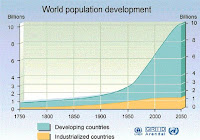
I recently read an article on the BBC News that I would like to discuss. The article talked about a topic I have mentioned here before, overpopulation. Specifically, the article discusses how talking about overpopulation has become something of a taboo with environmentalists because of the human rights issues involved. The article referred to overpopulation as “the elephant in the room” because it is so obvious but environmentalists continue to ignore it.

I hate to admit it, but this article brings up a profound point. Overpopulation is essentially the cause of almost all environmental issues; if the human population were smaller, the demand for natural resources and our pollution output would be significantly lower. However, I have never heard any environmentalist mention this issue. The reason for this probably does not have to do with human rights issues, though. In the US, at least, environmentalists are traditionally left-wing, and many of the measures suggested to combat overpopulation, such as limits on the number of children families can have, are typically unpopular with Democrats. Additionally, few people want to hear that the world’s environmental problems are caused by overpopulation; they would much rather hear that they can recycle and make everything better. Sadly, this approach only perpetuates the problem of overpopulation; if we want to solve it we first have to acknowledge it.

I would also like to talk about overpopulation in relation to global warming. The last time I talked about this, most of my predictions were based around the fact that the amount of arable land in the world does not change; however, climate change may change not only the amount of arable land but also its location. Regardless of whether global warming is man-made or natural, it will affect how we adapt to the coming overpopulation crisis.

Previously, I mostly ignored alternative methods of farming. However, I now realize that this was unwise—if we cannot accurately predict where the world’s arable land will be in the future, alternative methods of farming not reliant on climate are needed. Today, I would like to discuss a few of these.
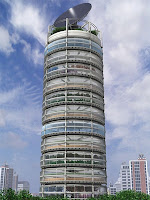
The first and most obvious solution is hydroponics. Hydroponic farming is nothing new—we have had the technology for years, but because it is so much cheaper to farm on land it has never been put to much use. Should global warming shift where the world’s arable land is, though, that may change. This could also be combined with what is known as “vertical farming,” an idea for farming in an urban area. As the name suggests, a large skyscraper is filled with crops, which are irrigated via pipes (the windows are enlarged to allow enough sunlight to get in). Also, both techniques could be combined with a “grow light,” a light placed above a plant to allow it to grow without sunlight. LED grow lights are cheap and easy to manufacture, making indoor or even underground farming a possibility. 

As for meat, scientists are working on a way to “grow beef without the cow.” Amazingly, it is possible to grow only a certain kind of cell from a cow in an isolated environment. This may make it possible to grow enormous vats of beef not only making slaughterhouses obsolete but also greatly increasing the efficiency of producing beef, reducing the time, labor, and air pollution involved in the process. If it is sufficiently developed, this technology could be a major tool in combating overpopulation. If a similar process could be applied to plants, crop-growing could undergo similar efficiency increases, greatly improving our chances of beating starvation.

But one thing is clear: we cannot continue to push this issue under the rug. We must develop these technologies soon, or else we will fall victim to the inevitable crash following the population boom that has come to define modern human history (the last 10,000 years). It may not happen in our lifetime, but when it does we must be ready. 

Tuesday, February 3, 2009

From Flatland to the fourth dimension (part 6)

Sorry, “law and order” series—this set of posts about the fourth dimension is now the longest, at 6 posts. Today I will cover the shape of the universe, wheels, and paper in four dimensions. Again, if you have not read the previous posts in this series, with the exception of #1, today’s post is going to seem even more confusing than it already is.

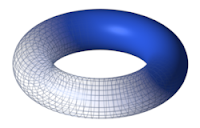
First, I would like to go into the shape of the universe in relation to the fourth dimension. Though there are several attempts to explain the shape of the universe, none of them have been completely proven, and the universe’s true shape is still unknown. It is possible that even if the universe is three dimensional is it “curved” four dimensionally, such as into the surface of a 4D sphere of cube. This seems difficult to visualize, but try an analogy: imagine a 2D ant living on the surface of a piece of paper. The paper can be curved, bent, or even folded but that ant would not know about it. Likewise, our universe can be curved in the same way. However, this might have some effects on exploration of the universe or our attempts to survey it. For example, our universe could be shaped like the surface of a 4D torus (doughnut). This is very hard to visualize, but think back to the analogy for a moment: consider what would happen if the 2D ant’s world were curved into the surface of a doughnut. The ant could walk in a straight line and actually come back to where he started (in several different ways—look at the shape of a torus).

Next, paper. In 3D paper is actually 3D as well, but for practical purposes it is 2D because we do not right on the “sides” of a piece of paper—not enough room. In 4D, then, paper is effectively three-dimensional. On a square 2D piece of paper, there are three paths from one corner to the others; on a 3D one there are six. Also, there are only four ways to cut a piece of paper symmetrically in half in three dimensions—in four dimensions, there are 8.

Lastly, wheels. A wheel in four dimensions is similar to a 4D torus, similar to the way a 3D tire resembles a torus. The area of a 4D tire that touches the ground, unlike a 3D one, is a plane; this means that if a 4D tire were rolling across the surface of our 3D world it would appears as if a thin rectangular prism were moving across the room. A 4D wheel as four directions to fall over, unlike a 3D tire, which only has two. Also, a four dimensional spherical tire (the 4D equivalent of a cylinder) has similar properties to a 3D cylinder—it has two directions to fall over into, but four to roll into. I realize all of this is almost impossible to visualize, but give it a try anyway.

This concludes the series on the fourth dimension for the time being. Tomorrow I would like to talk about some pressing current events that have happened over the past week.             

Wednesday, January 28, 2009

Who is John Galt?

I am going to postpone the series on the fourth dimension for one more day because I would like to talk about the book I just finished, Atlas Shrugged. I mentioned this briefly when I talked about some of Ayn Rand’s philosophies; today I would like to review the book (don’t worry, I won’t give away any plot details). 

The first thing people notice about Atlas Shrugged is that it is very, very long. And they’re right: the copy I read was 1,100+ pages, but the font was so small it probably comes out to about double that (I think my eyes are much worse after having read it). Unfortunately the length is complimented by the fact that there are huge sections that are almost unbearably boring, particularly in the first half of the novel. Atlas Shrugged is not light reading by any means, but that does not mean it is lacking in suspense—there are a multitude of scenes that are very captivating, it's just that most of them reside near the end of the novel, making the beginning boring.

Throughout the novel Rand lectures the reader, which some think detracts from the entertainment value of the book. To some extent this is true—her constant lecturing can be a bit annoying, but Rand’s ideas are the purpose of the novel in the first place, and I think the not-so-subliminal messages make it interesting. However, this message can get very repetitive, and the fact that the whole book is built around Rand’s philosophy does detract from both its entertainment value and its ability to be believed. At one point, just before the novel’s closing, one of characters launches into a 50-page lecture; this is the read “meat and potatoes” of the book, though it is incredibly boring as well. Almost all the characters are caricatures; they are either Rand’s heroes or her villains, either clearly “good” or clearly “evil.” As the novel progresses this becomes even more and more apparent; near the end of the novel the villains have become so pronounced that the plot just about lost whatever was left of its realism. Even in the names of Rand's villains is this obvious: the controller of the economy is Wesley Mouch, whose name is a clear reference to "mooch." Likewise, the President is Mr. Thompson, a reference to the machine gun commonly used by 1920's mobsters. Indeed, there are far too many characters, especially considering they can all be grouped into two factions. Also, the fact that some of the characters are introduced and then forgotten can become extremely annoying, as does the fact that the novel’s real main character is not introduced until the book is two-thirds over.

Of course, it is a must-read for anyone who fashions themselves an Objectivist or is interested in the works of Ayn Rand. The philosophy behind it is very interesting—even though I abhor Objectivism I found the concepts discussed very thought-provoking. Along with The Fountainhead and perhaps Anthem, Atlas Shrugged effectively describes the Objectivist philosophy and its applications. The Fountainhead uses Howard Roark to describe what Rand’s idea of a “prime mover” is; Atlas Shrugged shows how much the world needs Rand’s prime movers and what happens without them.  

My final word is this: read it if you feel you are up to the challenge. Atlas Shrugged is the kind of book that keeps you from reading anything else at the same time, due to the multitude of characters and plot details to remember. Also, I strongly recommend that anyone who reads it keep an open mind while doing so. After about 500 pages or so, what Rand is preaching suddenly begins to make more and more sense, mostly likely because by that point you have heard it over and over and have been reading about a fictional world in which it does work (I suspect that this is why the book is so long in the first place). Always think about what Rand has to say, do not treat it as gospel.  

I realize I never answer the question I asked in the title of today’s post, “Who is John Galt?” I’m not going to answer it entirely, as it would give away some plot details. I will simply say this: the phrase is an integral part of the novel, and each time you hear it it will mean something slightly different. 

Tuesday, January 27, 2009

Gaza: it’s not over yet

I would like to postpone the series on the fourth dimension for one more day, in light of a piece of world news I would like to talk about. The article in question can be found here.
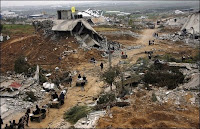
What does this mean? Simply that a ceasefire is far from a permanent truce. I suppose we knew that already—the Gaza crisis that just ended was a result of the previous ceasefire expiring. But I for one did not expect violence to erupt just yet; I figured it would be another few months at least until something happened.

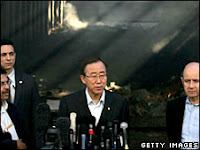
The article also mentions the fact that George Mitchell will be traveling to Israel soon. However, I think that this is pretty inconsequential; though the US and Israel are allies, I doubt we will be able to negotiate a truce. The tumultuous relations between Israel, Gaza, and the West Bank will continue as always, and there is little we can do about it. I will repeat what I have said before: the UN needs to act, and swiftly. Though Secretary General Ban-Ki Moon (below and left) called for a ceasefire as soon as the conflict started, he did little but talk throughout the whole affair. The UN has committed troops to Africa, Asia, and other areas of Middle East in peacekeeping operations—why is this one exempt? Unless the UN demonstrates that it has the weight of the world behind it, it is never going to accomplish anything. 

Why does the conflict continue to escalate? According to a few New York Times articles I read recently, it has to do with the mindset of the people in the region. Both the Israelis and Palestinians are adverse to any kind of compromise, especially one that involves monetary repayment or a gift on land. Both sides want the opposing government to make concessions, but do not want their own government to apologize for anything. Also, to the surprise of many Americans, Hamas has a huge amount of support from Gazans, even those who admit the organization’s military wing has the most influence. The reason is simple: they want someone to exactly what Hamas is doing. The same goes for the average Israeli—the air strikes and invasions of Gaza have had huge popular support. We often believe that it is the governments in the region that are the root of the problem, but this is only half of the truth. Though I still believe that Hamas can be “cleaned up,” such a task would not have the popular support of many Gazans, which would make the process more difficult.

We must remember that this is a place where the usual “rules of war” do not faze either side a bit. Israel must present a dignified and civilized image to the Western world, and Hamas must to the same to some extent—but they are locked in a desperate stuggle against each other where almost anything goes. I doubt the Israeli army had any moral qualms about using white phosphorous; their main concern was probably that the rest of the world would find out and accuse them of war crimes.

Sadly, it appears that the Gaza crisis will continue to flare up without warning for many years to come, barring a huge change in the status quo. We can only hope that sooner or later both governments will come to the realization that neither of them can truly win this battle and make concessions. In the meantime, as I said before, all we can do is watch and wait.   

Monday, January 26, 2009

World news flash 1/26/09

I would like to take a day off from the fourth dimension to discuss a few current events. The series will continue tomorrow.


First, as those who follow world news already know, the Tamil Tigers have been mostly defeated. No, I’m not talking about a sports team—the Tamil Tigers (right) are Sri Lankan rebels who have been fighting the government for more than 20 years. They are fighting a “freedom struggle” against the government for an independent homeland in the north and east; the Tamils are predominantly Hindu and Catholic, while the rest of Sri Lanka is mostly Buddhist. However, the Sri Lankan army has captured many of their key strongholds over the past few months—last Sunday, their last base was destroyed. However, the Tigers have just released a statement that they are by no means defeated and they will continue fighting. They have also refuted claims their leader, Velupillai Prabhakaran, has not left the country. I think that the recent events are going to be a setback for the Tigers, but I doubt this is the end of the movement. Are the Tigers in the right? Yes and no. Some of their methods are horrifying, like suicide bombs and the bombardment of innocent civilians. But the Sri Lankan government has clearly not treated the Tamils fairly. All in all situation would be best resolved by UN intervention, but since this is an unrealistic goal the Tamil movement is not entirely unjust.

Next, I would like to cover the first few days of the Obama administration. These first few days have been surprisingly eventful, from the bill to close Guantanamo to allowing federal funding to go to abortion agencies to his statement on oil independence. I am not surprised at any of these actions, but I must admit I am amazed at how quickly he was able to get these to pass. The Guantanamo decision, which is the most controversial, is actually the one that will affect us the least. Though the bill was signed a few days ago, the prison will not close for another year at least. Even then, many inmates will be transferred to other prisons. As for the decision to allow federal funding to go to abortion agencies…I am not surprised that Christian activist groups exploded at this, but I am glad Finally, I found Obama’s statements on oil independence to be very intriguing. Oil independence is a very desirable goal, but I don’t think it is not one he can achieve during his presidency. Though he preaches a “clean energy economy,” there is only so much he can do in 4 or even 8 years, and oil independence is an enormous task that will take much time and effort.

Finally, I would like to talk about Iceland. Today their leading political coalition announced that it is basically collapsing under the economic strain. However, the ruling conservative party will not allow one of their opposition parties, the Social Democrats, to run the government; it is likely that they will simply find other conservative officials to replace the ones resigning from key positions. Also, it is likely that Iceland will apply to join the EU within a year. Though this has little significance in the big picture, it is frightening that the global downturn can have such powerful negative effects on a country like Iceland, whose economy has been booming for the past decade. 

Friday, January 23, 2009

From Flatland to the fourth dimension (part 5)

I find it extremely amusing that this series, which is now tied with the “law and order” series for the most posts, is about math. I am by no means a math-oriented person. However, as I have said before I find this topic fascinating, and for that reason I feel it deserves this many posts. But I’m digressing. The point is: today’s post will cover the following in topics in four dimensions: water and islands. If you have not read posts 2, 3, and 4 in this series, please do so before reading this one.
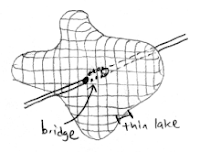
First, water. In all dimensions water fills up its container, but the nature of the container is obviously dependent on the number of dimensions. In two dimensions, in order to create a water-tight container the vessel’s surface is a line and the “seal” is two points. In three dimensions, a water-tight container’s surface is a plane (like the surface of a bowl) and the “seal” is a line (imagine saran-wrap or tinfoil stretched over a bowl). In four dimensions, the container’s surface must be 3D and the seal a plane, since the water has so many directions to escape. This is difficult if not impossible to visualize, but try to picture it. Along with this is the concept of surface area: in 2D surfaces are lines, in 3D they are planes, and the 4D they are three-dimensional. This is almost certainly impossible for us to visualize, but think about it like this: imagine a warped sphere, full of curves and indents…this what a body of water in zero-g in 3D would look like. But in four dimensions this is only the surface of the water…the rest of the water is sloshing about in the other perpendicular directions. And, if the water surface is not four-dimensionally flat, we wouldn’t even be able to see all of the surface (this is really hard to visualize—try to use the 3D-2D analogy).

Along with the concept of water go the concepts of river and bridges. In two dimensions, a river moves from higher elevation to lower elevation, but it covers the entire ground surface and cannot be crossed with a bridge (unless the bridge spans the entire length of the river). In three dimensions, rivers still move from higher elevations to lower ones, but they and they zigzag depending on the terrain. A 3D river can be crossed with a bridge. In four dimensions, a river is very similar, but there are two key differences: a river in 4D would corkscrew, and there is no need for a bridge—one could simple walk around a river.

Related to rivers is the idea of lakes. In 2D, there is only one kind of lake. In 3D, though, there are two kinds: linear and round. The surface of a linear lake, as the name implies, is thinner, like a river, but a round lake is more circular. In 4D, there are three kinds of lakes, linear, flat, and globular. The surface of a linear lake is like a cylinder; the surface of a flat lake is flat, and a globular lake has a spherical surface.

Next, and somewhat related to water, is the concept of 4D islands. First, though, let’s look at an island in two and three dimensions. In 2D, the surface of an island is a line; to “search” all of it, one must simply move from one end to another. In three dimension, land surface is a plane. To search a 3D island, one must move in a 2D grid to cover all the land area. Like the surface of water in four dimensions, the surface of land is three-dimensional. To search this surface, one must move in a 3D grid along 3 axes.

The series on the fourth dimension will continue, unless for some reason I grow bored with it all of a sudden. 

Thursday, January 22, 2009

From Flatland to the fourth dimension (part 4)

For the past two days I have been talking about the fourth spatial dimension and its implications. Today, the series continues with four-dimensional levitation, rotation, rolling, and truncation. If you have not read parts 2 and 3 of this series I strongly recommend doing so, and reading part 1 wouldn’t hurt either. Otherwise, today’s post is probably going to be very confusing. 

In part 3 of this series, I explained how a four-dimensional being could touch any part of a 3D object, even the inside. Today’s first topic, levitation, is related to this. In three dimensions, it is possible to attach a 2D plane, like piece of paper, to a wall with a nail. Consider hanging up a 2D of a square: the square would rest on the 3D nail, which would perpendicular to it. Now, imagine the same thing in four dimensions with a “tetranail.” To us, the cube would be suspended in the air, held by this “tetranail,” which we would see only as a hovering sphere. 

Next, I would like to discuss the rotation of 3D objects in four dimensions. Before I get to this, though, I would like to explain rotation of 2D objects in three dimensions. The key here is that an object of n-1 dimensions is being rotated in n dimensions on an n-2 axis. Consider a basic example: a square is rotated on its axis around one of its sides. This means it must be rotated out of its plane, which is different from just spinning in inside of its 2D plane. The latter means that the square is being rotated around a point; the former means it is being rotated around a line. To the “Flatland” observer, all but one line of the square disappears when the square is rotated out of the plane; when the rest of it returns, it appears to be reversed in such a way that spinning it will not turn it back to the way it was. (For example: if the letter “f” were imprinted on the inside of the square, after it is rotated the “f” would be backwards.) All this means that the four-dimensional equivalent would involve rotating a cube around one of its planar sides. The rest of it would disappear, and then re-appear on the other side of the cube. If letters were imprinted on the sides, they would be backwards. This is difficult to imagine—it would appear that it would be necessary to break the cube for it to do this, but this is not true. What we cannot see is that while the rest of the cube is “disappeared,” what it is actually doing is rotating around the remaining side on the 4D perpendicular axis.

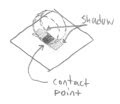
I would also like to discuss 4D rolling rotation. Imagine a ball resting on top of a frictionless book. The book can be moved sideways in 4 directions, making the ball appear to “roll” on top of it. There are 4 perpendicular directions for it to roll. In four dimensions, though, the book would have a 3D surface, and the ball would be a glome (4D sphere). The ball now has six perpendicular dimensions to roll in—for comparison, recall that our 3D world only has 6 perpendicular directions! However, it is interesting to note that the area where the glome touches the book is still a point. (In 2D, a circle contacts with other objects at one point, and the same happens in 3D with spheres. So the same must occur in four dimensions.) Also, a 3D ball can roll in a circle, but a 4D ball has 3 possible circles to make. 

Next, I would like to talk about truncation in four dimensions. Truncation, or cutting off the corners of an object, is a simple geometrical procedure. In four dimensions, though, it has some interesting implications. In 3D, when a cube’s corner is cut off it leaves a triangle. In four dimensions, when the corner of a hybercube is cut off, it leaves…a tetrahedron. I find this incredibly mind-boggling, imagining the corner of an object to be a three dimensional shape (as if a hypercube wasn’t hard enough to visualize already!). In reality it is no different than what a hypercube’s side is normally, but I think this is an interesting way to look at it.

Tomorrow the series on the fourth dimension will continue. 

Wednesday, January 21, 2009

From Flatland to the fourth dimension (part 3)

Last time, I explained the concept of the fourth spatial dimension and a few applications of it. Today, I would like to discuss more of what the fourth dimension would be like. I advise against reading today’s post without reading yesterdays, and reading part 1 of this series is also advisable, though not as necessary.

Yesterday I explained how we can deduce certain aspects of the fourth dimension by analogy. This is precisely what I would like to do today: explore what it would be like to experience four dimensions by looking at what it be like to experience three after living in two.

I would first like to talk about four-dimensional beings. A four-dimensional being would obviously be in the shape of a 4D figure, and it would be able to move in all 8 perpendicular directions, at least in zero gravity (like the way we can move in all 6 directions in zero-g). This obviously hints at the structure of a 4D being—it must have at least 4 legs to be stable (humans are not stable—we would need 3 legs in a tripod). But, like human beings, it is possible to get away with less—but I doubt a 4D being could have less than 3 because there are now more directions to “fall” (fall over, that is). Also, a 4D being’s line of sight would be a cube. This is because a 2D being’s is a line (recall the explanation of how “Flatlanders” see in part 1 of this series) and human beings see 2-dimensionally. However, because we have depth perception we can distinguish 3D objects. But our field of view is still a plane—our vision is akin to a photograph; everything is reduced to a 2D image. Thus, a 4D being would see in terms of a cube; a 4D photograph would be three-dimensional. At first this sounds normal enough, but consider the implications: 2D vision grants us the ability to see all the sides and the inside of an opaque square at the same time—a 4D being would be able to see all the sides, and the inside, of an opaque cube at the same time. Therefore, from the correct vantage point, a four-dimensional being could look at a human and see every inch of his skin as well as the inside and outside of all of his organs.

Next, consider what happens when four-dimensional beings or objects interact with our three-dimensional plane. This, too, can be done by analogy. In Flatland, the three-dimensional character reaches in and touches the insides of a two-dimensional character; this is the equivalent of touching the inside of a square drawn on a piece of paper. A 4D beings would have similar powers, and would be able to reach inside of sealed 3D objects or beings.

Also, consider what happens when a 4D object is passed though our 3D plane. This, too, can be explained by using an analogy from Flatland. When a square passes through a two-dimensional plane, a 2D observer sees a line appear and then later disappear. The observer can only perceive only one “square” at time (think back to when I described a cube as a stack of paper squares). Likewise, when a sphere is passed through a 2D plane an observer would see a line appear, grow in size, and then shrink and disappear. (Again, think back to part 2.) Similarly, if a hypercube is passed through our 3D plane we would see a cube appear and then disappear, since we can only see one cube at a time. If a glome (4D sphere) was passed through our 3D plane, we would see a sphere appear and grow in size and then shrink back down to nothing again. This is a bit harder to visualize, but it is essentially the same: the glome is made up of an infinite number of spheres, but we can see only one at a time because of the way they are stacked. 

I would also like to talk about geometrical nets. A net is a shape of n-1 dimensions that can be folded into an object of n dimensions. The net of a cube, for example, is 6 squares in the shape of a cross; these can be folded into a box. Interestingly, the net of a hypercube is 8 cubes arranged into a 3D cross: 4 cubes are stacked vertically, and the other 4 are attached to the other 4 exposed sides of the cube second from the top. The nets of other 4D figures are also 3D figures. However, though we can make the nets, we cannot fold them, since they must utilize the four-dimensional 8 perpendicular directions in order to fold. Note that once folded, one cube of the net of a hypercube remains in our 3D plane; the others will appear to have simply vanished because they are outside of our plane. In an amusing short story by Robert A. Heinlein, an architect builds a building that is the net of a hypercube, and an earthquake causes the building to fold into the 4D shape. This is impossible, of course, but the concept is clever.

Tomorrow, I will cover even more aspects of the fourth dimension as extrapolated by analogy. 

Tuesday, January 20, 2009

From Flatland to the fourth dimension (part 2)

Before I begin, a quick word on inauguration day: All I can say is that I am proud to be here during this historic event. We should rejoice at the changing of the guard in US politics and at the fact that Obama’s victory represents a step in the right direction for race relations. I already talked about my predictions in “In 103 days…” and I hope that what I talked about will really come to pass.

Now, to business: yesterday I briefly mentioned the mathematical concept of the fourth dimension while discussing Edwin Abbot Abbot’s Flatland. Today, I would like to devote an entire post to this intriguing mathematical topic.

First, let me make one thing clear: I am discussing the fourth spatial dimension; today, the layman uses the term “fourth dimension” to describe time, in accordance with Einstein’s idea of “space-time.” But here I am using the term in reference to the hypothetical next spatial dimension, as I shall explain.

The best way to explain the fourth dimension is by progression and analogy. First, consider a line, which has one dimension. It has two perpendicular directions, north and south (also known as length). Now, “drag” the line in a direction perpendicular two the existing two directions, like rolling a pencil covered in paint across a table. The result is a square, with two dimensions. The second dimension has four perpendicular dimensions: north, south, east, and west (also known as length and width). Now, drag the square in a direction perpendicular to the existing four (imagine lifting a paper square with string attached to the corners straight up off a table). The result is a cube, with three dimensions. The third dimension (the one we live in) has six perpendicular directions: north, south, east, west, up, and down (also known as length, width, and depth). Now, this is where it gets tricky: move the cube in a direction perpendicular to all 6 directions. The result is a shape with 8 perpendicular directions and four dimensions. This fourth dimension is to us what the third is to second; imagine how a box differs from a piece of paper and you will get an idea of what the fourth dimension is to us. Can’t imagine it? Don’t worry: it’s technically impossible to fully visualize it. But don’t give up yet—using analogies, we can figure out many aspects of the fourth dimension.

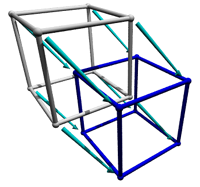
By moving a square out of our three-dimensional “plane,” a figure called a hypercube is created. As I stated previously, this object is the 4D equivalent of a square of cube. I would like to discuss some of the properties of this shape by analogy. For example: a line has 2 vertices, a square has 4, and a cube has 8, so a hypercube must have 16. A line has 2 sides (which are its vertices), a square has 4, and a cube has 6, so a hypercube must have 8. But remember that a square’s sides are lines, and a cube’s sides are squares, so a hypercube’s sides must be three-dimensional cubes. Confused? Remember that the fourth dimension has 8 perpendicular directions. Think about how a cube can be created by stacking square pieces of paper on top of each other; likewise, a hypercube is essentially an infinite number of stacked cubes, placed on top of each other on the new perpendicular axis. Still having trouble? Look at the figure to the top right; this is a drawing of a hypercube. Can you see the 8 cubes? If not, try looking at the figure below to the left and try to see the 8 cubes there, then look back at the other one. See how they are the same picture only projected differently? (Some of the cubes are “slanted” because of perspective, like the squares in a drawing of a cube. As you can see there is actually more than one way to draw a hypercube—read this But I prefer the one to the right because it shows the extrusion into the fourth dimension.)

A 4D sphere, called a glome, can be explained in a similar way. A 3D sphere is a infinite number of circles of increasing-then-decreasing size stacked on top of each other. (Try to imagine making a sphere out of a stack of pieces of paper. How would you cut the paper? The answer is into circles of increasing-then-decreasing size.) Likewise, a glome is made out of spheres stacked in increasing-then-decreasing size. Like the hypercube, these sphere are stacked in the new perpendicular direction.

Geometry-minded people’s brains are probably going crazy with all the applications of this idea. Personally I am not particularly interested in geometry, but I would like to elaborate just a little on 4D geometry. For example, look at a triangle, the simplest polygon it is possible to create. In three dimensions, the closest equivalent is a tetrahedron, a polyhedron with four sides made of triangles. Thus, the 4D equivalent is a pentachoron, a 4D figure with 5 sides made of tetrahedrons (a polychoron is the word for a 4D shape, like polygon or polyhedron). Also, similar to how regular polyhedrons exist in 3D, regular polychora exist in 4D. However, geometry is not really my area and I am not entirely sure about all the properties of these figures. Perhaps another day I will explain more about them.

If the concept of the fourth dimension still isn’t making sense, I recommend perusing this website—it’s very helpful.

Tomorrow I will look into more aspects of the fourth dimension.

Monday, January 19, 2009

From Flatland to the fourth dimension (part 1)

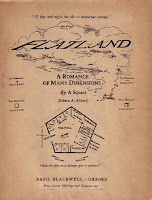
Today I would like to talk about Edwin Abbot Abbot’s famous 1884 science-fiction novel Flatland. This book is renowned for its criticism of Victorian society as well as for its explanation of abstract geometrical theories.
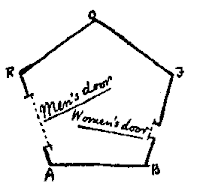
The setting of Flatland is a two-dimensional world in which all of the “people” are geometric shapes moving around in a plane. The first half of the story explains the nature of Flatland and its society; the second half focuses on the main character’s encounter with a sphere.

Abbot begins with an explanation of what Flatland actually is. I will take a moment to do so as well, since it is very important to the story and to the points I am trying to make. Flatland is a two-dimensional plane, like a piece of paper. The inhabitants are two-dimensional polygons that move about the plane; they have no concept of the third dimension. A Flatlander can move in four perpendicular directions (north, south, east, west) and its field of vision is a line. No part of a Flatlander is three-dimensional; for example, a Flatlander’s “face” is not on its surface but on one of its sides.

Confused? Here’s a demonstration that will help: Put several coins on a table or desk and then bend down next to it so your eyes are level with the surface. See how the coins look like lines? This is how a two-dimensional being sees. Move the coins around a bit and try to visualize them as living beings, thinking about what they biological structure would have to be. (This is actually how Abbot explains it.)

The plot of Flatland is very simple; in the first half, Abbot explains what Flatland is (like I just did) and how its society functions. The second half is considerably more interesting; a Sphere visits the main character, A. Square, and tries to explain the idea of three dimensions to him. The Sphere first attempts to do so with words, notably with the phrase “Upward, not Northward” but A. Square simply cannot understand. To demonstrate, the Sphere pokes A. Square in his intestines, which he can reach by putting his finger into the Square insides from “above” (three dimensional above). However, A Square is still not convinced, so the Sphere knocks him out of his plane and drags him about outside of Flatland.

The duo then visit other societies that are defined by dimensionality: they first visit Lineland, in which the inhabitants are forever stuck next to the same people because they are in a line (one dimension). Next, they look at Pointland, which is inhabited by a single dimensionless being. Communication with it is impossible because the being is a solipsist; it believes everything it hears is its own thoughts, since it cannot move, see, or feel. A. Square then suggests that there could be more than three dimensions, since until recently he only knew of two. The Sphere dismisses this as nonsense, and sends A Square back to Flatland. A. Square later tries to teach others about the third dimension, but without the sphere he is incapable of doing so. Since he cannot show his peers the direction of “Upward, not Northward,” he is thrown in jail for heresy.

Flatland clearly satires Victorian society: Abbot goes into detail explaining a class system based around shape. The few sides a “person” has, the lower their rank; triangles are working class and are considered non-intelligent; polygons with many sides are priests or leaders. The king is a polygon with so many sides he is almost indistinguishable from a circle. Certain shapes can “evolve”—all shapes except triangles gain a side each generation, increasing their rank. The lower class triangles do not share this attribute; they are forced to first become equilateral triangles. However, they only progress at a rate of half a degree per generation—this obviously signifies the perpetual enslavement of the working class by the Victorian elites. Women in Flatland are straight lines, and they are forced to move in such a way that they constantly swing back and forth so they can be seen (remember that looking at a straight line in a certain way makes it look like a point, which is hard to see). This is also a parody of Victorian women, who were also “invisible” unless they made their presence known. Colors are banned in Flatland society, since lower classes could paint themselves to look like higher-class shapes.

But Flatland is better known for its explanation of dimensional theories of geometry. Abbot explains the theory of the fourth spatial dimension by analogy in the story, and certain plot events are actually methods for “studying” the fourth spatial dimension. Tomorrow, I will delve deeply into what the fourth spatial dimension actually is, some applications of it, and how it relates to Flatland. 

Sunday, January 18, 2009

Gaza ceasefire: nothing gained

It appears the fighting in Gaza has subsided. Israel declared a ceasefire yesterday and has announced that they will be removing troops from Gaza. Today Hamas stated that they have agreed to the ceasefire and look forward to seeing the Israeli army out of Gaza. But the damage done speaks for itself: over the past few weeks, over 1,300 Palestinians have been killed, thousands more have been injured, many been driven from their homes and Gaza’s food supply and utilities have been crippled. And what has been achieved? Almost nothing. Hamas remains in control, and I doubt they are on any better terms with Israel than they were a month ago. Their military wing remains enormous, and they are still firing rockets at Israel on occasion.
So, where do we go from here? I don’t know. But I think there are many things we can learn from this brief crisis in Gaza. 

Firstly, this Gaza crisis reminds us of how turbulent the situation there really is. This is probably evident to people in Israel and Gaza, but to the rest of us sheltered in the Western world we do not hear much about it. This especially reminds us that a ceasefire is not a peace treaty or a time of peace; the Israeli attacks were prompted by Hamas attacks and tension that arose when the previous ceasefire ended. From this I gather that unless the UN or surrounding countries can make the current ceasefire last longer and be more legitimate war may well start again. 

Also, the crisis reminded us of how many Palestinians stand firmly behind Hamas and its militant wing. Many Palestinians in Gaza and the West Bank called for another intifada (which fortunately did not happen). Others stood strongly behind Hamas even after admitting that Hamas was mostly responsible for starting the violence.

Next, I would like to address the issue of white phosphorous gas. Many Palestinian news stations accused Israel of using this deadly gas, the use of which against populated areas has been outlawed by the UN and the Geneva Convention. Did they use it? I think the answer is yes. A later UN investigation clearly shows evidence of some of these WP bombs being used. (The picture on the left is one such piece of evidence.) So what does this mean? For the most part, it simply reinforces the message that Israel is not afraid to get its hands dirty. I am surprised and worried to hear that they even have WP weapons in the first place. I hope that should this conflict begin again Israel will refrain from using these weapons, but I am not optimistic about this. There is little we can do to prevent this, though, as the neither the UN nor humanitarian groups have been able to influence Israeli military policy thus far. 

I still believe that Hamas can be cleaned up and made more legitimate, as I discussed in “How to handle Hamas,” but I realize that is probably never going to happen because no one is going to step up and do it. Israel can’t—Hamas will physically fight them every step of the way. The UN can’t—they are far too weak to put such a program together. The US can’t—we have our own problems right now. So Israel’s goal of destroying them entirely is much more realistic. But is it the right course of action? I am not entirely sure. One thing is sure, though: we won’t be hearing the end of Gaza anytime soon. I have no doubt that the violence will continue, certainly before the year comes to a close. All we can do is watch, wait, and hope for the best.

Tomorrow I will begin a series that I hope you will find interesting.