Tuesday, November 18, 2008

On “The Last Question”

Inspired by Asimov’s The Last Answer, I have decided to talk about another of his famous short stories, The Last Question. In this story, a computer called AC ponders whether entropy can be reversed. However, it does not come up with the answer until after the universe undergoes heat death. At the end, the computer discovers the answer and decides to demonstrate it:

“And AC said, ‘LET THERE BE LIGHT!’ And there was light—”

Of course, this brings up some interesting questions. First of all, Asimov is referencing the concept of the technological singularity, the idea that technology increases at an exponential rate, and that it will eventually increase infinitely fast so that it encompasses everything. However, I have some doubts about this. If the world were to have a nuclear war or fall into a worldwide depression (both somewhat realistic!), wouldn’t the rate technology is being invented at decrease? After all, technology is probably dependent on the economy (and certainly on the world population). If such an event were to occur, we may never reach this technological singularity.

Asimov is also making an amusing statement about the creation story. (A devout atheist, he often derides religion in his writing.) In The Last Question, he is toying with the definition of God by exploring how an omniscient computer could possible “become” God. If the concept of the technological singularity is true, this is possible—an intriguing yet frightening thought.

But don’t look for this in your lifetime—one thing Asimov hammers home in this story is the stretched-out timeline. If it happens at all, the technological singularity will not happen for billions of years, and our moral, ephemeral bodies simply won’t last that long. 

Monday, November 17, 2008

Heinlein’s moon colony (part 2)

In my last post on this topic, I discussed the practicality of the food-producing moon colony from Heinlein’s The Moon is a Harsh Mistress. This time, I would like to talk about the cultural and societal aspects of the novel.

In the novel, the moon colony’s society is ultra-capitalist, dependent on technology, multi-cultural and polygamous. The society in general is portrayed as being utopian, or at least close to it. However, I suspect that Heinlein is employing a technique he has used in other novels, such as Starship Troopers. He will often write novels from a first-person perspective, and the main character will proceed to describe the society as ideal. (In the case of Starship Troopers, as fascist and militaristic society.) However, Heinlein himself does not agree with what he is writing about, and he often drops hints to the reader that the society he is describing is not as perfect as it seems.

Many credulous readers probably believe that the society in Moon is Heinlein’s idea of a utopia, though, since it is very close to his political philosophy. However, I am not entirely convinced, and I would like to examine the novel further.

Firstly, I would like to talk about the multiculturalism Heinlein describes in Moon. Though the main character repeatedly emphasizes how the Lunar colony is a melting pot and haven of multiculturalism, this is clearly not the case. The society is influenced mostly by Russian culture—most of the cities described have Russian names, everyone speaks with a Russian accent, and Russian words are prevalent in the novel. Chinese and Indian culture are briefly mentioned as being somewhat of an influence, but European, African, Middle Eastern, or Latin American culture is not mentioned at all. The last is particularly important to note because in his other works Heinlein often describes Latin culture as becoming more prominent in the future. In fact, the only South American character in the book, Professor Bernardo de la Paz, displays no signs of being Latin American at all, besides speaking Spanish—he exhibits no Latin American culture whatsoever. Because of this, I think Heinlein is describing a farce of multiculturalism, and he is showing us how difficult to achieve the “melting pot” really is. 

Next, I would like to discuss the ultra-capitalism found in Moon. The people of the moon colony—the “Loonies”—are laissez-faire to a fault; their motto is TANSTAAFL (an acronym for “There Ain’t No Such Thing As A Free Lunch”, a word Heinlein made up), and they are vehemently against the concept of taxation or anything socialized. They even are against the idea of free air! This overdone capitalist spirit, I think, is the most quixotic aspect of Moon’s society, and Heinlein is certainly sending a message here. Though Heinlein eventually became must more right-wing as he got older, Moon was written in the 60’s—recall that only a few years earlier he was a leftist, and in his youth he was a socialist! Though I am no expert on Heinlein by any means, I don’t believe he would write a pro-capitalist work at this time—it seems out of place in terms of the other novels he was writing in the 60’s. Regardless, some of the flaws of this kind of system are clearly mentioned in the novel, whether intentional or not.

Also, I think it is necessary to examine a theme that often goes overlooked, the idea of too much reliance on technology. In his later years, Heinlein began to distrust computers and artificial intelligence (and excoriate them in his works), and I think he is making his message quite clear in Moon. In the novel, the self-aware computer Mike is essential to the lunar revolution—too essential. He can listen in on anyone by wiretapping them, assassinate someone by cutting off their air supply, and hurl large rocks at Earth. He funds the entire venture by printing fiat money (albeit in small amounts and using a series of ruses to allay suspicion). At the end of the novel, after Mike’s “death,” the other characters have difficulty doing anything without his advice. Clearly, Heinlein is pointing out the dangers of having a centralized computer in charge of everything. On this point I believe be may be correct—if such a computer were to be perfidious or malicious, the results would be disastrous.

Lastly, I would like to talk about the polygamy found in the novel. The group marriage system in the lunar colony in Moon is described as very successful, and it manages to keep the society stable despite an imbalance in the ratio of males to females. Here I believe Heinlein is being sincere—he has often lauded group marriage in many of his works, and I think he truly believes, as I do, that it has great potential. In many of his novels he acknowledges that it currently possesses as huge social stigma, but he hopes that in the future people will come to adapt it.

To conclude—the system Heinlein is describing should be examined with a grain of salt. In some cases he is actually pointing out the flaws in a certain aspect of it, as he does in Starship Troopers. However, The Moon is a Harsh Mistress remains my favorite novel despite this somewhat pessimistic technique. 

Saturday, November 15, 2008

Karl Marx and the American Dream

You may be wondering, what does Karl Marx have to do with the American Dream? Actually, quite a lot.

Marx is famous for his Communist Manifesto, the anathema of all rich capitalists. In this paper he outlines his system of communism, and tries to examine the course of history though this new lens. However, what many people do not realize is that his system is based on the labor theory of value. (This is mostly because it is hidden in cryptic and archaic language in the first section of the paper.)

Labor theory of value is the idea that the value of a product is directly related to the amount of work needed to create it. However, this idea is obviously false, as modern economics have shown. This is mostly because it does not take into account technological advancements and the simple laws of supply and demand. For example, consider a shoemaker who uses an awl, a wooden bench, and leather to make shoes. He must work for several hours to produce one pair of low-quality shoes. A factory worker, on the other had, can churn out thousands of high-quality rubber shoes per day with little effort by using modern machinery. The shoemaker’s shoes required much more labor, but they are far less valuable than the factory worker’s shoes. However, the shoemaker’s shoes can greatly increase in value if the demand greatly increases; likewise, the factory worker’s can depreciate in value if the demand decreases. Marx’s labor theory of value does not account for either of these factors, so it is obviously flawed.

But how does this relate to the American Dream? Remember the main principle of the American Dream: If you immigrate to the US and work hard, you will be successful and wealthy. This obviously parallels the American dream idea of “the harder you work, the better off you will be.” For this reason, the American Dream is just as fictional as the labor theory of value, as countless manual laborers can confirm. Though it isn’t entirely false—capitalism does reward hard work to some extent, it by no means the guarantee many people believe it to be.

It may sound as if I am disparaging immigration—I’m not. America is a nation of immigrants, and immigration is an integral part of our past and future. However I am skeptical of the idea that anyone can immigrate to the US and be successful by working hard. 

Wednesday, November 12, 2008

Jerry was a man—then again, maybe not

The “Jerry” that I’m talking about is a character from Robert A. Heinlein’s short story “Jerry Was a Man.” Jerry is a “Joe,” or a genetically altered chimpanzee/human mix used to perform manual labor. In the story, a not-too-bright rich woman feels empathy for the Joes, and she files suit against the genetic engineering company Workers, Inc. that creates them. In court her lawyer argues that it is illegal for Workers, Inc. to create and kill these Joes because they are men, not creatures or property (hence the title).

In the story, the lawyer “proves” that Jerry is a man. First, he defines the term man:

“What is a man? A collection of living cells and tissue? A legal fiction, like this corporate ‘person’ that would take poor Jerry’s life? No, a man is none of these things. A man is a collection of hopes and fears, of human longings, of aspirations greater than himself—more than the clay from which he came; less the Creator which lifted him up from the clay…[manhood] is not a matter of shape, nor race, nor planet of birth, nor acuteness of mind. Truly, it cannot be defined, yet it may be experienced. It can reach from heart to heart, from spirit to spirit.”

He then calls up a Martian witness, who has “superior intelligence.” The Martians states cynically that there is little difference between an anthropoid such a Jerry and human beings. Finally, Jerry sings a song for the court, which is the conclusive piece of evidence that he is “a man." So, I have to ask—is this just Heinlein sounding off on personal responsibility like he usually does, or is there a legitimate idea here?

First, I think we have to look at the definition of mankind Heinlein uses. He says that being a man has nothing to do with physical form—instead, it is a more spiritual kind of definition. But which is correct? Unfortunately for the reader I’m going to have to drop a big old “don’t know” on this one. This is far too cosmic a question for me to even guess at. However, I will lay out what my analysis would be if the definition were a certain way:

If the definition of man is dependent on a physical characteristic, then it is safe to say Jerry is not a man.  If it is dependent on some spiritual aspect of humankind, we have many options. Some might argue that since Jerry is an artificial creation, he has no soul and is therefore not a man. Others, though, might say that the fact he was created in a test tube is not relevant—he still has a soul and is still a man. As far I am concerned, the argument over whether or not people have souls is not over, so I cannot commit to either option.

In any case, I think Heinlein is on to something here. We may very well face this dilemma in the future, as the science of genetic manipulation continues to advance. I hope that by the time we reach this point we will have solved this moral problem. 

Monday, November 10, 2008

On "The Last Answer"

I promise to discuss The Moon is a Harsh Mistress again—but for now, I’d like to talk about a story by Isaac Asimov, The Last Answer. In this short story, a man’s soul is preserved by a God-like creature, which keeps people’s minds alive so that they can “think of something new.” The man responds that he does not want to do this, but he realizes that the only way out of the situation is to think of a way to kill the God-like creature. Asimov says that this is the “last answer,” which is what the God-creature desired all along. One of the last lines in the story is:

“For what could any Entity, conscious of eternal existence, want–but an end?”

However, I think Asimov is wrong, or, at least, not necessarily right. He is making the assumption that any eternal being would want an end. But this begs the question—why would such a being want an end? (Or we can ask the opposite question, why wouldn’t such a being want an end?) Though there are reasons why an eternal entity would or would not want an end, they all depend on its psychology. If such a being existed, it could have a temperament that would make it want to commit suicide, or it could have one that would not make it want to commit suicide—we have no way of knowing.

Also, I am not sure about another aspect of the story: In the narrative, the eternal being creates the universe to “introduce random factors” to help it think of new things. I have difficult visualizing this—how is it that a (presumably) omniscient, omnipresent, and omnipotent entity does not know everything? But, in the end, I suppose it depends on the exact nature of the eternal being. To sum it up—Asimov’s description of an eternal being is not necessarily accurate—he humanizes the creature, and makes many assumptions about its nature. A fine story, but by no means philosophically accurate.  

Saturday, November 8, 2008

Heinlein’s moon colony (part 1)

As I have mentioned before, my favorite book is Robert A. Heinlein’s science fiction novel The Moon is a Harsh Mistress. I have begun rereading it again, which I do about once every year. In this novel, revolutionaries on a lunar colony carry out a revolution against Earth, which owns the colony. In the story, the original purpose of the lunar colony is to grow wheat to export to Earth, which is suffering from serious overpopulation problems. After reading about half of it, I began to wonder: could this be a practical program for the future? Could the moon be exploited in this way?

This question is multi-faceted and deserves a careful analysis. Firstly, is this technologically possible? As far as I can tell, the answer is yes. In the book, wheat is farmed in tunnels using hydroponics and ultraviolet light. Both of these are widespread today, and hydroponics is becoming very popular. The technology required to transport whatever materials are need to the moon certainly exist, as does the equipment needed to drill tunnels and make them airtight. The biosphere has been perfected over several decades, so it would also be safe to say that the technology exists to support the “farmers” and their crops on the moon. In order to ship food down, Heinlein suggests a magnetic “catapult” to launch barges of grain down to Earth. This is by no means pure fantasy—MagLev trains illustrate the potential of electromagnetism, and I have no doubt that such a catapult could be developed. Also, remember that the moon sits on top of Earth’s gravity well—with a small push, an object can simply “fall” down to Earth, and land safely with simple retro rockets and/or parachutes.

The second part of the question is: Is this practical and/or feasible? I believe the answer is yes, if we look at the project as a long term investment. The initial cost is going to be very high—in the beginning, fuel, personnel, seeds, and many truckloads worth of equipment must be shuttled up to the moon. Once we get past this initial setback, though, the cost of maintaining the project is much lower. Lunar metal can be used to create more drilling equipment, and lunar ice can support more farms. The most expensive parts of the project from here on in are shipping up of chemicals and whatever supplies cannot be produced on the moon, and the creation of the “catapult” to ship food down to Earth. Eventually, though, the returns will be enormous—food, particularly grain, can be shipped to Earth at any time of year, and it can “land” in any part of the world. If food prices continue to rise as the world population increases, grain will become a very valuable commodity, and it will fetch a very high price.  

But what are the implications of such a project, and is it in fact worth it? As I read more, I’ll continue to think about it and write another post about it. I will also do some research and get some numbers—I’m interested to see if this is actually mathematically feasible. 

Thursday, November 6, 2008

The ever-changing purpose of culture (part 2)

In my previous post on this topic, I explained the justification for manipulating and changing culture with the purpose of creating the happiness. I also said that this culture would be flexible so that it can adapt to the flow of history. Additionally, I explain that it would be based around empirical evidence and case studies rather than on some baseless theory.

But, as I asked yesterday, what specifically would this culture include? My official answer would have to be “I don’t know.”  (This should come as no surprise—I am a pyrrhonist, after all.) I am neither an anthropologist nor a sociologist—I do not know enough to look at what we know about how people interact and devise a culture based on this.

However, I will make some educated guesses, as I do with everything.

First, I believe this culture will possess various types of group marriage and polygamy. Group marriage is not very common in human history, but has a very high success rate nonetheless. This is mostly because it offers a more secure environment for raising children for economic and social reasons and increases diversity. Group marriage can be arranged in the form of a “line” marriage, in which people continuously join the marriage as older members die or others divorce out of it. This creates a stable environment for raising children, which will, in theory, last forever.

Second, I believe nudity and sexual taboos have no place in this type of society. Though most of the benefits of nudism are false, there are still some benefits to it that have been scientifically verified. Additionally, sexual liberation would create a large amount of happiness in this new culture. Contraception can be made cheaper (or even free), decreasing the risks of increased sexuality in a society. By removing the moral and social stigma from sexuality, it can become a widespread source of happiness that is morally meaningless.

Next, I believe this new type of culture will be very diverse. Mixed-race individuals have greater protection from disease and often have longer life spans. Furthermore, diversity eliminates racism, which is an obvious source of unhappiness in our current culture.

Additionally, I think gender roles and sexual jealousy will almost disappear. Even today there is little use for them; they are simply leftovers from our early history and evolution, as Margaret Mead (right) proved. This would also end sexism, which, like racism, is a major problem in today’s society. The removal of sexual jealousy would aid in the introduction of group marriage, and it would also remove a current source of social tension.

You may be asking in horror: What about all the innocent children? Do they get no protection? Well, yes, of course they do! I did not propose anything that would physically or psychologically harm children (or anyone) in any way. However, I did not protect them morally in any way (by our current Judeo-Christian standards). The reason for this harps back to a previous post I wrote, which had to do with comparing moral systems. To sum it up, protecting children from the “horrors” above is a concept that only applies to our current moral system; in the one I described, they are not “horrors” at all, but the very pillars of society. 

Will we ever see such a culture? Probably not in a large society, but I would not be surprised if some smug philosopher, anthropologist or scientist tries to create such a system and some small utopianist group tries to implement it.

Will it work? I sure hope so. No promises, though. 

Wednesday, November 5, 2008

The ever-changing purpose of culture (part 1)

Before I begin—well done, Barack Obama! Congratulations on becoming President-elect! And congrats to all Democrats, who have won a majority in both the House and the Senate. Now, to business:

We often talk of human nature, using it as an example of something immutable and fixed. We speak of human beings as though they are incapable of changing—but this is far from the case. As George Orwell stated eloquently in his dystopian novel 1984,

“Men are infinitely malleable.”

I won’t take his word for it, though—I have many examples to back up this hypothesis. First, consider the oldest and most basic aspect of “human nature”—our reaction to food. For almost all of our history (more than 99%), the human response to seeing a morsel of food was to devour it instantly. This served us well when we were caveman and when agriculture was in its infancy. Today, though (at least in developed areas), things have changed. In the Western world, it is no longer desirable to do so—in fact, it is very undesirable to have that sort of reaction to food. The result? Our environment changed our nature; I am sure most Westerners can look at a plate of food without trying to eat it instantly.

 Next, look at the second-oldest piece of human nature: the sex urge. Over time, our attitudes and reactions to sexuality have changed—almost every religion and culture has a different view on it. It would be absurd to think that there is a set “human nature” when it comes to sex—think about the differences between a Puritan community, a polygamy cult, and a pagan clan.

Also, note that human nature does not just change over long periods of time—a perfectly civilized person “trained” not to gobble up food instantly will revert back to the caveman reaction if he has not eaten in a few days. Additionally, think about people live for long periods of time in different countries—often their philosophy, religion, and viewpoint changes entirely.

Similarly, culture is mutable and constantly changing. However, all cultures have some sort of purpose. The primary purpose of all cultures is to survive, even if the creators of a culture did not intend this (if a culture did not try to sustain itself, it would not be around for long). In modern history (circa 5000 years) cultures have been based around some kind of religion or moral system. The purpose of these cultures is to carry out the demands of a religion or belief.

I believe that culture and human nature can be mutated to improve quality of life. How, you may ask, can this be accomplished? The answer, I believe, has to do with the way we create cultures and moral codes, and how this can be improved.

Though all cultures undergo a kind of natural selection that weeds out the “weak” ones, human history is so short we have not really had time to see cultures evolve. Furthermore, all cultures, moral codes, or societies that have been designed with a specific purpose in mind have been designed according to someone’s theory of morals. None have been developed by empirical evidence.

You may not see the problem with this, so I’ll use an example to explain:

Consider a cannon. Cannons have been around since medieval times, when gunpowder was invented, and since then they have been aimed with gunsights. In the past few centuries, the theory of how gravity works (which affects cannonballs) has been changed repeatedly. However, all gunsights were not junked every time the theory of gravity was changed. Why? Because gunsights are based on observable empirical evidence, and changing the theory does not change the fact that cannonballs fly a certain way. This is how we must design a moral system—by basing it around evidence and changing the theory to fit. Thus, such a culture would be flexible, so that it could change if necessary. 

How would this be implemented in, say, the United States? Firstly, by finishing the job our Founding Fathers started—creating a total separation of church and state. (It would be naïve to say we have that now—laws prohibiting prostitution, polygamy, pornography, public nudity, and public “swearing” are just a few of the many counterexamples.) The reason for this is simple—morals based on religion do not necessarily create the most happiness possible. As Arthur C. Clarke puts it,

"The greatest tragedy in mankind's entire history may be the hijacking of morality by religion."

Once we have achieved a totally secular society, we can create a new moral system with the aim of creating the most empirical happiness.

Exactly what will this new moral system will include? I will discuss that in part 2.


Tuesday, November 4, 2008

Musings on voting

Inspired by Election Day (today!), I though that it’s time I examined voting. After all, it’s what makes democracy democracy, and empowers the common man. But there are clearly many flaws in voting, and we should closely examine them in order to improve our government. 

An important aspect of voting that should probably be scrutinized is the voting process itself. The system we have in America is almost certainly flawed; it comes from a far less democratic time than today, and it has changed little since then. The most prominent flaws are the Electoral College and the “winner-take-all” scheme used in elections, which makes the “one person one vote” idea bunk. There have been many solutions proposed to amend this, the most obvious being to get rid of the Electoral College altogether.

However, representative democracy is what makes us different from many other democratic nations. Our founding fathers made the nation a representative democracy because they were afraid that a direct democracy would fall prey to “factions,” or political parties. However, today we see that even a representative democracy can fall prey to political parties. Thus, eliminating the Electoral College is probably not a bad idea.

On a similar note, in my favorite novel (The Moon is a Harsh Mistress, by Robert A. Heinlein), one of the characters suggests:

 “Suppose instead of election a man were qualified for office by petition signed by four thousand citizens. He would then represent those four thousand affirmatively, with no disgruntled minority, for what would have been a minority in a territorial constituency would all be free to start other petitions or join in them. All would then be represented by men of their choice. Or a man with eight thousand supporters might have two votes in this body. Difficulties, objections, practical points to be worked out— many of them! But you could work them out…and thereby avoid the chronic sickness of representative government, the disgruntled minority which feels—correctly!—that it has been disenfranchised.”

This is a fascinating proposal (which, unfortunately, is not discussed any more than this in the novel), and it would be interesting to consider the effects if it were applied to our system at one or more levels. If applied to the concept of presidential elections, the result would probably be about the same—people would most likely still support 2 major candidates, one Republican and one Democrat, so that they increase their party’s chances of winning.

In a senatorial election, though, this system would have very interesting implications (Obviously our system would have to be slightly tailored to fit). It is likely that both parties would make a list of candidates and have people support them, so that they can get as many people in the Senate as possible. However, several independents might be elected, because independent party voters from all over the country or state could support one or two candidates, rather than have a few independent voters in each state or district being eclipsed by the majority.

Overall, though, the effects would probably be minimal—the two-party structure built into our country will probably not go away very soon.

There is another point I would like to bring up, one that I feel is forgotten in American history: Which is more important, democracy or the protection of liberties? Remember that what made the US so revolutionary in 1776 was not that it was democratic but that it tried to ensure that government would never encroach on our civil liberties (I won’t say “natural rights”). As history progressed, though, this promise has been broken. We did not extend these rights to Native Americans, African-Americans, or women until recently, and I can think of countless examples of times (usually during wartime) when an act was passed that limited freedom of speech or privacy. Though this was often done without the direct consent of the people, in many cases they would have voted for the decision anyway. (We see this today with the PATRIOT Act.) 

Because of all this, I think our government must always remember its roots, especially its noble pledge to respect all human beings. Though democracy is important, the majority should not be able to vote to oppress the minority. 

Monday, November 3, 2008

Robot economics

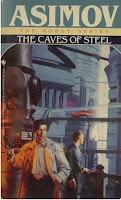
Yesterday I reread Isaac Asimov’s science fiction novel The Caves of Steel, which is about a murder mystery in a futuristic setting. According to the book, robots will begin to take both blue-collar and white-collar jobs, resulting in mass unemployment. Combined with overpopulation, this will create a huge economic crisis. Asimov believes that the solution is mass emigration to other planets, solving the population problem. In his later books, he describes how sparsely populated colonies on other planets can create a kind of feudal system, with each family owning an estate and enough robots to work it. 

However, as I described in a previous post, space travel might not be viable until long after this crisis occurs. This made think of the question: Is there any way that this crisis can be resolved without the colonization of other planets, i.e., in a “closed” system?

To do this, some manipulation of economics by the government is probably necessary. I have always believed that an economic system is at optimum efficiency when “Anything physically possible can be made financially possible.” (C.H. Douglas) Our current economic system is not even close to this state, and it is unlikely that it will be any better if/when this technological crisis occurs. Beyond that, though, there are a few options we can probably rule out:

Asimov’s feudal system can be eliminated right away. It requires a low-density population, which obviously does not exist on Earth. The only way to reduce Earth’s population would be to “eliminate” a large number of people by draconian means—not a very desirable solution.

Technological regression can also be eliminated. Though many people probably do not want robots integrated into society because of the effects on the labor pool, corporations would probably find them very desirable because of the decreased cost of labor. Because of this, it would be very difficult if not impossible to get rid of robots entirely.

So, what are we left with? I believe the answer is Social Credit. This economic system, designed by C.H. Douglas during WWI, was supposed to deal with the problem of overproduction in a closed system. In order to ensure the excess goods are consumed, Douglas recommends a government subsidy and a welfare check for everyone (to increase the net amount of purchasing power). In our robot scenario, it is reasonable to assume that there is a large amount of overproduction. Today the US suffers from chronic overproduction, but we resolve it by dumping foreign aid on African nations and selling goods below cost overseas. If robots are replacing jobs, it is likely that this overproduction has worsened (since both people and robots would be working if there were underproduction, except in unlikely circumstances). Thus, Social Credit is probably applicable.

But how would it be implemented? Almost definitely by the government; corporations are far too selfish to do it themselves (I’m not criticizing them; it is the nature and purpose of a company to be selfish—they must make money, after all). However, note that Douglas recommends that the money the government uses to pay for all this comes right of the printing presses with no gold or silver backing—fiat money. Wall Street will immediately label this as “inflationary” and “striking at the roots of our institution.” The government must persevere and go ahead with this—if Douglas is correct (which he probably is) this fiat money will not cause inflation at all. This is because this extra purchasing power is “needed” by the corporations (they do not want to waste goods) and by the people (they do not want to starve).

As time progresses, robots will probably become more prevalent, and as a result the nation dividend (welfare) must increase as well. If the system is balanced, the dividend will become enough for everyone to live on at exactly the same time that robots take over every job (thus creating communism). At this point the crisis has ended, and people will no longer have to work at all.

I suppose this is overly optimistic and highly unlikely. It is far more reasonable to assume that if this crisis occurs we will simply go into a worldwide depression, which we will not recover from until we have regressed technologically or thought of some other solution. If it does happen, though, I hope we will at least consider Social Credit—it may be the best and most desirable way out of this inevitable labor crunch.   

Saturday, November 1, 2008

Heinlein vs. the Framers

Americans often use the term “natural rights,” or “unalienable rights,” usually referring to the Constitution or Declaration of Independence. However, there has always been a dispute over what natural rights actually are or even whether they exist at all. Robert A. Heinlein stated in one of his novels that human beings have no natural rights of any kind, especially not the three listed in the Declaration of Independence. Other scholars, though, defend the idea of natural rights. However, I think that this debate amounts from nothing more than a confusion in terms.

We must begin by defining the terms “natural” and “right.” I believe this to be the root of the problem, so we must proceed carefully. Webster’s defines natural as “not made or caused by humankind,” and right as “a moral or legal entitlement.” These definitions, though not perfect, should be good enough for now. 

Next, we should figure out if natural rights (as we just defined them) exist. I believe the answer is no. As Heinlein states succinctly, nature guarantees nothing. He then goes on to disprove the Framers' notions of "life, liberty, and the pursuit of happiness." Since his definitions are similar to the ones above, I’ll use his proofs for a moment:

Life: What “right” does a person drowning in the ocean have to live? Or, if two people are stranded on an island and their only way to survive is to eat each other, which person’s right is unalienable? 

Liberty: Simply put, freedom isn’t free. The Framers of the Declaration obviously knew this, since they knew that it was going to be necessary to fight for liberty.

The pursuit of happiness: According to Heinlein, this is a trait of all human beings, not a right. (I’ll ignore this for the moment.)

Now, how is it that the founders of the US did not think of this, great philosophers that they were? They certainly knew these things—so why did they use the words “natural rights” in the Declaration? The answer is that they were using the terms in a different way. They defined a “natural right” as a civil liberty that all people should have, not one that everyone automatically does have. Why, then, did they define them this way? They did so mostly because philosopher John Locke, whose ideas greatly influenced their thinking, used them in this context (though his “natural rights” were life, liberty, and property). In this context, it is much clearer what the framers meant: they wanted the new nation to always ensure that all people would have these civil liberties. Thus, Heinlein does disprove the concept of natural rights by his definition, but he does not refute the Framers’ ideas because he does not even discuss natural rights as they define the term.

Finally, let’s settle the issue of the pursuit of happiness. This, too, is a problem of definition. Heinlein defines it as follows:

“…simply a universal condition which tyrants cannot take away nor patriots restore. Cast me into a dungeon, burn me at the stake, crown me king of kings, I can 'pursue happiness' as long as my brain lives—but neither gods nor saints, wise men nor subtle drugs, can insure that I will catch it."

Whether this is true or not is irrelevant; the only thing that matters is that he is using the phrase differently than the Framers. They meant that government should not hinder people on their path to pursue happiness—i.e., government should not make people unhappy. Again, Heinlein is not disproving the Framers because he is not using their definitions.